Neither answers the real question most commercial growers are asking: how do I run my grow operation without duct-taping together spreadsheets, group texts, and sticky notes?
This guide clears up both meanings of "Trellis," then gets into what actually matters — cultivation management software that standardizes your workflows, keeps your team accountable, and helps you harvest more consistently. We'll also look at how platforms like PlanaCan approach this differently than compliance-first tools.
Key Takeaways
- Clarify whether "Trellis" means plant-support netting or the seed-to-sale software before you compare tools
- Cultivation management software covers scheduling, task accountability, and team communication—not just compliance tracking
- Grower-first platforms cut manual work and labor spend with templates, visual scheduling, and mobile floor access
- Pick an ops layer that complements METRC/BioTrack-style track-and-trace instead of trying to replace it
What is Trellis Cannabis Software? Clearing Up the Confusion
Trellis has two unrelated meanings in the cannabis world, and mixing them up wastes research time.
Trellis Solutions Inc. is a Canadian software company founded in 2014 in Toronto. It raised $2 million in 2017 in a round led by Casa Verde Capital, the investment firm connected to Snoop Dogg.
The platform focused on seed-to-sale inventory management, tracking plants through the supply chain and generating regulator-mandated reports, including plant-mortality rates and cost-per-gram analytics, according to The Globe and Mail's 2018 coverage.
That's compliance and inventory tracking. It's a different job than running day-to-day cultivation operations.
Physical Trellising vs. Cultivation Management Software
The other "trellis" is agricultural, not digital. It's netting or stakes woven through plants to support heavy branches and maximize light exposure, a growing technique, nothing more.
Neither Trellis Solutions nor physical trellising addresses what most commercial cultivators actually struggle with:
- Scheduling perpetual harvests
- Standardizing SOPs across rooms
- Keeping grow teams on the same page
That's the cultivation management software category, and it's growing fast. The North American cannabis technology market hit $12.7 billion in 2023, with a projected 28.3% CAGR through 2030, according to Grand View Research.
What to Look for in Cannabis Cultivation Management Software
Not all cultivation software solves the same problems. Here's what separates a tool that actually gets used from one that gets abandoned after month one.
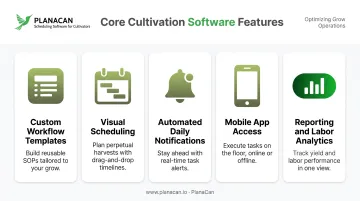
Core features to prioritize:
- Custom workflow templates: Build once per strain or treatment protocol, then reuse every cycle instead of rebuilding schedules from scratch
- Visual scheduling: View every harvest across every room in interactive Gantt-style boards
- Automated daily notifications: Put tasks in front of the right person without a manager chasing anyone down
- Mobile app access: Update tasks from the grow room floor on iOS and Android, not from a desk
- Reporting and labor analytics: Track completed tasks, time-per-task benchmarks, and accountability data
Why Cannabis-Specific Software Beats Generic Tools
Generic project management apps like Asana or Monday weren't built for phase-based plant lifecycles, strain genealogy, or harvest batch tracking. Cannabis operators need software that understands veg-to-flower phase transitions and treatment SOPs natively.
There's also a documented gap between compliance software and actual operations. MJBizDaily reported in 2024 that Native Roots employees were using Google Sheets and Excel to log clone planting, harvests, and room transfers, then duplicating everything into Metrc because Metrc alone couldn't run their day-to-day process.
Metrc itself says plainly it's a compliance reporting tool, not an inventory or operations system. That gap is exactly where cultivation management software lives.
How Grow-First Software Like PlanaCan Powers Smarter Operations
PlanaCan is built specifically for commercial cannabis cultivation, from single flower rooms around 3,000 square feet up to multi-state operators managing 20,000+ square feet across multiple state markets.
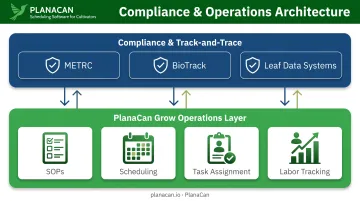
Where Trellis focuses on a broader compliance-heavy stack, PlanaCan stays in the grow operations layer. It does not replace state track-and-trace reporting. It runs beneath systems like METRC, BioTrack, and Leaf Data Systems, covering SOPs, scheduling, task assignment, and labor tracking while the compliance platform handles regulator reporting.
Create Once, Deploy Anywhere
PlanaCan's template system lets teams build a workflow once per strain, treatment, or cultivation phase, then deploy it across every harvest cycle. A saved template might include:
- Phase and day markers (for example, Pre-Veg, Day 2)
- Task detail such as "Crack lids 50%"
- Tags and priority levels for team assignment
- Time-investment benchmarks for labor tracking
Refine the template after each harvest, and it gets sharper every cycle.
Full-Canopy Visibility
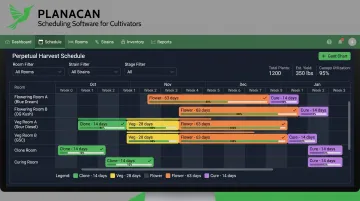
The platform's interactive Gantt chart gives a bird's-eye view of every harvest schedule across every room, strain, and batch. Growers can filter by room, phase, or team, then drill into an individual harvest for task completion history and time-based KPIs. That view is especially useful for perpetual harvest operations juggling staggered start dates across multiple flower rooms.
Documented results: In a Garden First Cannabis case study, PlanaCan helped manage 16 rotating harvests while driving a 36% increase in completed tasks and a 23% decrease in labor costs.
Those gains stick when teams get real support. PlanaCan offers 100% availability for onboarding questions and feedback, with flexible trial periods that run until the team is ready—not on a fixed demo clock.
Benefits of Adopting Cultivation Management Software
Beyond any single platform, cultivation software delivers benefits that compound over harvest cycles:
- Fewer manual errors: Digital scheduling and automated logs replace paper checklists and clipboard SOPs
- Stronger accountability: Tasks, deadlines, and ownership live in one system instead of scattered texts and sticky notes
- Real labor savings: Operators report meaningful reductions in wasted hours once workflows are standardized
Industry reporting points the same way. Trym's Happy Valley case study reported 23 labor hours saved per week. A Harborside Farms production director told MJBizDaily that automation, paired with integrated software, helped cut labor costs by 80% or more.
Treat these as reported outcomes, not universal guarantees. The direction across operators is consistent.
Choosing the Right Software for Your Grow Operation
Match the platform to your actual operation, not the flashiest feature list.
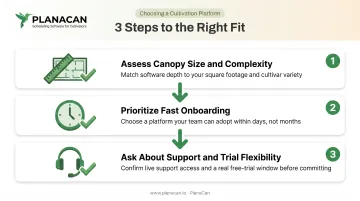
- Assess your canopy size and complexity. A single 3,000-square-foot flower room has different needs than a 20,000-square-foot MSO running cross-site SOPs and portfolio-level analytics.
- Prioritize fast onboarding. If onboarding means interrupting an active harvest cycle, the switch isn't worth it. Look for intuitive interfaces your team can pick up in days, not weeks.
- Ask about support and trial flexibility. Before you commit, confirm support responsiveness after signup and whether the trial lets you run real workflows—not just a demo sandbox.
Frequently Asked Questions
What kind of company is Trellis?
Trellis Solutions Inc. is a Canadian seed-to-sale cannabis software company founded in 2014, known for compliance tracking and plant-mortality analytics. It's distinct from cultivation management platforms focused on scheduling and workflow standardization.
Which AI is best for cannabis growing?
No single AI tool dominates commercial cultivation yet. Companies like Neatleaf use AI for sensor-based environmental monitoring. Most growers still rely on cultivation management software with automation as their day-to-day backbone.
What are the best apps for cannabis growers?
The strongest apps combine scheduling, task tracking, and mobile accessibility. Grower-first platforms like PlanaCan with iOS and Android apps are built for daily use directly from the grow room floor.
What is the difference between trellising and cultivation software?
Trellising is a physical growing technique using netting or stakes to support cannabis branches. Cultivation software is a digital tool for managing schedules, tasks, and team accountability. The two are completely unrelated.
How much does cannabis cultivation software typically cost?
Pricing varies based on canopy size, user count, and feature tier, and most vendors don't publish flat rates. Look for flexible trial periods so you can confirm fit before committing to a subscription.
Can cultivation software help reduce labor costs?
Yes. Automation and standardized workflows can cut labor costs. One PlanaCan case study documented a 23% decrease in labor costs alongside a 36% increase in completed tasks after adoption.