The consequences are real. Disconnected systems create compliance blind spots, missed cultivation tasks, inaccurate inventory counts, and decisions made on stale data. According to Whitney Economics, fewer than 25% of U.S. cannabis operators were profitable in 2023 — and fragmented operations don't help.
The right ERP changes that equation. The wrong one creates a new set of problems.
This guide covers what a cannabis ERP actually is, why cultivators need purpose-built solutions rather than generic software, and the six factors that should drive any platform selection decision.
Key Takeaways
- A cannabis ERP unifies compliance, cultivation, inventory, production, finance, and sales into one connected system.
- Generic ERP software lacks cannabis-specific capabilities; seed-to-sale traceability and state compliance integrations must be native, not added on after the fact.
- Six factors drive ERP selection: compliance and traceability, cultivation operations, inventory control, integration flexibility, ease of adoption, and scalability.
- Cultivators should prioritize state compliance integration and cultivation workflow management above all other features.
- Daily usability matters more than feature count — a system your team ignores delivers no value.
What Is a Cannabis ERP System?
A cannabis ERP (Enterprise Resource Planning) is an integrated software platform built for the specific operational and regulatory demands of the cannabis industry. Unlike a standalone compliance tool or a single-purpose inventory app, an ERP connects every core business function — compliance, cultivation, production, sales, and finance — into one system.
The critical distinction from generic ERP software: standard platforms like NetSuite or SAP lack cannabis-critical capabilities. Seed-to-sale traceability, state reporting integrations (METRC, BioTrackTHC, CCRS), and cultivation-specific workflow management are afterthoughts in generic systems. In cannabis-specific ERPs, they're the foundation.
Core Modules of a Cannabis ERP
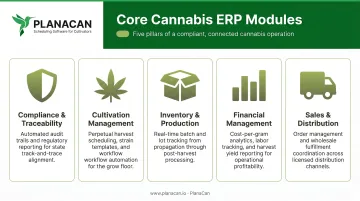
Most cannabis ERP platforms are built around five functional modules:
| Module | Function |
|---|---|
| Compliance & Traceability | Tracks every plant and product from seed to sale; integrates with state reporting systems |
| Cultivation Management | Manages grow schedules, treatment protocols, and team workflows across rooms and strains |
| Inventory & Production | Monitors raw inputs, batch processing, and finished goods in real time |
| Financial Management | Handles accounting, COGS tracking, and financial reporting |
| Sales & Distribution | Manages orders, fulfillment, and customer relationships |
One important caveat: cultivation management is the module most likely to receive surface-level attention in full-suite ERP products. For commercial growers, that gap is where yield and profitability are actually won or lost. Evaluate that module rigorously — or supplement the broader ERP with a purpose-built cultivation layer like PlanaCan, which is designed specifically for commercial grow operations.
Why Generic Software Creates Real Risk
Cannabis businesses face two distinct risks when they rely on non-specialized tools.
Compliance risk is immediate. State regulations require precise, auditable records on every plant, batch, and transfer. METRC's seed-to-sale system — used across California, Colorado, Michigan, New York, Ohio, and other states — requires native integrations that generic ERP software can't provide. California's Department of Cannabis Control issued 366 disciplinary actions in 2024, including 230 suspensions and 73 revocations or denials. Non-compliance has direct, documented consequences.
Operational risk builds more gradually. Without a unified system, data stays siloed between cultivation, processing, and finance teams — leading to missed tasks, inventory discrepancies, and decisions based on outdated numbers. The efficiency gap is measurable: one cultivation team saved 23 hours per week after adopting dedicated cultivation software, while another cut monthly reconciliation time from five-to-seven days down to half a day.
What to Consider When Selecting a Cannabis ERP
Selecting a cannabis ERP isn't a feature-list exercise. It requires matching platform capabilities to your specific license type, team structure, operation scale, and growth trajectory. A dispensary operator and a large-scale commercial cultivator have very different requirements from the same category of software.
The six factors below move ERP evaluation beyond marketing claims to measurable operational outcomes.
Compliance and Seed-to-Sale Traceability
This is the non-negotiable starting point. State regulations demand real-time tracking of every plant, batch, and transfer — and the penalties for failure range from fines to license suspension.
Before evaluating any other feature, verify that the ERP has native or certified integrations with your state's tracking system:
- METRC — California, Colorado, Michigan, Massachusetts, Missouri, Ohio, Nevada, Oregon, and others
- BioTrackTHC — Illinois, New York, Connecticut, Delaware, and others
- CCRS — Washington State (replaced Leaf Data Systems)
KPIs this protects: audit pass rates, compliance reporting turnaround time, manual steps per regulatory submission.
Cultivation Operations Management
For commercial cultivators, grow workflow management is where yield and profitability are actually determined. This module deserves more scrutiny than any other.
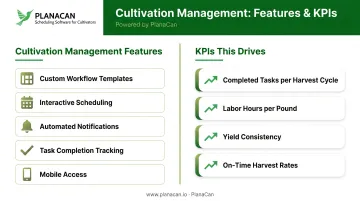
Look specifically for:
- Custom workflow templates per strain and treatment type
- Interactive scheduling with multi-harvest visibility across rooms
- Automated daily team notifications so no phase-day task gets missed
- Task completion tracking with user-level attribution
- Mobile access (iOS and Android) for on-the-floor execution
Generic ERPs often treat this module as a checkbox — a bare-minimum add-on rather than a purpose-built system. Platforms like PlanaCan are built specifically around cultivation workflows, which is worth considering if grow operations are your core business.
KPIs this drives: completed tasks per harvest cycle, labor hours per pound produced, yield consistency across rooms, on-time harvest rates.
Inventory and Production Control
Real-time inventory visibility serves two masters simultaneously: compliance and cost control. Cannabis operators must know exactly what they have at every stage — raw inputs through finished products — to avoid over-ordering, under-producing, or failing a spot audit.
Michigan's Cannabis Regulatory Agency, for example, requires physical and electronic inventory to align and moved to unannounced semi-annual inspections in October 2024. That's a high bar for operations running on disconnected tools.
KPIs this influences: inventory accuracy rates, COGS, waste percentage, production batch consistency.
Integration Flexibility
No single ERP does everything well. Most cannabis operations rely on specialized tools alongside their ERP — accounting platforms like QuickBooks or Sage Intacct, point-of-sale systems, LIMS for lab results, or e-commerce. An ERP with limited API connectivity forces manual re-entry, which reintroduces the exact data fragmentation it was supposed to eliminate.
Ask every vendor: what does your API ecosystem look like, and how does data flow between your platform and the tools we already use?
KPIs this protects: data entry errors, time spent on manual reconciliation, software cost per function.
Ease of Use and Team Adoption
A powerful ERP that sits underused delivers no return. Gartner projects that by 2027, more than 70% of recently implemented ERP initiatives will fail to fully meet their original business-case goals — often because of adoption failures, not technical ones.
For cannabis operations specifically, cultivation teams work on the floor, not at desks. Prioritize platforms with:
- Intuitive onboarding with flexible trial periods
- Native iOS and Android apps for in-grow execution
- Responsive vendor support, especially during early adoption
KPIs this impacts: time-to-full-adoption, task completion rates post-implementation, reduction in spreadsheet workarounds.
Scalability and Business Model Fit
The ERP you choose today should support where your business is going over the next three to five years. A single-license cultivator scaling to multi-room or multi-state operations needs a platform that grows with them — not one that requires full re-implementation when the footprint expands.
Larger MSOs add another layer of complexity: multi-entity financial consolidation, multi-location dashboards, and state-by-state compliance variations. Major operators like Curaleaf (19 states), Green Thumb (17 states), and Verano (15 states) operate across regulatory environments that each mandate different reporting systems. The feature requirements, integration depth, and compliance architecture for an MSO are in a different category entirely — and your evaluation process should reflect that.
KPIs this protects: cost per additional license or location, implementation time for new facilities, system downtime during growth transitions.
How PlanaCan Helps Cultivators Take Control of Their Grows
Even the most capable full-suite ERP typically underdevelops the cultivation management layer — the part of the operation where yield, labor efficiency, and team accountability are actually determined. That's the gap PlanaCan was built to fill.
PlanaCan is a cultivation operations platform designed specifically for commercial cannabis growers. It's not a seed-to-sale compliance system, and it doesn't compete with platforms like Canix, Distru, or GrowFlow. Instead, it sits alongside those platforms as the layer that runs the daily work of the grow.
What PlanaCan Does in Practice
The platform is organized around the operational problems commercial cultivators actually face:
- Custom workflow templates — Build templates for every strain, treatment, and cultivation phase. Deploy them across multiple rooms and facilities with one click. Create once, deploy anywhere, refine with each harvest.
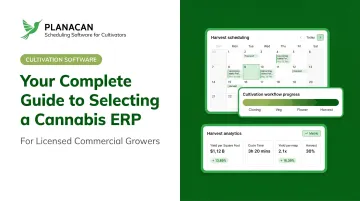
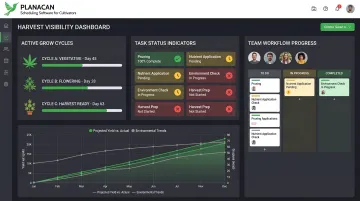
- Harvest visibility — The Harvests Tab provides a bird's-eye view of every active cycle simultaneously, showing phase milestones, upcoming task loads, and schedule status across all rooms — no physical walk-through required.
- Automatic daily notifications — Team members receive push notifications or email alerts each morning with exactly what they need to do that day. Supervisors get real-time alerts when tasks go overdue — proactive intervention instead of end-of-day surprises.
- Mobile apps for iOS and Android let line-level cultivators log data and mark tasks complete directly from their phones as they move through the grow.
- Labor and harvest analytics — Track hours per user, task, phase, and strain, with forward-looking projections for upcoming cycles. Harvest analytics connect process execution to yield outcomes, giving head growers the data to drive continuous improvement.
Real Results from Garden First Cannabis
Garden First Cannabis, a PlanaCan customer managing 16 rotating harvests, reported a 36% increase in completed tasks and a 23% decrease in labor costs after implementing the platform. Co-founder Andreas Hero summarized it simply: "Simple to use, and effective. Our team knows what they need to do, and when to do it."
These figures come from Garden First Cannabis's specific operational experience. For methodology details or comparable results from other customers, contact PlanaCan directly.
How PlanaCan Fits in a Typical Tech Stack
PlanaCan doesn't replace your compliance or ERP software — it completes the cultivation layer beneath it:
- State track-and-trace (METRC, BioTrack, CCRS) — plant-tag compliance reporting
- Seed-to-sale platform (Canix, Distru, GrowFlow) — compliance UI, inventory, sales
- PlanaCan — cultivation operations: templates, scheduling, team management, labor analytics
- Accounting platform (QuickBooks, Sage) — financial reporting
PlanaCan operates in METRC-regulated and BioTrack states across the U.S., including California, Colorado, Michigan, Illinois, New York, New Jersey, Ohio, Massachusetts, and others. Note: direct state system reporting (METRC submissions, BioTrack data entry) is outside PlanaCan's scope — verify current integration capabilities at planacan.io/contact.
Onboarding is built around your team's readiness, not a countdown clock. Free trial periods — typically one to two weeks — last as long as it takes your cultivators to feel comfortable with the platform. Full support is available throughout onboarding and beyond.
Conclusion
Selecting a cannabis ERP comes down to one question: does this platform match your operation's license type, team structure, and growth trajectory — or does it match someone else's?
Compliance and cultivation are the two functions where gaps cost you the most — in fines, failed audits, and lost harvests. No platform should make your shortlist without being tested against both under real operational conditions, not controlled demos.
ERP selection is also not a permanent decision. As regulations evolve and your operation scales, revisit software performance periodically. If a platform can't keep pace with your next license, your next facility, or next year's regulatory changes, it wasn't the right fit to begin with.
Frequently Asked Questions
What is a cannabis ERP system?
A cannabis ERP is an integrated software platform that connects key business functions — compliance tracking, cultivation management, inventory, production, and finance — into a single system built for the cannabis industry's specific regulatory and operational demands. Unlike generic ERP software, cannabis-specific platforms include native seed-to-sale traceability and state reporting integrations as core features.
What is the ERP selection process for cannabis businesses?
Start by mapping your business functions and license requirements. Then evaluate vendors against compliance integration, cultivation workflow management, inventory control, and integration flexibility. Assess scalability and ease of adoption before committing — and always pilot the platform with your actual team before full deployment.
What are the core modules of a cannabis ERP?
The five core modules are: compliance and seed-to-sale traceability, cultivation operations management, inventory and production control, financial management, and sales and distribution. Not all platforms cover each module equally — cultivation management in particular often receives less depth in full-suite products.
Do small cannabis cultivators need a full ERP system?
Not necessarily. Smaller operations may not require full enterprise ERP capabilities, but every licensed cultivator needs integrated tools for compliance reporting and cultivation workflow management at minimum. Purpose-built cultivation platforms often deliver more direct operational value for grow-focused businesses than a generic or oversized ERP would.
How does a cannabis ERP differ from cultivation management software?
A full cannabis ERP covers the entire business: finance, sales, compliance, HR, and inventory. Cultivation management software focuses specifically on grow scheduling, workflow standardization, team accountability, and yield tracking. Many commercial operations run both — using the ERP for compliance and financials and a dedicated cultivation platform for day-to-day execution.
What should cultivators prioritize when choosing a cannabis ERP?
Start with state compliance integration — if the platform can't connect to your state's track-and-trace system, everything else is secondary. Then prioritize cultivation workflow management, ease of use for floor-level teams, and the vendor's responsiveness. A system your team actually uses every day will always outperform a more powerful one they avoid.