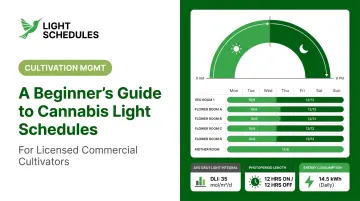
Introduction: Why Light Schedules Make or Break a Cannabis Grow
In a commercial cannabis facility, light schedule errors don't just slow a crop — they compress your margin. For photoperiod strains, the ratio of light to darkness each day determines whether a plant stays in vegetative growth or begins producing buds.
Get it right, and you control exactly when flowering starts. Get it wrong, and you're looking at delayed harvests, reduced yields, or plants that revert mid-cycle.
For home growers managing one tent, a missed light schedule is an inconvenience. For commercial cultivators running multiple rooms, multiple strains, and staggered harvest cycles, it's a revenue problem.
This guide covers the core light schedules for each growth stage, when and how to flip plants to flower, spectrum basics, and how to maintain schedule consistency across multiple rooms and harvest cycles.
Key Takeaways:
- Seedlings thrive on 16–24 hours of light; 18/6 is the commercial standard for veg
- 12/12 triggers flowering in photoperiod strains — and the dark period must be uninterrupted
- Most commercial operations veg 4–8 weeks before flipping — yield varies significantly by duration
- Light leaks during flower can prevent bud development entirely
- Autoflowers flower by age rather than light schedule, offering scheduling flexibility but less yield control
What Is the Cannabis Photoperiod (And Why It Matters)?
Cannabis plants are natural timekeepers. They use light-sensitive proteins called phytochromes — specifically PHYA and PHYB — to measure the length of uninterrupted darkness each night. When dark periods become long enough, the plant interprets this as the approach of autumn and redirects energy toward bud production.
Recent peer-reviewed research confirms that flowering in cannabis is triggered when the dark period (scotoperiod) exceeds approximately 10–11 hours, with phytochrome signaling driving the Flowering Locus T (FT) pathway that initiates the transition.
That biological mechanism is exactly what gives indoor growers a distinct advantage: complete control over the dark period. Maintain 18+ hours of light per day and photoperiod plants stay vegetative indefinitely. Reduce light to 12 hours — with 12 hours of uninterrupted darkness — and flowering begins.
One important distinction worth noting upfront: this photoperiod sensitivity applies only to regular and feminized photoperiod strains. Autoflowering strains operate on an entirely different internal clock, which this guide addresses in a later section.
The Three Light Schedules Every Cannabis Grower Must Know
Seedling Stage: 16–24 Hours of Light
Seedlings need extended light exposure to establish strong stems and root systems. Most commercial growers use an 18/6 or 20/4 schedule through early seedling — Cannabis Business Times reports that most operations provide at least 18 hours of light to keep young plants in an immature state.
Light intensity should stay low during the first couple of weeks. Root systems at this stage can't yet support high-energy photosynthesis, so blasting seedlings with intense light does more harm than good.
Blue-spectrum light (400–500 nm) is the right call here. Research links blue wavelengths to shorter internode spacing and compact early growth — exactly what you want before transplant.
Vegetative Stage: 18/6
The 18/6 schedule (18 hours light, 6 hours dark) is the commercial standard for vegetative growth. Long days simulate summer, keeping the plant's energy focused on:
- Stem thickening and structural development
- Canopy expansion and lateral branching
- Root mass building that will support bud sites later
Some growers run 24/0 (continuous light), but most commercial operations prefer 18/6. The dark period allows for metabolic recovery, reduces electricity costs, and avoids the subtle growth inconsistencies some strains show under constant illumination.
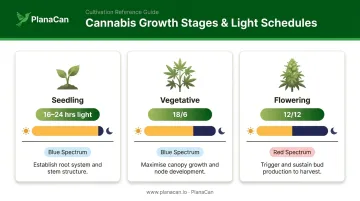
Blue-heavy spectrum reinforces compact internodal spacing and dense canopy structure throughout veg.
Flowering Stage: 12/12
Once your plants have reached the desired size and structure, a single schedule change triggers the shift to bud production. The 12/12 schedule — 12 hours of light, 12 hours of uninterrupted darkness — is the standard trigger for photoperiod strains.
A 2025 peer-reviewed night-break study found that a single 1-hour light pulse during the dark period of a 12/12 schedule was sufficient to prevent flowering and maintain vegetative growth. Even brief light intrusions disrupt the phytochrome signaling that drives bud development.
Once flowering is initiated, plants must remain on 12/12 from initiation through harvest. Spectrum should shift toward red wavelengths (600–700 nm) during this stage, as red light drives photosynthesis and supports the bud development process.
When to Switch Your Cannabis Plants from Veg to Flower
The flip decision isn't purely about observing the plant — it's a scheduling calculation.
The Height Rule of Thumb
Flip to 12/12 when plants have reached roughly half their target final height. Most photoperiod strains continue stretching significantly after the light schedule change, so accounting for post-flip growth before the flip prevents plants from outgrowing their canopy space.
Flipping too early produces underdeveloped plants with lower yields. Waiting too long in a height-limited space means plants push into fixtures and create their own problems.
Age Matters for Seed-Grown Plants
Cannabis plants grown from seed need a minimum of 3–4 weeks of vegetative growth before they're physiologically ready to respond to a 12/12 schedule. Clones, being cuttings from mature plants, don't have this limitation — they can be flipped as soon as they're rooted and established.
Veg Duration and Yield Impact
How long you veg directly affects what you harvest. A 2024 peer-reviewed medicinal cannabis study tested vegetative durations of 1–4 weeks and found area yields ranging from 295 to 571 g/m² from shortest to longest duration treatment — nearly double the yield at the longer veg period. The same research notes that commercial indoor operations most commonly run vegetative durations between 7 and 35 days, adjusted for plant density and target canopy size.
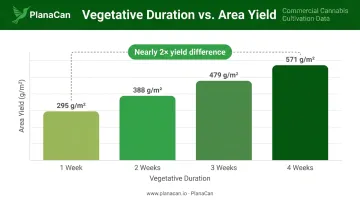
The practical range for most facilities lands between 4–8 weeks of veg, adjusted for strain genetics, room size, and harvest frequency targets. Longer veg means larger plants and higher per-plant yields but slower room turnover.
Coordinating the Flip Across Teams
That scheduling variability makes coordination critical. In a multi-room facility, the flip date can't live in someone's head or on a personal calendar — it needs to be shared across grow teams so rooms transition on schedule, harvest timelines stay predictable, and output stays consistent.
PlanaCan is built for exactly this kind of operational complexity. Cultivation managers can template the flip date into each strain's workflow, position the light schedule change on the facility's Gantt chart, and set automatic team notifications — replacing verbal handoffs and manual calendar entries with a traceable, repeatable process. When the flip task is completed, PlanaCan logs who executed it, when, and in which room, creating an audit trail that supports both internal accountability and regulatory compliance.
Managing Light Schedule Consistency Across Your Cultivation
Why Consistency Outweighs Perfection
A one-time delay in flipping a room is recoverable. Ongoing inconsistency during the flowering dark period is not.
Stray light from equipment indicator lights, a poorly sealed door, or a team member entering at the wrong time can disrupt phytochrome activity, delay bud development, or stall flowering entirely.
In sensitive strains, repeated dark-period interruptions can also trigger hermaphroditism — the development of both male and female flowers — which poses serious contamination risks to adjacent rooms.
The Scale Problem
At home, one grower can personally verify the light schedule daily. In a commercial facility with 6–12 flower rooms, multiple strains at different stages, and a team of 5–20 cultivators:
- A single incorrect timer setting affects an entire room's harvest
- A team member entering a dark room at the wrong time can set back weeks of progress
- A missed flip notification delays the room's schedule and cascades into harvest timing downstream
Practical Safeguards
Every commercial operation should have these basics locked in:
- Light-proof grow rooms with self-closing, light-sealed doors
- Reliable timer systems with battery backup for power interruptions
- Documented SOPs for every light schedule transition, accessible by the team at the point of task execution
- Team communication protocols that don't rely on verbal confirmation alone
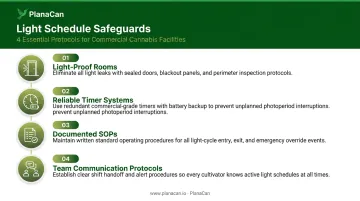
Getting the physical infrastructure right is only half the challenge. Coordinating a team across multiple rooms — each on its own schedule — requires an operational layer that most facilities manage through whiteboards and group texts.
PlanaCan is built for exactly this. Automatic daily notifications alert the grow team to upcoming schedule changes before they happen. Custom workflow templates standardize the exact steps for transitioning a room, with embedded SOPs that team members can access from their mobile device on the floor. The Gantt chart gives cultivation managers a bird's-eye view of where every room sits in its light cycle, so every room's status is visible at a glance.
Garden First Cannabis, managing 16 rotating harvests simultaneously with PlanaCan, achieved a 36% increase in task completion and a 23% reduction in labor costs.
Autoflowering Strains: A Different Set of Rules
Autoflowering cannabis strains don't rely on photoperiod cues. Peer-reviewed genetic research has identified specific flowering-time loci — including Autoflower1 — that make these plants flower based on age rather than light schedule. A 2025 transcriptomic study confirmed that the autoflowering trait is photoperiod independent, regulated instead by age-triggered gene expression.
Autoflowers transition to flower around 3–4 weeks from germination regardless of how many hours of light they receive. Many commercial growers run them on 18/6 or 20/4 from seed to harvest.
The tradeoff for commercial operations:
| Factor | Autoflowering | Photoperiod |
|---|---|---|
| Light schedule management | Simple — no flip required | Requires strict 12/12 dark period |
| Yield per plant | Generally lower | Higher with proper veg duration |
| Timing control | Age-determined, less flexible | Fully controllable via flip date |
| Canopy management | Limited | Full control over size and structure |
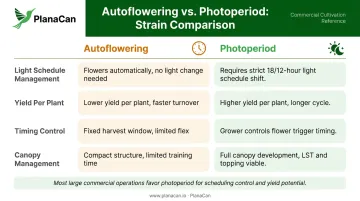
Most large commercial operations favor photoperiod genetics for the scheduling control and yield potential the table above illustrates. Autoflowers suit smaller operations or situations where eliminating the light flip is worth the yield tradeoff. Either way, understanding this distinction shapes how you plan room cycles, batch timing, and harvest sequencing — the core of any commercial light schedule strategy.
Common Light Schedule Mistakes (And How to Avoid Them)
Light leaks during flowering — the most consequential mistake. Even minor stray light during the dark period can interrupt phytochrome cycles and prevent or delay bud development. Practical fixes:
- Seal all light entry points before the first dark cycle, not after you notice a problem
- Use timers with battery backup
- Establish a strict no-entry protocol during the dark period and document it in your SOPs
Flipping too early from seed — growers eager to start budding sometimes flip to 12/12 before seed-grown plants are ready (under 3–4 weeks from germination). The result is dramatically reduced yields from plants that weren't structurally developed enough to support meaningful bud production. Patience in veg is a direct investment in harvest output.
Inconsistent schedule timing — shifting lights on/off by even an hour from day to day creates photoperiod stress that compounds across a run. Practical fixes:
- Set timers once and verify them at initial setup
- Never manually override without updating the full team
- If your operation depends on someone remembering a manual change, replace that process with an automated one
Frequently Asked Questions
What is the best light schedule for cannabis plants?
It depends on the growth stage: 16–24 hours of gentle light for seedlings, 18/6 for vegetative growth, and 12/12 to initiate and maintain flowering. The 18/6 schedule is the most widely used across commercial operations at every stage except the flowering room.
What happens if the dark period is interrupted during the flowering stage?
Even a brief light pulse during the 12-hour dark period can disrupt phytochrome signaling and prevent or delay flowering. A single 1-hour interruption is enough to halt bud development, which means indicator lights and poorly sealed doors are a genuine risk.
Can cannabis plants stay in the vegetative stage indefinitely?
Yes. As long as photoperiod plants receive 18 or more hours of light daily, they'll continue vegetative growth without initiating flowering. Commercial growers use this to control canopy size and coordinate flip timing across multiple rooms.
How long should cannabis stay in the vegetative stage before flipping?
Most commercial operations run 4–8 weeks of vegetative growth, flipping when plants reach approximately half their target final height. Research shows that yield nearly doubles between the shortest and longest veg durations tested, making veg duration one of the highest-leverage decisions in the grow cycle.
What is the difference between photoperiod and autoflowering cannabis in terms of light?
Photoperiod strains require a shift to 12/12 to flower and stay vegetative indefinitely under long days. Autoflowers flower based on age regardless of schedule — simpler to manage, but with less control over timing, canopy size, and per-plant yield.
Does light spectrum matter, or is schedule all that matters?
Both matter, but they do different things. The schedule (photoperiod) triggers the growth stage. Spectrum influences the quality of that growth — blue light (400–500 nm) promotes compact vegetative structure and tight internodal spacing, while red light (600–700 nm) supports photosynthesis and bud development during flower.