The right software doesn't eliminate that complexity, but it does make it manageable. This guide covers five platforms purpose-built for multistate cannabis operations — evaluated for scalability, compliance depth, and real-world MSO fit.
Key Takeaways
- Cannabis MSOs need software that handles multiple licensed entities across state lines, not just a single-location tool
- The strongest MSO stacks pair cultivation management (scheduling, SOPs, accountability) with ERP platforms for inventory, compliance, and financials
- PlanaCan is built specifically for multi-site cultivation operations, with template propagation, cross-site visibility, and mobile apps
- Platforms like Distru, Canix, Flourish, and 365 Cannabis handle ERP functions across multiple state entities: inventory, compliance, and supply chain
- Scalability and integration depth matter more than brand recognition when choosing your stack
Why Cannabis Procurement Software Matters for Multistate Operators
In most industries, "procurement software" means a centralized purchasing system for a single supply chain. For cannabis MSOs, it means something fundamentally different: managing purchasing across legally separate state entities, each with its own licenses, compliance rules, and mandated tracking systems.
Because cannabis cannot legally cross state lines, each state operation runs as its own independent entity — with its own cultivation licenses, its own compliance obligations, and its own mandated track-and-trace system. As of 2024, 41 states, 3 territories, and D.C. allow medical cannabis programs, and 24 states plus D.C. have adult-use programs. An MSO operating in just five states may be subject to five entirely different regulatory frameworks, each with distinct reporting timelines and documentation standards.
The Real Cost of Fragmented Operations
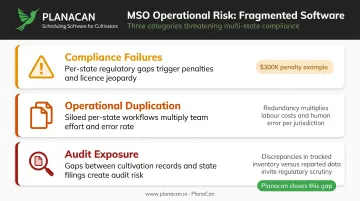
Without standardized software, the operational risks compound quickly:
- Compliance failures — California's DCC and other state agencies issue license denials, fines, suspensions, and revocations for non-compliance. A Nevada Cannabis Compliance Board settlement resulted in a $300,000 civil penalty for one operator.
- Operational duplication — Without shared systems, each state site builds its own workflows, its own spreadsheets, its own communication patterns. The MSO loses the scale advantages it should have.
- Audit exposure — State regulators expect cultivation records to match compliance filings exactly; gaps between what was done and what was reported create inspection risk in every licensed market.
The tools covered below were selected for their ability to serve MSOs with multiple cultivation sites, processing operations, or distribution networks — and their track record helping operators enforce consistent workflows across state lines.
Best Cannabis Procurement Software for Multistate Operators
These platforms were selected for scalability, compliance depth, workflow automation, and real-world adoption among multi-site cannabis operations.
PlanaCan
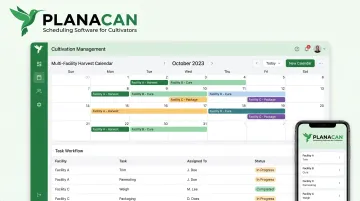
PlanaCan is a grower-first cultivation management platform built specifically for commercial cannabis operations. It's not a seed-to-sale compliance tool; it's the operational layer that runs the grow underneath systems like Metrc and BioTrack.
For MSOs, the core value is template propagation: cultivation workflows, SOPs, and treatment protocols are built once at the corporate level and deployed across every facility in the footprint. A cultivation director managing facilities in California, Michigan, and Massachusetts runs the same standardized schedules at every site, while retaining per-site flexibility where state-specific compliance requirements require deviation.
The platform serves operations from single-flower-room cultivations (3,000+ sqft) to MSOs running across 11+ states on the same architecture — no migration required as you scale.
Documented results from Garden First Cannabis: 36% increase in completed tasks, 23% decrease in labor costs, and 16 rotating harvests managed simultaneously.
Key features for multi-site MSOs:
- Custom workflow templates — Build once per strain or treatment protocol, deploy to any facility. Templates include task descriptions, data-collection prompts (pH, EC, IPM applications), priority flags, and subtasks. Version-controlled and time-stamped for audit defensibility.
- Interactive calendar and Harvests Tab — Consolidated view of every active harvest across all facilities, organized by phase day and room. Perpetual harvest scheduling across multiple flower rooms is built into the core architecture.
- Automatic daily notifications — Push and email alerts for cultivators, plus supervisor alerts when tasks are overdue at any site. Replaces group texts and whiteboards with structured, documented communication.
- iOS and Android mobile apps — Real-time task execution and reporting from the grow floor, synchronized across all sites instantly.
| Category | Details |
|---|---|
| Best For | MSOs with multiple cultivation facilities (5,000+ sqft) needing standardized grow schedules and cross-site team accountability |
| Key Features | Custom workflow templates, interactive harvest calendar, automatic team notifications, mobile apps (iOS & Android), labor analytics |
| Pricing | Flexible free trial; contact PlanaCan for custom pricing based on cultivation size and number of sites |
Distru
Distru is a cannabis ERP used widely by MSO cultivators, manufacturers, and distributors. Its core strength is centralizing inventory, orders, and compliance data from multiple state locations into one hub — reducing the need for separate state-by-state systems.
Deep Metrc and BioTrack integration means compliance data flows from operations into reporting without manual re-entry. Real-time analytics dashboards let multistate teams compare performance across facilities and identify gaps in procurement or production planning.
| Category | Details |
|---|---|
| Best For | MSOs managing cultivation, distribution, and wholesale operations across multiple states |
| Key Features | Multi-location inventory management, Metrc/BioTrack compliance integration, order management, production tracking, reporting dashboards |
| Pricing | Custom pricing; request a demo via Distru's website |
Canix
Canix is a cannabis-specific ERP designed for cultivators, manufacturers, and distributors in regulated markets. Real-time inventory tracking, Metrc compliance integration, and production planning tools are built for licensed operations from the ground up.
Its open API and built-in integrations enable cross-platform connectivity, connecting Canix to accounting, retail, or logistics systems already in your stack. Continuous scanning tools accelerate multi-location transfer workflows that are routine in multistate operations.
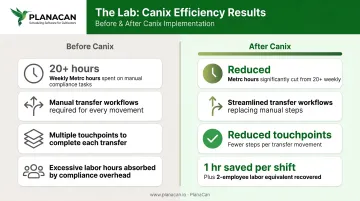
One documented case study: The Lab switched from Fishbowl to Canix, reducing Metrc touchpoints by over 20 hours per week and saving approximately 1 hour per shift — equivalent to the labor of two employees.
| Category | Details |
|---|---|
| Best For | Cultivators and manufacturers needing tight compliance and inventory management across multiple locations |
| Key Features | Real-time inventory tracking, Metrc compliance integration, production planning, COGS tracking, open API |
| Pricing | Custom pricing based on business size, license type, and modules selected |
Flourish Software
Flourish is a seed-to-sale ERP built by cannabis operators, covering cultivation, distribution, and retail in one platform. Built-in SOP management, automated compliance workflows, and audit logs address the inspection-readiness challenge that MSOs face across multiple state regulators.
Two-way Metrc integration, LeafLink for wholesale, QuickBooks Online for financials, and thousands of additional connections via Zapier make it a flexible hub without requiring a full technology rebuild.
Flourish supports operations scaling from single locations up to 50+ facility enterprises.
| Category | Details |
|---|---|
| Best For | Vertically integrated MSOs needing a single platform from cultivation through retail |
| Key Features | Integrated cultivation-to-retail modules, compliance automation, SOP management, real-time analytics, Metrc and LeafLink integrations |
| Pricing | Custom pricing based on business size, modules selected, and integrations |
365 Cannabis
365 Cannabis is a cannabis ERP built on Microsoft Dynamics 365 Business Central, designed for larger, vertically integrated MSOs with multi-license and multi-location operations. It covers financial management, cultivation batch tracking, recipe-based processing, CRM, and POS in one system.
The Microsoft Dynamics foundation brings familiar infrastructure with strong financial consolidation and intercompany accounting across state entities. Multi-location dashboards, consolidated financial reporting, and support for organizations from 5 to 5,000 employees make it one of the few platforms built for enterprise-scale MSO complexity.
| Category | Details |
|---|---|
| Best For | Large, vertically integrated MSOs needing enterprise-scale financial and operational consolidation |
| Key Features | Financial management, cultivation batch tracking, recipe-based processing, CRM, POS, multi-location reporting |
| Pricing | Custom pricing based on business size, deployment scope, and licensing needs |
How We Chose the Best Cannabis Procurement Software for MSOs
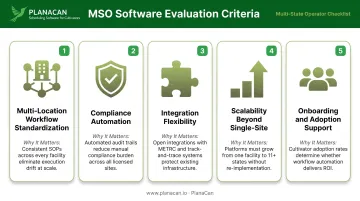
Each platform on this list was evaluated against a consistent set of criteria tied to multistate operational realities — not single-site feature lists.
Evaluation Criteria
| Criterion | Why It Matters for MSOs |
|---|---|
| Multi-location workflow standardization | Reduces operational duplication across state entities; enables brand-consistent cultivation practices |
| Compliance automation | Reduces audit risk and manual reporting labor in states with Metrc, BioTrack, or other mandated systems |
| Integration flexibility | New states can be added without rebuilding the tech stack from scratch |
| Scalability beyond single-site | Platform must grow with the MSO footprint, not require migration at 3 or 5 sites |
| Onboarding and adoption support | Teams at multiple facilities with varying technical comfort levels need to actually use the platform |
The Most Common MSO Software Mistake
The biggest selection error operators make is choosing a single-state or single-site tool because it's familiar or affordable, then facing a costly migration mid-expansion. A platform that works well for one licensed facility but can't support multiple legal entities or cross-site reporting will create exactly the operational fragmentation it was supposed to solve — just at a larger scale.
Worth understanding before you evaluate any platform: Metrc and BioTrack are compliance reporting systems, not cultivation management systems. They record what was done; they don't manage how work gets scheduled, assigned, or executed at the facility level. MSOs that treat track-and-trace as their only cultivation software often end up with well-reported grows that are poorly managed underneath. Platforms like PlanaCan fill that gap specifically — handling perpetual harvest scheduling, task assignment, and workflow execution across every facility in the operation.
Conclusion
No single platform handles everything a multistate cannabis operator needs. The strongest MSO software stacks combine a cultivation management tool — for grow team accountability, scheduling, and SOP standardization — with an ERP or compliance platform for inventory, financials, and regulation. The right combination depends on your specific license types, state footprint, and operational complexity.
When evaluating options, prioritize scalability and integration depth over brand recognition — a tool that works for one state today must expand cleanly as you enter new markets, without forcing you to rebuild workflows from scratch.
For MSOs managing multiple cultivation sites, PlanaCan offers a grower-first scheduling platform that standardizes grow workflows, drives team accountability, and scales across facilities — from 3,000 sqft single-room grows to 11-state MSO footprints.
The free trial is flexible: it runs as long as it takes for your team to feel confident, with hands-on support from the founding team throughout. Start a free trial or reach out to sales@planacan.io to discuss fit for your operation.
Frequently Asked Questions
What POS systems do cannabis dispensaries use?
Cannabis dispensaries commonly use POS systems including Flowhub, Dutchie, Blaze, IndicaOnline, and Treez. Many integrate with seed-to-sale and ERP platforms to maintain compliance with state track-and-trace requirements. These are retail-facing tools, distinct from the cultivation and procurement platforms covered in this guide.
What is the difference between cannabis ERP software and cultivation management software?
ERP software manages broad business operations — inventory, financials, compliance, and supply chain — across the full license. Cultivation management software focuses specifically on grow scheduling, task assignment, SOP enforcement, and workflow standardization at the facility level. MSOs typically run both, with cultivation management operating as the layer underneath the ERP.
Do multistate cannabis operators need separate software for each state?
Each state entity requires compliance with that state's mandated tracking system (Metrc, BioTrack, or another platform), so you can't avoid state-by-state compliance infrastructure. However, platforms built for MSOs — like those on this list — allow centralized management of multiple state entities from one dashboard, eliminating the need to duplicate your entire software stack per state.
What should MSOs look for when choosing cannabis procurement software?
Prioritize these when evaluating options:
- Multi-location visibility across all state entities
- State-specific compliance integrations (Metrc, BioTrack, and others)
- Scalable pricing that grows with your facility footprint
- Fast onboarding for teams with varying technical experience
- Workflow standardization across facilities running different strains
Avoid tools designed for single-site operations that were retrofitted for MSO use.
How does cultivation scheduling software help MSOs improve yields across multiple facilities?
Cultivation scheduling software like PlanaCan allows grow teams to build standardized templates for each strain and treatment protocol, deploy consistent schedules across all facilities, and use automated notifications to ensure tasks are completed on time. Consistent execution across sites is the most direct path to consistent yields between them.