Most compliance conversations in cannabis focus on retail or HR. The cultivation floor gets less attention — and that's exactly where the risk concentrates. Missed pesticide application logs, undocumented harvest weights, and canopy tracking gaps don't surface until an audit makes them impossible to ignore.
This article covers why cultivation compliance varies so dramatically by state, what the core requirements are for licensed growers, and how standardizing SOPs and workflows is the most practical way to stay compliant across multiple markets.
Key Takeaways
- Cannabis remains federally Schedule I, so each state sets its own cultivation rules — and those rules differ significantly across licensing, testing, and tracking requirements
- Seed-to-sale discrepancies and incomplete pesticide logs are among the most common cultivation compliance failures
- Modular SOPs — built once, adapted per state — prevent duplicate work while maintaining regulatory specificity
- Digitally tracked workflows build the audit trail regulators expect — before an inspection ever happens
- PlanaCan gives multi-site operators a single system to standardize workflows, track task completion, and keep documentation inspection-ready across every location
Why Cannabis Compliance Varies Across States
Cannabis remains a Schedule I controlled substance under federal law, which means there is no national cultivation framework. Every state that permits commercial growing sets its own rules, and those differences directly affect daily grow operations.
According to the National Conference of State Legislatures, 41 states, three territories, and D.C. allow medical cannabis as of mid-2026, with 24 states having legalized adult-use. Each of those programs comes with its own cultivation regulations.
What This Means for Multi-State Operators
For a multi-state operator (MSO), a workflow that passes inspection in Colorado may be non-compliant in Michigan. The differences aren't trivial:
- Canopy limits vary by tier and license type across states
- Approved pesticide lists differ — California enforces food-and-agriculture pesticide standards through the Department of Pesticide Regulation, while Colorado prohibits any application inconsistent with product labeling under the Colorado Pesticide Applicator Act
- Testing requirements span different contaminant categories, approved labs, and testing stages
- Seed-to-sale platforms are state-mandated and not interchangeable
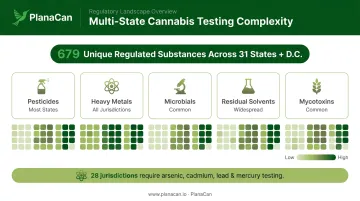
Those differences add up fast. A 2022 peer-reviewed study found that 31 states and D.C. regulated 679 unique substances across cannabis testing programs — pesticides, heavy metals, microbials, residual solvents, and mycotoxins — with significant variation in which contaminants each state required and at what thresholds.
The Regulatory Change Problem
Regulations don't stay static. Recent examples show just how frequent the pace of change can be:
- Colorado: The Marijuana Enforcement Division adopted revised rules effective January 2026, following additional rulemaking in 2023, 2024, and 2025
- California: The DCC updated its cultivation regulations on January 1, 2026
Without a process to translate regulatory changes into SOP updates before they take effect, compliance gaps develop undetected and surface during inspections.
Key Compliance Requirements for Cannabis Cultivators
Licensing
Cultivation licenses are state-specific and typically tiered by canopy size or plant count. California structures licenses by cultivation method and scale — outdoor, indoor, mixed-light Tier 1, mixed-light Tier 2, nursery, and more. Colorado tiers by plant count, with Tier 2 covering 1,801–3,600 plants.
Many states require separate licenses for different grow methods. License renewal typically requires documented proof of compliant operations. That makes operational records central to maintaining licensure — not just useful paperwork.
Seed-to-Sale Tracking
Most regulated states mandate a specific tracking platform. Metrc operates in more than 20 states including California, Colorado, Michigan, Massachusetts, Illinois, and New York. Washington uses its own Cannabis Central Reporting System. BioTrack holds government contracts across multiple jurisdictions.
Every cultivator on these platforms must log plant tags, batch movements, harvest weights, and waste events. The core compliance risk is discrepancies between what the platform shows and what's physically in the grow. That gap is a direct path to a violation.
Testing Requirements
Each state specifies:
- Which contaminants must be tested (pesticides, heavy metals, microbials, residual solvents)
- At which production stages testing is required
- Which state-approved labs are permitted to conduct testing
Across regulated states, 31 states list 551 pesticides as regulated substances, and 28 jurisdictions require testing for arsenic, cadmium, lead, and mercury. Requirements can also differ within a single state: Maine required contaminant testing in its adult-use program but made it voluntary in its medical program as of Fall 2023. That inconsistency means MSOs must maintain entirely distinct testing workflows for each state market.
Canopy and Inventory Controls
Many states cap licensed canopy square footage and require cultivators to track active canopy by room or zone. Key record-keeping obligations include:
- What was planted, in what volume, and when
- Active canopy totals by room or zone
- Documentation supporting regulatory reporting submissions
Canopy overages are a well-documented compliance risk, and gaps in these records are among the most common triggers for violations.
Packaging, Labeling, and Documentation
Harvest batches moving from cultivation to processing or retail must be tagged and documented. Labeling requirements — THC/CBD content, batch numbers, required warnings, and universal cannabis symbols — differ by state and cannot be standardized across markets without state-specific templates.
Building Cultivation SOPs That Standardize Compliance Across State Markets
A Standard Operating Procedure in cannabis cultivation is a documented, step-by-step workflow for a specific task — pesticide application, transplant protocol, harvest procedure, sanitation routine. They serve two functions: operational consistency for grow teams and compliance documentation for regulators.
Michigan's Cannabis Regulatory Agency makes this explicit. Its May 2026 Compliance Best Practice Guide states that cultivators should maintain step-by-step SOPs for routine tasks including chemical and plant treatment applications, trimming, harvesting, and Metrc tracking — with documented roles and controls. Michigan CRA also conducts unannounced semi-annual inspections at all licensed marijuana businesses, effective October 2024. SOPs need to be inspection-ready at any time.
California takes it further: DCC requires Form 19: Standard Operating Procedures as a component of the license application itself.
The Modular SOP Approach
Effective multi-state SOPs must be modular. The structure that works:
- Start with a core procedure framework covering universal best practices: IPM protocols, harvest procedures, sanitation standards.
- Layer state-specific requirements on top — approved pesticide lists, mandated testing steps, and documentation format differences vary by market.
- Tie treatment logs to specific harvest batches so any auditor can trace a pesticide application back to a batch and verify it against that state's approved list.
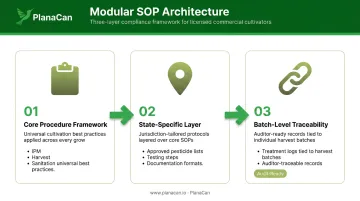
This "create once, adapt per market" approach prevents duplicate work while keeping each state version specific enough to hold up under inspection.
Documentation and Team Training
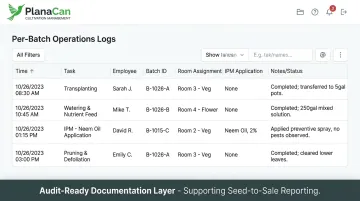
Regulators don't just want SOPs to exist — they want proof they were executed. Michigan's CRA guide notes that employee and operational records must be readily available for agency inspection at any time. Every completed task needs a record: date, employee, quantities used, and batch reference.
Training across multi-location grow teams adds another layer of complexity. Verbal instructions leave no accountability trail, and they don't scale when new hires in State B need to follow different pesticide protocols than the team in State A. Written, structured SOPs solve both problems at once.
PlanaCan is built specifically for this operational layer. Cultivators can build custom workflow templates for every treatment, strain, and cultivation step, then deploy those templates across any grow location with state-specific modifications. When a task is completed, PlanaCan automatically captures who did it, when, which batch it applied to, and any associated data — creating the audit-defensible record that state inspectors expect to see.
How Workflow Standardization Reduces Compliance Risk
The connection between inconsistent workflows and compliance violations is direct. When grow teams operate without standardized schedules, tasks get missed. In cannabis cultivation, a missed pesticide application log or an unrecorded harvest weight is both an operational lapse and a compliance violation.
Accountability Through Scheduled Workflows
When every cultivation task — fertigation, IPM applications, sanitation, harvest processing — is scheduled in advance and assigned to specific team members, compliance becomes visible. Managers can see who is responsible for what and whether it was completed. Gaps stop forming because responsibility is explicit before work begins.
Garden First Cannabis, an existing PlanaCan customer, achieved a 36% increase in completed tasks after implementing standardized cultivation workflows on the platform. Andreas Hero, co-founder of Garden First Cannabis, put it plainly: "Simple to use, and effective. Our team knows what they need to do, and when to do it." That operational clarity translates directly to compliance consistency.
Multi-Site Visibility
MSOs managing multiple grow rooms or facilities need more than per-site accountability — they need a consolidated view across the operation. Compliance managers overseeing multiple locations must catch execution gaps before a state inspector does.
PlanaCan's interactive Gantt chart gives cultivation managers a real-time view of every harvest schedule across the entire operation. Custom filtered views by room, phase, team, user, or batch allow compliance oversight personnel to isolate specific facilities and verify that SOPs are being executed consistently — not just documented.
Audit-Readiness Before the Audit
When workflows are standardized and digitally tracked, the documentation required for a state compliance audit already exists. Task logs, treatment records, and employee activity by date are generated as a byproduct of daily operations, not reconstructed after a notice of inspection arrives.
PlanaCan captures per-batch operations logs that include who completed each task, timestamps, batch and room attribution, environmental data, and IPM application records. This is the operational layer that seed-to-sale platforms like Metrc and BioTrack don't cover — PlanaCan fills that gap by generating the cultivation execution record that supports what those platforms report at the plant-tag level.
Best Practices for Multi-State Cannabis Compliance Management
Stay Ahead of Regulatory Changes
Regulations update on a rolling basis across every state with active cannabis programs. Assign a designated compliance point person at each location — a compliance officer or head grower — responsible for:
- Monitoring state cannabis control board rulemaking updates
- Subscribing to state regulatory newsletters and industry publications
- Translating new requirements into SOP updates before effective dates
Conduct Regular Internal Compliance Audits
Schedule periodic reviews — at minimum quarterly — covering:
- Seed-to-sale tracking accuracy vs. physical inventory counts
- SOP documentation completeness and version currency
- Cultivation records matched against license conditions for each state
Document the outcomes of every internal audit and record any corrective actions taken. That documentation becomes part of your compliance record and demonstrates good-faith compliance management to regulators.
Invest in Ongoing Team Training
Audits and SOPs only hold up if the people executing them understand the requirements. Build training around the compliance infrastructure you've already put in place:
- Incorporate state-specific requirements into onboarding for every new hire at each location
- Schedule refresher sessions whenever regulations or SOPs are updated
- Use written SOPs as the training reference — not institutional memory from senior staff
- Verify training completion and log it as part of your compliance record
Frequently Asked Questions
What is SOP in cannabis?
An SOP (Standard Operating Procedure) in cannabis is a written, step-by-step document outlining how cultivation tasks should be performed consistently — from pest management to harvest protocols. SOPs function as both operational guides for grow teams and compliance documentation showing that regulated activities were performed to a defined, verifiable standard.
What is the standardized cannabis symbol?
The standardized cannabis symbol is a universal warning icon — typically a cannabis leaf inside an exclamation triangle — used on product packaging to identify cannabis-containing products. California requires it to be printed in black at a minimum of 0.5 x 0.5 inches. Colorado's version includes the letters "THC" and the statement "Contains Marijuana. Keep away from children." Requirements vary by state.
How do multi-state cannabis operators manage different state compliance requirements?
MSOs typically manage compliance across states by building modular SOPs with state-specific variations, assigning dedicated compliance oversight at each location, integrating the seed-to-sale tracking platform each state requires, and deploying cultivation management tools to standardize workflows and maintain documentation across all sites.
What are the most common cannabis cultivation compliance violations?
Common violations include discrepancies between physical inventory and seed-to-sale tracking records, incomplete or missing pesticide application logs, testing failures tied to undocumented IPM protocols, and canopy overages relative to licensed square footage. Most stem from workflow execution gaps rather than intentional non-compliance.
How does standardizing grow workflows help with cannabis compliance?
Standardized workflows ensure tasks are completed consistently and documented as they happen, creating the audit trail regulators require. When a workflow is scheduled, assigned, and tracked digitally, the completion record exists automatically — reducing the risk that a missed step or unrecorded treatment creates a compliance gap during inspection.
Why is seed-to-sale tracking important for cannabis cultivators specifically?
Seed-to-sale tracking ties every plant, harvest batch, and waste event to a licensee's account in the state-mandated system. Discrepancies between what's recorded and what's physically in the grow rank among the most consequential compliance violations cultivators face. They're typically the first thing a state inspector checks.