This guide is built for licensed commercial cultivators operating under Colorado's MED framework. Colorado's home grow statute requires plants be kept in an enclosed, locked space — outdoor cultivation is permitted for licensed commercial operations only. Verify your licensing status and local MED regulations before planting anything outside.
What follows is a practical month-by-month calendar anchored to verified regional frost data, photoperiod science, and the specific climate risks Colorado growers face.
Key Takeaways
- Outdoor transplants are not safe before mid-May on the Front Range, and as late as early June in high-elevation regions like the San Luis Valley
- Photoperiod cannabis begins accumulating flowering hormones after June 21; expect visible bud development in mid-to-late July in Colorado
- September is the highest-risk month — Alamosa's average first fall freeze arrives as early as September 11
- Sites above 6,000 feet require autoflowering or early-finishing strains to beat the first freeze
- Tracking your seasonal milestones on a dedicated cultivation calendar prevents costly last-minute pivots during Colorado's narrow grow window
Why Colorado's Climate Makes Outdoor Grow Timing Unique
Elevation Compresses Everything
Colorado's topography ranges from roughly 3,315 feet on the eastern plains to over 14,000 feet in the mountains, according to the Colorado Climate Center. That elevation gap doesn't just affect temperature — it shortens the frost-free growing season dramatically compared to lower-elevation states.
Here's how the numbers break down across key growing regions, using NWS station data:
| Region | Benchmark | Last Spring Freeze | First Fall Freeze | Frost-Free Window |
|---|---|---|---|---|
| Front Range | Denver | May 5 | October 7 | ~155 days |
| Western Slope | Grand Junction | April 22 | October 22 | ~183 days |
| San Luis Valley | Alamosa | June 8 | September 11 | ~95 days |
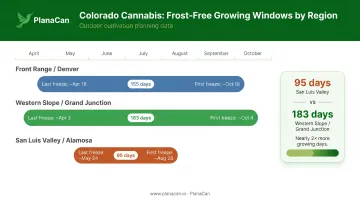
The Alamosa figure is stark: 95 frost-free days leaves almost no room for error. For comparison, California's Central Valley gets nearly 300. Colorado's Western Slope is the most forgiving region, but even Grand Junction growers face a shorter window than most California operators plan around.
UV, Thunderstorms, and Mold Risk
Elevation also drives UV intensity. According to the EPA, UV radiation increases approximately 2% per 1,000 feet of elevation gain. At 5,500 feet, plants receive noticeably more UV exposure than at sea level — which can drive terpene and cannabinoid production but can also accelerate moisture loss and heat stress if plants aren't monitored closely.
The other major climate factor is Colorado's summer storm pattern. The Colorado Climate Center confirms the last half of July and much of August are particularly prone to mountain thunderstorms. These afternoon storms are brief but intense, and they arrive precisely when outdoor cannabis is in peak flowering.
Rapid humidity spikes after rain events create ideal conditions for Botrytis cinerea (bud rot). A 2023 peer-reviewed cannabis Botrytis study found the pathogen can destroy inflorescences rapidly when relative humidity exceeds 70% and temperatures sit between 17–24°C, a combination Colorado growers hit regularly in late July and August.
Colorado Outdoor Cannabis Grow Calendar: Month-by-Month Breakdown
All timing below should be cross-referenced with your specific elevation, region, and licensed grow site conditions. Higher elevations shift every date later.
Germination & Indoor Preparation (March–April)
March and April are indoor months. Seeds need warmth and moisture to germinate reliably — Greenhouse Grower recommends approximately 85°F until seeds crack, then dropping to 75–78°F for early seedling growth. Hold light cycles at 18 hours to keep seedlings in vegetative mode while outdoor temperatures remain unsafe.
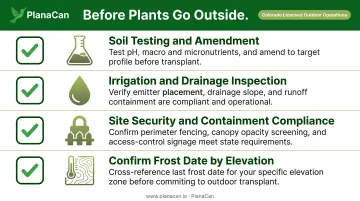
Key site prep tasks to complete before plants go outside:
- Test and amend your outdoor growing medium
- Inspect irrigation lines and drainage after spring snowmelt
- Confirm all plant containment and security requirements for your licensed outdoor site are in place
- Document your site's confirmed last frost date by elevation (see regional table above)
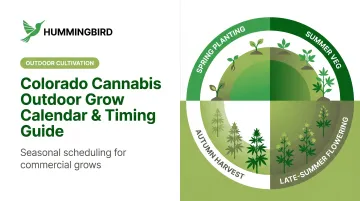
Transplant & Vegetative Growth (May–June)
Transplanting outdoors before your site's last average frost date is one of the most common and costly timing mistakes Colorado growers make. For Front Range operations, mid-May is the earliest safe window. At higher elevations, wait until early June. CSU Extension recommends warm-season transplants go in at least two weeks after the average last spring frost date when soil is workable.
Even after the freeze risk passes, cold nights matter. Temperatures dropping toward 40°F can shock recently transplanted cannabis and set back vegetative development by weeks — a significant cost in Colorado's compressed season.
That compressed season does have a bright side. Denver gets nearly 15 hours of daylight around the solstice, and Alamosa isn't far behind at roughly 14.5 hours. Plants in healthy vegetative growth during June will respond to this long-day light with aggressive canopy expansion.
That compressed season does have a bright side. Denver gets nearly 15 hours of daylight around the solstice, and Alamosa isn't far behind at roughly 14.5 hours. Plants in healthy vegetative growth during June will respond to this long-day light with aggressive canopy expansion.
Priorities during May–June:
- Top plants to encourage lateral branching suited to outdoor canopy development
- Train branches early — outdoor plants can get large fast
- Remove male plants promptly if growing regular (non-feminized) seeds
- Monitor early for aphids, caterpillars, and spider mites, which establish faster in outdoor environments than in controlled indoor rooms
Flowering Trigger & Bud Development (July–August)
After the summer solstice on June 21, day length begins shortening. Cannabis is photoperiod-sensitive — it accumulates flowering hormones as nights lengthen. The research-backed standard for initiating flowering is moving toward equal light/dark duration, though cultivar-specific critical day length varies roughly between 9–14 hours of light.
After the summer solstice on June 21, day length begins shortening. Cannabis is photoperiod-sensitive — it accumulates flowering hormones as nights lengthen. The research-backed standard for initiating flowering is moving toward equal light/dark duration, though cultivar-specific critical day length varies roughly between 9–14 hours of light.
In Colorado, expect visible pre-flowers and early bud development in mid-to-late July, with timing varying by strain genetics and elevation. Growers coming from Southern California or Arizona timelines are often caught off guard — Colorado's higher latitude means day length shortens faster after the solstice, pushing the flowering trigger earlier than expected.
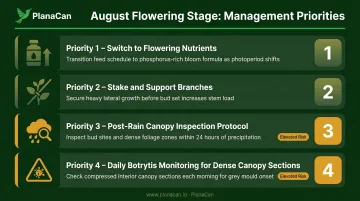
August management priorities:
- Switch to a flowering-focused nutrient profile
- Stake or support branches as bud weight increases
- Build a post-rain inspection protocol — after every afternoon thunderstorm, walk the canopy and look for moisture-trapped bud sites
- Check dense canopy sections daily for early Botrytis signs: gray fuzzy growth, browning calyxes, or soft spots in the cola structure
Ripening & Harvest Window (September–October)
September is the month that determines your final yield and quality. Trichomes are maturing, potency is peaking, and the first hard frost is approaching — often faster than forecasts suggest.
Using the Ed Rosenthal trichome maturity framework: milky/cloudy trichomes indicate peak THC levels, while amber trichomes signal THC converting to CBN. For Colorado growers, the practical guidance is this: don't wait for full amber if a frost event is on the forecast. A slightly early harvest at peak cloudy trichomes will always outperform a frost-damaged one.
Pre-harvest checklist:
- Begin flushing 1–2 weeks before your planned harvest date
- Schedule labor in advance — frost forecast acceleration requires quick response
- Harvest Indica-dominant and dense-canopy cultivars first; they're most vulnerable to mold
- Pull harvest in early morning to preserve terpene and cannabinoid integrity
Target harvest window: late September through mid-October for most Front Range operations. At elevation or in the San Luis Valley, push that to mid-September to be safe.
Post-Harvest Processing (October–November)
Once plants are down, drying must happen indoors in a controlled environment. A 2022 peer-reviewed postharvest cannabis review identifies commonly used drying conditions as 18–21°C and 50–55% relative humidity.
Once plants are down, drying must happen indoors in a controlled environment. A 2022 peer-reviewed postharvest cannabis review identifies commonly used drying conditions as 18–21°C and 50–55% relative humidity.
Colorado's dry air is an asset here — but it cuts both ways. Denver's average afternoon relative humidity in October runs around 36%, well below the target range. Plan to run humidifiers in your dry room to prevent over-drying, which degrades terpenes and reduces sellable weight.
After drying and cure are underway, turn to site cleanup:
- Remove root balls and all plant debris
- Sanitize grow areas to reduce overwintering pest and pathogen load
- Document strain performance, weather events, and timing observations before the season fades from memory
Signs It's Time to Move to the Next Growth Stage
Knowing when to move from one stage to the next is where most outdoor timing mistakes happen. These indicators take the guesswork out of each transition.
Safe to Transplant Outdoors
- Check overnight lows: consistently above 45°F for at least two weeks in the forecast
- Confirm soil temperature at 6-inch depth is in the mid-60s°F or higher
- Look for 3–4 established nodes with a hardened-off appearance from gradual outdoor acclimation
Flowering Has Begun
- Look for visible pistil formation at the nodes
- Pre-flowers appearing along the main stalk above the 4th node
- Watch for a noticeable slowdown in vertical growth as the plant shifts energy toward reproductive development
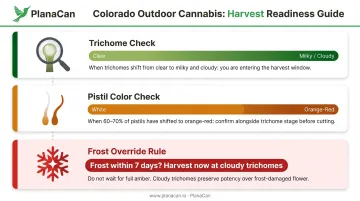
Ready to Harvest
- Trichomes transitioning from clear to milky/cloudy (peak potency window)
- Pistil color shifting from white to orange-red
- Frost override: if a frost event is within a week of your forecast, harvest at cloudy trichomes rather than waiting for amber development
Timing Mistakes Colorado Growers Should Avoid
Three timing errors cost Colorado outdoor growers more harvests than any other factor:
Transplanting on a national calendar instead of a Colorado one. Generic outdoor cannabis guides often target late April or early May transplant dates based on lower-elevation states. In Colorado, that timeline can put unprotected plants in the ground before the last frost, killing them outright or setting back vegetative growth enough to compress the entire season.
Chasing the perfect trichome window too deep into fall. Waiting for full amber development in October above 5,500 feet risks an unrecoverable loss. A frost-damaged harvest cannot be salvaged. A slightly early harvest can.
Skipping post-rain bud inspections during July–August. Colorado's afternoon thunderstorm pattern is predictable, but the resulting damage isn't if you're not monitoring. Botrytis doesn't announce itself until a bud is already compromised, and dense Indica cultivars with tight bud structure are especially vulnerable after moisture events. Build post-rain canopy walks into your standard operating procedure before flowering begins.
Best Practices for Keeping Your Colorado Outdoor Grow on Schedule
Build a site-specific calendar, not a national one. Anchor every key date — transplant, expected flowering trigger, harvest window — to your confirmed last spring and first fall freeze averages for your specific elevation. The USDA Plant Hardiness Zone Map and NOAA/NWS station data are the right starting points. Local CSU Extension vegetable planting guides serve as a useful proxy for cannabis timing: if warm-season transplants like tomatoes aren't going in the ground yet in your region, your cannabis plants shouldn't be either.
Log everything, every season. A grow journal or digital tracking system that records germination dates, transplant dates, first flower sightings, weather events, pest treatments, and harvest dates by strain and plot compounds in value over time. Each season's calendar should sharpen the next — the patterns you miss in year one become the adjustments that protect your harvest in year three.
Select genetics that match Colorado's season. Early-finishing photoperiod strains, autoflowering varieties for high-elevation or uncertain-timing sites, and mold-resistant cultivars for sites with afternoon thunderstorm exposure should form the core of a Colorado outdoor strain program. The right genetics can shave 2–4 weeks off the flowering window — which is the difference between a clean harvest and a race against the first frost.
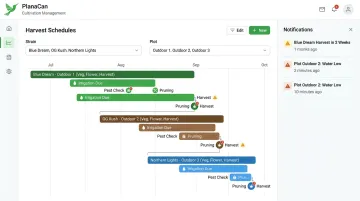
Use cultivation management software built for commercial operations. For outdoor grows managing multiple strains, plots, or staggered harvest windows, static spreadsheets break down fast. PlanaCan gives commercial outdoor operations the structure to manage all of it in one place:
- Interactive Gantt chart — bird's-eye view of every harvest schedule, filterable by strain, plot, phase, or team
- Automated daily notifications — push alerts to iOS and Android so your crew knows what's due without a manager briefing each person
- Reusable seasonal templates — encode your Colorado-specific calendar (transplant windows, flowering triggers, harvest targets) once, then deploy and refine each season
Frequently Asked Questions
What is a Colorado outdoor cannabis grow calendar?
It's a season-specific planting and harvest schedule built around Colorado's elevation, regional frost dates, and photoperiod flowering triggers. It maps when to germinate indoors, when to transplant safely, when to expect flowering, and when to harvest — all within the state's compressed outdoor growing window.
When should I plant cannabis outdoors in Colorado?
Outdoor transplanting is generally safe after mid-May on the Front Range and in early June at higher elevations, once overnight temperatures are consistently above 45°F. Indoor germination should begin in March–April to give plants a head start before outdoor conditions are ready.
Can you grow cannabis outdoors in Colorado?
Licensed commercial cultivators can obtain outdoor cultivation facility licenses through the Colorado MED. Colorado's home grow statute requires plants in an enclosed, locked space, so outdoor cultivation is restricted to licensed commercial operations. Verify your licensing status and current MED regulations before planting outside.
When does cannabis start flowering outdoors in Colorado?
Photoperiod cannabis transitions into flowering once day length begins shortening after the summer solstice on June 21. In Colorado, visible bud development typically appears in mid-to-late July, with the exact timing varying by strain genetics and elevation.
What strains grow best outdoors in Colorado?
The strongest fits for Colorado's outdoor season are:
- Early-finishing photoperiod strains for Front Range and mid-elevation sites
- Autoflowering varieties for high-elevation or short-season locations
- Mold-resistant genetics for sites prone to late-summer humidity spikes
Strain selection is effectively a timing decision — the right genetics can reduce flowering time by 2–4 weeks, cutting frost and mold exposure.
When should I harvest outdoor cannabis in Colorado?
Most Colorado outdoor harvests target late September through mid-October, with earlier targets for high-elevation sites. Use trichome color (milky/cloudy) as the primary readiness signal, and prioritize harvesting before the first frost over waiting for full amber development.