Introduction
Every input in your grow room — nutrients, genetics, lighting intensity — performs relative to your climate. Get temperature, humidity, CO2, and airflow right, and those inputs amplify each other. Get them wrong, and even the best genetics underperform.
Most commercial cultivators understand which parameters matter. The gap between knowing and executing consistently is where yields are won or lost.
Equipment sized for the wrong load, humidity targets that ignore VPD, CO2 running while exhaust fans pull enriched air out of the room — these are the mistakes that separate profitable operations from ones that struggle to hit yield targets cycle after cycle.
This guide covers:
- How to control each climate variable, step by step
- What infrastructure you need before you start
- The key parameters that drive yield outcomes
- The most common mistakes commercial growers make — and how to avoid them
Key Takeaways
- Temperature, humidity, CO2, VPD, ventilation, and lighting all interact — manage them as a system, not as separate targets
- Stage-specific climate recipes are non-negotiable — running flower-stage settings in veg suppresses growth and invites disease
- VPD is the most underused metric in commercial cultivation — chasing RH numbers without it leaves yield on the table
- Equipment sizing matters as much as equipment selection — undersized or oversized units both create instability
- Documented SOPs and team accountability turn climate targets into repeatable, auditable outcomes
How to Control Grow Room Climate Step by Step
Step 1: Set and Maintain Temperature Targets by Growth Stage
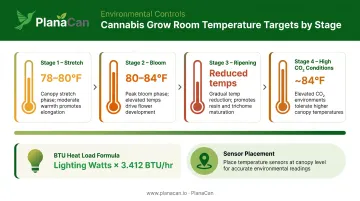
Temperature is not static across a grow cycle. According to Fluence's cannabis cultivation guidance, leaf temperature targets during stretch run 78–80°F, rising to 80–84°F during bloom, then pulling back as flowers ripen and tissue growth slows. Under high CO2 conditions, Fluence recommends air temperatures of approximately 84°F in the reproductive phase.
The physiological reason: temperature drives metabolic rate. As light intensity increases, plants need higher temperatures to maintain the balance between photosynthesis and transpiration. Push temperatures too high or let them drop too low, and stomatal function suffers — CO2 uptake stops and growth stalls.
Why your lights are your biggest heat source:
- HID fixtures convert most of their wattage to heat — calculate 3.412 BTU/hr per watt of installed lighting as your baseline HVAC heat load (per Electronic Theatre Controls)
- LED fixtures run cooler but still generate significant heat — don't skip this calculation when switching fixture types
- CO2 generators add additional BTU load (Hydrofarm's 4-burner natural gas unit outputs 11,068 BTU)
An undersized HVAC system will fail to hold temperature during peak lighting load — the exact period when precise temperature control matters most. Size your cooling against total wattage installed, not room square footage alone.
Measure temperature at canopy level, not from wall-mounted sensors. The Resource Innovation Institute recommends sensors placed in aspirated, light-shielded housings covering approximately 500 canopy square feet, with leaf temperature measured at multiple points to capture microclimates.
Step 2: Control Humidity Relative to Growth Stage
Humidity targets shift substantially across the grow cycle. Quest Climate's dehumidification guidance puts the verified targets at:
| Growth Stage | Target RH |
|---|---|
| Clone / Propagation | 65–70% |
| Vegetative | 60–70% |
| Flowering | 40–60% |
Anden tightens the flowering band further, recommending 40–50% RH during flower, noting that humidity above 60% risks plant damage. That risk isn't hypothetical — peer-reviewed research published in the Canadian Journal of Botany found that Botrytis cinerea rapidly destroys cannabis inflorescences under >70% RH at 17–24°C. Dense late-flower buds trap moisture and give the pathogen everything it needs.
Sizing your dehumidification:
Plants are the largest moisture source in the room — not the walls, not leaks. Quest puts baseline cannabis transpiration load at 0.5–2 pints per square foot of canopy per day. As canopy size grows through veg and into flower, the moisture load increases. Size dehumidifiers against plant count and water input, not room volume alone.
A common sizing method: multiply plant count by daily water input, then convert to pints (1 gallon = 8 pints). That number is your minimum removal capacity at peak transpiration. Temperature and humidity don't operate independently — VPD ties them together, which is covered in the Key Parameters section below.
Step 3: Manage CO2 Levels and Enrichment
Ambient CO2 sits at approximately 400 ppm. At high light intensities, that limits photosynthesis. CO2 enrichment — typically targeting 1,000–1,500 ppm — can increase yields by 10–25% when PPFD is sufficient to use it, according to Cannabis Business Times.
The threshold matters. Fluence's high-intensity lighting guidance states CO2 becomes productive once canopy PPFD reaches 800–850 μmol/m²/s. Below that, enrichment produces no meaningful benefit — you're spending money on CO2 the plants can't process.
Generator vs. compressed tank:
- CO2 generators burn natural gas or propane to produce CO2 — effective but they add significant heat to the room (11,068 BTU for a 4-burner unit). That heat must be factored into your HVAC load
- Compressed tank systems add no heat but cost more per pound ($0.70–$1.30/lb depending on cylinder size)
Controller logic that matters:
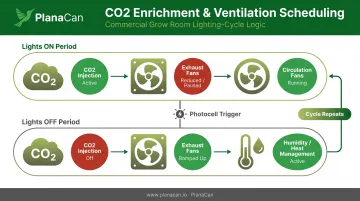
CO2 controllers with photocell sensors activate CO2 delivery only when lights are on — plants only photosynthesize CO2 during daylight periods. The critical programming point: exhaust ventilation and CO2 injection must run on mutually exclusive schedules. If exhaust fans pull air while CO2 is being injected, enriched air exits the room before plants absorb it. As a rule of thumb, target less than 0.5 air changes per hour during the injection window to hold enriched concentration levels.
Step 4: Optimize Ventilation and Airflow
Ventilation and circulation serve different functions — both are required.
Circulation fans (oscillating or clip-on) prevent microclimates, strengthen stems, and keep CO2 from depleting within the canopy. Fluence recommends a minimum inner-canopy air velocity of 0.2–0.4 m/s to prevent CO2 pooling at the canopy boundary layer.
Ventilation systems (intake/exhaust) exchange CO2-depleted, heat-laden, humidity-saturated air with fresh outside air. According to Cannabis Business Times' airflow mapping research, commercial cannabis facilities target 15–30 air changes per hour — roughly one full air exchange every 2–4 minutes — with air velocities of 0.35–1.0 m/s.
Fan speed controllers allow rooms to dial back ventilation without creating CO2 depletion during the CO2 injection period. When CO2 is being injected, reduce exhaust fan speed or pause ventilation on a timer. When CO2 injection ends, ramp ventilation back up to manage heat and humidity.
Step 5: Manage Lighting Schedules and Their Climate Impact
Lighting schedules are a climate variable, not just a plant development variable. Every time lights switch on, your heat load spikes, CO2 demand begins, and VPD shifts.
Standard photoperiod targets based on peer-reviewed cannabis research:
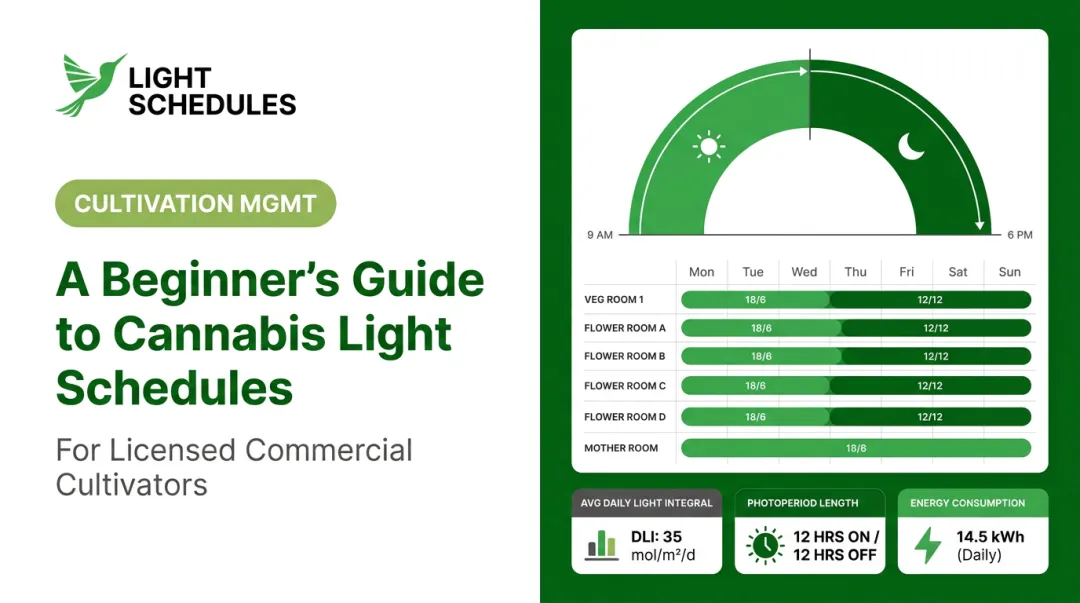
- Propagation/clones: 18L:6D
- Vegetative: 16+ hours of light
- Flower: 12L:12D (note: some genetics respond better to 14L:10D — confirm per cultivar)
In commercial multi-room facilities, staggered lighting schedules across rooms prevent peak electrical demand spikes and help balance HVAC load. Boulder County energy assessments found participating cannabis facilities averaged peak electrical demand of just over 2,000 kW, occurring at 9 a.m. — a direct result of rooms switching on simultaneously. Staggering start times distributes that load.
DLI and Dimming
Daily Light Integral (DLI) measures total PAR photons accumulated over a 24-hour period, expressed as mol/m²/d. Modern LED fixtures with dimming capability let you reduce wattage during high-ambient-temperature periods, cutting heat load while maintaining DLI targets by extending photoperiod slightly. That's a more precise approach than simply shutting lights down.
What You Need Before Controlling Your Grow Room Climate
Climate control is only possible when foundational infrastructure is in place. A poorly sealed room, undersized equipment, or a team with no clear protocols will undermine even the best sensor and controller setup.
Equipment and Sensor Requirements
Minimum equipment stack for a commercial operation:
- Canopy-level temperature and humidity sensors — placed in aspirated, light-shielded housings at canopy height (wall-mounted sensors read unrepresentative air)
- CO2 monitor with controller — with photocell for lights-on/off logic and exhaust interlock
- Fan speed controllers — for throttling ventilation without disrupting CO2 enrichment
- Properly sized dehumidifier — calculated against plant count and water input at peak canopy
- Humidifier — for propagation and early veg stages where RH needs to stay elevated
- HVAC system sized for peak heat load — calculated from lighting wattage, CO2 generator BTU, and occupancy
A multi-function environmental controller consolidates temperature, humidity, CO2, and fan control into one unit with coordinated logic. In a commercial setting, this matters because separate controllers don't communicate: a standalone CO2 controller can't interlock with a standalone fan controller.
Integrated units prevent the scheduling conflicts that waste CO2 and create humidity spikes.
Operational Systems and Team Readiness
Equipment alone doesn't produce consistent results. A properly sized HVAC system still fails if no one checks readings, responds to drift, or adjusts settings at stage transitions.
Commercial operations need:
- Documented climate recipes per stage, per room
- Daily climate-check tasks assigned and tracked
- Clear accountability when readings fall out of range
Platforms like PlanaCan help cultivation teams build these workflows into consistent, team-executable processes. Climate-check tasks can be scheduled as phase-day-driven assignments, with automatic notifications alerting cultivators when checks are due and supervisors when tasks go overdue.
Environmental readings logged during task execution — temperature, humidity, CO2, VPD — feed into a per-batch operations record that can be correlated with harvest outcomes over time. That traceability is what separates operations that learn from each cycle from those that repeat the same problems.
Key Parameters That Affect Grow Room Climate Control Results
Even growers with the right equipment get inconsistent results when they manage parameters in isolation. Temperature, humidity, CO2, and ventilation interact constantly.
Vapor Pressure Deficit (VPD)
VPD measures how much pulling force the air exerts on water at leaf stomata. High VPD pulls hard — plants transpire rapidly, nutrient uptake increases, but if VPD gets too high, stomata close and CO2 uptake stops. Low VPD means plants hold water, slow transpiration, and reduce nutrient flow.
Per Fluence's cannabis-specific VPD targets:
| Growth Stage | Target VPD |
|---|---|
| Propagation | 0.5–0.8 kPa |
| Vegetative | 0.8–1.0 kPa |
| Early Flower | 0.9–1.1 kPa |
| Late Flower | 1.1–1.3 kPa |
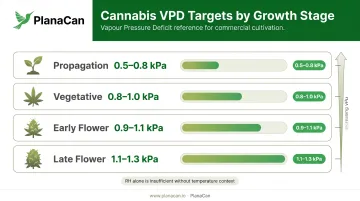
Fluence states directly that humidity alone is not a functional metric for environmental management. It should be used to reach target VPD for a given temperature. A grower can hit a technically correct RH number while VPD is outside the optimal range simply because temperature shifted.
That's why peer-reviewed research found that elevated canopy humidity outside optimal VPD thresholds delayed flowering and reduced both biomass accumulation and cannabinoid concentration.
Growth Stage Transitions
The riskiest period for climate errors is the first week after flower flip. Temperature needs to drop slightly to simulate seasonal change. Humidity must come down as bud sites begin to form — what the plant tolerated in cloning will trigger botrytis in week 4 of flower.
Climate recipes must change at every stage transition. Key shifts to make at flip:
- Drop temperature 2–4°F to simulate seasonal change
- Reduce RH below 55% as bud sites form
- Tighten VPD targets toward the Early Flower range immediately
Day/Night Temperature Differential
The differential between lights-on and lights-off temperatures matters independently of absolute temperature. Peer-reviewed research in Frontiers in Plant Science confirms that hermaphroditic flower formation can be triggered by temperature stress, including reduced temperatures. HVAC controllers with photocell functionality automatically shift temperature setpoints when lights go off, preventing large swings without manual intervention.
Room Sealing and Structure
CO2 enrichment is cost-effective only in a sealed room. Air infiltration through wall gaps or poor insulation allows CO2 to escape before plants absorb it. Humidity targets become nearly impossible to hold when uncontrolled passive air infiltration continuously introduces outside air. The City of Denver's Cannabis Environmental Best Management Practices guide specifically recommends sealing cultivation spaces as a foundational facility requirement.
Common Mistakes When Controlling Grow Room Climate
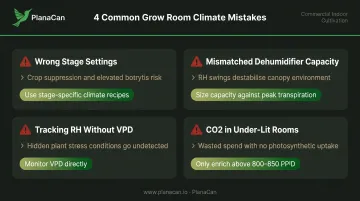
Wrong stage, wrong settings. Flower-stage temperature and humidity targets applied during veg suppress growth. Clone-stage humidity in a dense flower room creates botrytis conditions. Each growth phase has distinct climate requirements — using a single recipe across all stages is one of the fastest ways to compromise a crop.
Mismatched dehumidification capacity. Undersized units run continuously without reaching target RH. Oversized units short-cycle, producing swings instead of stability. The Dehumidifier Corporation of America notes that cycling HVAC causes temperature and RH to rise and fall quickly, negatively affecting crop growth. Size for peak transpiration load, not room volume.
Ignoring VPD and tracking only RH. An RH reading can look correct while VPD sits outside the optimal range because temperature shifted. Without monitoring VPD directly, the problem stays invisible until plants start showing stress symptoms.
Enriching CO2 in under-lit rooms. CO2 supplementation adds cost and operational complexity. Below roughly 800–850 PPFD, photosynthesis can't utilize the additional CO2, so enrichment delivers no measurable yield benefit in those conditions.
Troubleshooting Grow Room Climate Issues
Temperature Spikes During Lights-On Period
Likely cause: HVAC undersized relative to lighting heat load, or lights were added after original sizing.
What to check:
- Calculate total cooling capacity in BTU against installed lighting wattage (3.412 BTU/hr per watt) — if you've added fixtures since the HVAC was specified, recalculate
- Verify air handler intakes aren't blocked
- Add CO2 generator BTU output to your heat load calculation if running burner-based CO2
- Check inner-canopy air velocity — stagnant air pockets cause localized temperature spikes even when the room average reads correctly
Persistent High Humidity Despite Dehumidifiers Running
Likely cause: Canopy has grown beyond original dehumidifier sizing, or stagnant air pockets are giving sensors inaccurate readings.
What to adjust:
- Add circulation fans to eliminate dead zones where humid air pools
- Confirm humidity sensors are at canopy height, not high on walls where readings are lower
- Recalculate dehumidifier capacity against current plant count and actual water input — if the crop has grown since original sizing, you may need more capacity
CO2 Levels Dropping During Lights-On Despite Injection Running
Likely cause: Exhaust ventilation overlapping with CO2 injection, or unsealed gaps letting enriched air escape.
What to fix:
- Program CO2 injection and exhaust ventilation on mutually exclusive schedules — they should not run simultaneously
- Inspect and seal obvious infiltration points (door seals, electrical penetrations, HVAC duct connections)
- Calibrate the CO2 sensor — NDIR sensors have a lifespan of 5–15 years but can drift well before failure. If readings seem inconsistent, recalibrate against a known reference gas
Frequently Asked Questions
What is the ideal temperature range for a cannabis grow room?
According to Fluence, leaf temperature targets run 78–80°F during stretch and 80–84°F during bloom, with temperatures pulling back as flowers ripen. Measure at canopy level using aspirated sensors — wall-mounted readings at height consistently underrepresent actual canopy conditions.
What humidity levels should I maintain at each growth stage?
Clones and propagation: 65–70% RH. Vegetative: 60–70% RH. Flowering: 40–60% RH, with Anden recommending the tighter band of 40–50% during flower. Late-flower humidity reduction is critical — Botrytis cinerea becomes an active threat above 70% RH on dense developing buds.
What is VPD and why does it matter for grow room climate?
VPD (Vapor Pressure Deficit) measures the air's pulling force on water at leaf stomata. It governs transpiration rate and nutrient uptake. Managing to VPD targets — rather than temperature and humidity in isolation — catches conditions where a correct RH reading still represents poor VPD after a temperature shift.
How often should air be exchanged in a commercial grow room?
Commercial cannabis facilities target 15–30 air changes per hour, or roughly one full exchange every 2–4 minutes. Fan speed controllers allow you to throttle ventilation during CO2 enrichment periods so you're not exhausting enriched air before plants can use it.
Does CO2 enrichment always increase yield?
No. CO2 enrichment only benefits plants when canopy PPFD exceeds approximately 800–850 μmol/m²/s. Below that threshold, photosynthesis can't use the additional CO2, and the investment in enrichment produces no measurable yield return.
How do temperature swings between lights-on and lights-off affect plants?
Excessive differentials create stress that peer-reviewed research links to hermaphrodite flower formation. HVAC controllers with photocell functionality automatically shift temperature setpoints when lights go off, maintaining a controlled differential across every light cycle change.