Total startup costs range from under $300,000 for a small outdoor operation to well over $2.5 million for a commercial indoor facility — and that's before the first sale. Operators who budget only for visible costs like equipment and construction routinely run short on working capital before their first harvest.
This guide provides a practical cannabis cultivation startup expense template covering the five core cost categories, typical ranges by grow type, the key factors that drive costs up (or down), and the most common budgeting mistakes to avoid.
Key Takeaways
- Startup costs by grow method: outdoor $250K–$750K; greenhouse $500K–$1.5M; indoor commercial $1M–$2.5M+
- State licensing fees alone range from $2,500 to $100,000+ — research your state's fee schedule before building any budget
- MEP systems (HVAC, electrical, plumbing) are frequently the single largest line item and the most underestimated
- Pre-revenue operating costs (12–18 months before first sale) are the most commonly underfunded category
- Budget a 10–15% contingency reserve on total CapEx; construction delays and permitting complications are near-certainties
How Much Does It Cost to Start a Cannabis Cultivation Operation?
Cannabis cultivation startup costs don't follow a fixed price sheet. Grow method, facility size, state, and technology choices each move the number significantly — sometimes by 50–100% on a comparable canopy footprint.
Budgeting without understanding these variables leads to underfunding, wrong facility configurations, or exhausting capital before the first harvest.
Typical Cost Ranges by Grow Method
| Grow Method | Estimated Startup Range | Key Cost Drivers |
|---|---|---|
| Outdoor operation | $250,000–$750,000 | Land/lease, water infrastructure, security, basic processing |
| Greenhouse operation | $500,000–$1.5 million | Greenhouse structure, light dep, supplemental lighting, HVAC |
| Indoor commercial facility | $1 million–$2.5 million+ | Full MEP buildout, sealed rooms, LED, environmental controls |
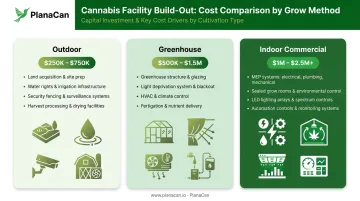
These ranges cover buildout, equipment, licensing, initial working capital, and contingency. They do not represent construction costs alone, and they exclude ongoing post-launch operating expenses.
Outdoor Operation ($250K–$750K)
Outdoor grows have the lowest entry cost but carry meaningful trade-offs: weather variability, one to two harvests per year, and limited pricing power compared to indoor flower.
Budget typically covers:
- Land or lease
- Water infrastructure and security fencing
- Basic drying and processing equipment
- Licensing and pre-harvest operating capital
Wholesale-focused operators in permissive markets tend to find the best fit here, as do cultivators testing a market before scaling into a more capital-intensive facility type.
Greenhouse Operation ($500K–$1.5M)
Greenhouse grows offer a middle path — near-indoor quality at a fraction of the energy cost. With light deprivation systems, operators can achieve four to five harvest cycles annually.
Budget typically covers:
- Greenhouse structure and light deprivation systems
- Supplemental lighting and HVAC
- Fertigation, licensing, and professional services
- Working capital through first harvest
Operators supplying both wholesale and vertically integrated retail are the natural fit — quality consistency without the full energy burden of a sealed indoor facility.
Indoor Commercial Facility ($1M–$2.5M+)
Indoor carries the highest entry cost, but it also gives operators the tightest quality control, year-round production capacity, and the pricing power that premium markets reward. NStar Finance cites $150–$350 per square foot of canopy for sealed rooms with HVAC, dehumidification, LED lighting, fertigation, and controls.
Budget typically covers:
- Full MEP buildout (HVAC, electrical, plumbing) and sealed grow rooms
- LED lighting and automated environmental controls
- Fertigation and post-harvest processing equipment
- Licensing, professional services, and 12–18 months of pre-revenue working capital
Operators targeting premium wholesale or vertically integrated retail are the best fit — provided they have the capital runway to reach profitability, which in this build category typically means 18 months or more before the operation turns cash-flow positive.
Key Factors That Drive Cannabis Cultivation Startup Costs
Two cultivation startups with identical canopy targets can produce startup budgets that differ by 50–100%. The variables below explain why — and why modeling against your specific situation matters more than relying on generic industry averages.
Grow Method and Facility Type
Indoor, greenhouse, and outdoor operations have distinct cost structures across buildout, equipment, energy, and labor. Indoor sealed facilities require full MEP engineering, utility upgrades, and climate control infrastructure that outdoor and greenhouse operations largely avoid. HVAC and electrical systems alone for an indoor facility can run $150,000–$1 million or more, depending on canopy size and complexity.
Canopy Size and Scale
More canopy generally means more capital — but not in a straight line. Larger operations achieve economies of scale on a per-pound basis over time, but MEP complexity increases disproportionately with size. A 10,000 sq ft indoor canopy requires more than twice the capital of two 5,000 sq ft facilities built separately, because mechanical systems don't scale linearly.
State and Local Regulatory Environment
Licensing fees vary dramatically by state:
- Michigan: $3,000 application fee; initial/renewal grower fees from $1,200 (Class A) to $24,000 (Class C)
- Oklahoma: Indoor/greenhouse tiered licensing from $2,500 to $50,000+
- Illinois: Craft grower application $5,000, awarded-license fee $40,000; medical cultivation center application $25,000, awarded-license fee $200,000
- New York: Indoor Tier 5 cultivation license can exceed $100,000
- California: Cultivation annual license fees range from $1,205 to $77,905+, with additional fees per 2,000 sq ft for large-scale operations
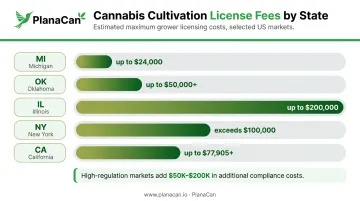
Beyond state fees, compliance infrastructure adds significant cost. High-regulation markets can add $50,000–$200,000 in security, environmental compliance, local permitting, and seed-to-sale tracking compared to less restrictive states. Two examples illustrate the range: New York requires commercial-grade security systems with 60-day video retention and 8-foot metal perimeter fencing for outdoor areas; California mandates enrollment in the Cannabis Cultivation Waste Discharge Regulatory Program.
Seed-to-sale tracking carries its own recurring costs. In Oklahoma and Alabama, Metrc charges $40/month per license, $0.45 per plant tag, and $0.25 per package tag.
Technology and Automation Decisions
Equipment choices — particularly lighting — shape both the startup budget and long-term operating costs. The HPS vs. LED decision is one of the most consequential a new cultivator makes. Key data points:
- LED fixtures cost more upfront, but peer-reviewed research in One Earth found energy reductions per unit of flower of 6–32% depending on cultivar
- Energy accounts for 20–40% of indoor cannabis annual operating costs (NEEP)
- Lighting represents nearly 40% of that energy load
The upfront premium for LEDs is real. So is the compounding operating cost difference — a gap that grows more significant as canopy scales.
Cannabis Cultivation Startup Budget Template: Core Cost Categories
A complete cultivation startup budget must go beyond equipment and construction to capture every phase of costs from pre-license to first sale. These five categories form the practical template framework.
1. Licensing, Permitting, and Compliance Fees
Both one-time and recurring. Every state has its own fee structure, and most operators underestimate the full cost of getting licensed.
Include in this line item:
- State application and annual renewal fees (research your specific state — ranges are wide)
- Local municipal permits and zoning variances
- Security system installation required by state rules
- Seed-to-sale tracking system setup (Metrc, BioTrack, Leaf Data)
- Cannabis attorney and licensing consultant fees
Professional licensing consultants and cannabis attorneys typically add $50,000–$100,000 on top of state fees for cultivation startups, based on available industry data. Budget this as a separate sub-line, not an afterthought.
2. Facility Acquisition and Buildout
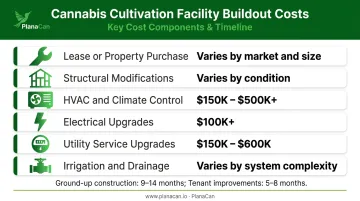
One-time, and typically the largest single category in the budget. MEP (mechanical, electrical, plumbing) is where most operators are surprised.
Key line items:
- Lease or purchase costs
- Structural modifications
- HVAC and climate control: $150,000–$500,000+
- Electrical upgrades and backup power: $100,000+
- Utility service upgrades for large rural draws: $150,000–$600,000, with 6–12 month utility coordination lead times
- Irrigation, drainage, and fire suppression
Get MEP engineering quotes from cannabis-experienced contractors before finalizing your budget. Generic commercial construction estimates routinely understate what a cannabis facility actually requires. Ground-up construction typically runs 9–14 months; tenant improvements run 5–8 months.
3. Cultivation Equipment and Technology
Capital expenditure covering everything from canopy to post-harvest — planned once, but priced carefully.
Key categories:
- Lighting systems (LED vs. HPS — cost and operating implications differ significantly)
- Growing systems: benching, racking, fertigation
- Environmental monitoring and controls
- Post-harvest: drying rooms, trimming equipment, packaging
For a 10,000 sq ft indoor canopy, lighting alone can run $150,000–$300,000 depending on fixture type and density. Budget it as its own sub-category and get current quotes — LED prices have dropped noticeably in recent years, making older estimates unreliable.
4. Professional Services
Operators frequently undercount professional services — both the one-time and early recurring costs.
Include in this line item:
- Cannabis attorney: entity formation, licensing, zoning
- Cannabis-specialized accountant: critical from day one for 280E cost allocation strategy
- Architectural and MEP engineering design
- Cannabis consultant or licensing specialist
Architectural and MEP design runs approximately $4–$8 per square foot for indoor grows. Combined with legal and consulting, professional services for a cultivation startup commonly reach $50,000–$100,000 before a permit is filed.
5. Pre-Revenue Operating Capital and Working Capital
This is the most consistently underfunded line item in cultivation startup budgets.
From lease signing to first paid wholesale delivery, 12 months at minimum typically pass — often longer. During that window, the facility burns cash on rent, utilities, payroll for core cultivation staff, insurance, and compliance without generating revenue.
Budget a minimum of 12–18 months of monthly operating expenses as working capital. For indoor facilities, monthly burn rates run $50,000–$150,000 depending on size and staffing. Labor is the largest ongoing cost — typically 30–50% of cultivation operating expenses.
Once harvests begin, controlling that labor spend becomes the primary financial lever. Garden First Cannabis used PlanaCan's cultivation management platform to achieve a 23% decrease in labor costs while managing 16 rotating harvests simultaneously. PlanaCan's SOP standardization, automated scheduling, and per-task labor tracking let cultivators confirm that actual labor consumption matches budgeted assumptions — and catch variances before they compound across harvest cycles.
6. Contingency Reserve
A 10–15% contingency reserve on total CapEx is not optional — it's planning for the near-certainties of construction delays, permitting complications, equipment lead times, and crop issues in initial cycles.
On a $1.5M project, that means $150,000–$225,000 set aside before ground breaks. Operators who skip this reserve often find themselves short on cash exactly when they need it most.
Indoor vs. Greenhouse vs. Outdoor: Comparing Cost Profiles
Your grow method choice sets the financial trajectory of the entire operation. Startup cost, ongoing cost structure, quality ceiling, pricing power, and risk profile all flow from this single decision.
| Outdoor | Greenhouse | Indoor | |
|---|---|---|---|
| Startup cost | $250K–$750K | $500K–$1.5M | $1M–$2.5M+ |
| Production cost/lb | ~$100/lb (2020 median) | ~$233/lb (2020 median) | ~$396/lb (2020 median) |
| Wholesale price range | $400–$600/lb (Q1 2024) | ~$789/lb (mid-2024) | ~$955/lb spot (Jan 2025) |
| Annual harvest cycles | 1–2 | 4–5 with light dep | 4–6+ |
| Quality ceiling | Lowest | Mid-high | Highest |
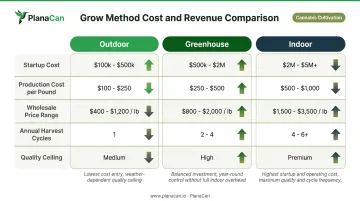
Production cost data sourced from Cannabis Business Times reporting on a cultivation cost study.
The key trade-offs:
- Outdoor: Lowest entry cost, but highest exposure to weather, market pricing variability, and limited harvest windows. Rarely competitive in premium product tiers.
- Greenhouse: The efficiency play. Lower energy costs than indoor, more harvest cycles than outdoor, competitive mid-tier wholesale positioning.
- Indoor: Maximum quality control, year-round production, and the strongest wholesale pricing power — but that margin only holds when your cultivation team delivers consistent grade, harvest after harvest.
None of these options are inherently "safe." Lowest startup cost does not equal lowest risk — an outdoor operation hitting market at $400/lb with $100/lb production costs can still fail if spot prices drop further or licensing complications push back the first harvest by a season.
Common Cannabis Cultivation Budgeting Mistakes to Avoid
Three patterns appear repeatedly in under-capitalized cultivation startups:
Focusing Only on Visible Costs
Equipment and construction are tangible and easy to quote. MEP engineering design, legal fees, state compliance infrastructure, and professional services are less visible — but add $100,000–$200,000 that doesn't appear in early estimates. Budget professional services as a standalone category from the start.
Exhausting Capital on Buildout Without a Working Capital Reserve
Physical buildout gets funded. Then the facility is complete, the team is hired, and there's nothing left to cover payroll and utilities for the 6–12 months before the first paid sale arrives. This is the most common failure mode in cultivation startups. Working capital must be a hard budget requirement — not a residual after everything else is funded.
Modeling Only Best-Case Yields and Prices
A realistic financial model must stress-test at 70–80% of projected yield and at wholesale prices 20–30% below current market rates. If the project doesn't pencil under those conditions, it isn't a fundable plan. Cannabis wholesale prices have dropped 40–60% in mature markets like Oregon and California — that range needs to be in your model before you commit capital.
How to Build a Realistic Cannabis Cultivation Startup Budget
Start with your grow method and canopy target, then build from the bottom up using the five template categories: licensing, facility/MEP, equipment, professional services, and working capital plus contingency.
Get actual quotes — not published averages. Construction costs vary by region, contractor availability, and current material costs. What was accurate in another state or two years ago may not reflect your project.
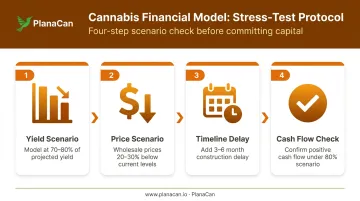
Stress-test your model before committing capital:
- Model at 70–80% of projected yield
- Run scenarios at wholesale prices 20–30% below current levels
- Add a 3–6 month delay to your construction timeline
- Confirm the operation reaches positive cash flow under the 80% scenario, not just the best case
Those stress tests are only as reliable as the cost assumptions feeding them. One line item startups consistently underestimate: cultivation operations software, which is separate from state-mandated seed-to-sale platforms (Metrc, BioTrack, Leaf Data) and covers scheduling, SOP management, and labor analytics.
Seed-to-sale platforms handle state regulatory reporting — that's their entire job. Cultivation operations platforms like PlanaCan handle daily workflow execution, perpetual harvest scheduling, team communication, and labor tracking.
Once a facility reaches 5,000+ square feet of canopy with a perpetual harvest model and five or more cultivators, managing that work through spreadsheets and group texts creates real cost overruns: missed tasks, inconsistent SOP execution, labor variance, and yield unpredictability.
PlanaCan's labor analytics let cultivation teams compare actual labor consumption against budgeted assumptions in real time and catch variances before they compound. If your budget assumes $X per pound in labor, you'll know within the first harvest cycle whether that number is real.
Frequently Asked Questions
How much does it cost to start a cannabis cultivation business?
Total startup costs range from $250,000–$750,000 for outdoor operations to $500,000–$1.5 million for greenhouse and $1 million–$2.5 million or more for commercial indoor facilities. Your grow method, state, and scale determine where you land in that range.
What are the biggest startup expenses for a cannabis grow operation?
The five major cost buckets are:
- Facility buildout and MEP systems
- Cultivation equipment
- Licensing and professional services
- Pre-revenue working capital
- Contingency reserves
MEP systems — HVAC, electrical, and plumbing — are typically the single largest line item and the most commonly underestimated.
How much working capital do I need before my first harvest?
Budget a minimum of 12–18 months of monthly operating expenses as working capital before the facility is operational. Indoor facilities typically burn $50,000–$150,000 per month covering rent, utilities, payroll, and compliance — all before the first paid sale.
How do state regulations affect cannabis cultivation startup costs?
Licensing fees range from $2,500 to over $100,000 depending on state and license tier. High-regulation markets like New York and California add $50,000–$200,000 in security infrastructure, environmental compliance, local permitting, and seed-to-sale tracking — costs that less restrictive states don't require.
What is the difference in startup costs between indoor and outdoor cannabis cultivation?
Outdoor operations can start at $250,000–$750,000 with low per-pound production costs but one to two harvests per year and limited pricing power. Indoor requires $1M–$2.5M+ but enables year-round production, premium quality, and substantially higher wholesale pricing — closer to $955/lb spot versus $400–$600/lb for outdoor flower.
What is a realistic timeline to profitability for a cannabis cultivation startup?
Ground-up construction runs 9–14 months; tenant improvements run 5–8 months. Factor in licensing timelines, harvest cycles, and the ramp to first paid sale. Most well-capitalized indoor operations reach cash-flow breakeven 12–24 months post-first-harvest, with full capital payback typically taking 2–5 years.