Introduction
Commercial cannabis cultivation is an expensive undertaking. Genetics, lighting, nutrients, labor, compliance — every dollar invested needs to translate into sellable product. Yet a significant portion of every plant never sells or gets processed. Understanding exactly how much of a cannabis plant is waste — and what separates true waste from recoverable byproduct — has real consequences for profitability.
"Waste" means different things depending on whether you're measuring fresh plant weight or dry weight, whether you have extraction capabilities, and what your state's disposal regulations actually require. Trim that one operator discards is feedstock another sells for $204 per pound.
This guide covers:
- The real biomass numbers behind a cannabis harvest
- Each waste stream broken down by commercial value
- What compliance requires before anything leaves your facility
- How growers can use tracking and standardized workflows to improve their flower-to-waste ratio over time
Key Takeaways
- Dried flower represents roughly 6–7% of total fresh plant weight — the rest is water, trim, leaves, and structural material
- Sugar leaves and trim contain trichomes and have real extraction value; fan leaves, stems, and roots do not
- Most regulated states require cannabis waste to be rendered "unrecognizable and unusable" before disposal, usually via a 50/50 mix with non-cannabis material
- Tracking flower yield, trim weight, and discarded biomass per harvest cycle helps identify inefficiencies that cut directly into margins
How Much of a Cannabis Plant Is Actually Waste? The Real Numbers
Most growers have a general sense that buds are a fraction of total plant weight — but the actual numbers are starker than many expect.
Fresh Weight vs. Dry Weight: Why the Distinction Matters
A peer-reviewed indoor cannabis study published in Frontiers in Plant Science provides useful benchmarks. In that study:
| Plant Component | Share of Total Fresh Plant Weight |
|---|---|
| Wet buds | 25.5% – 34.1% |
| Wet leaf trim | 27.6% – 38.1% |
| Final dried buds | 6.5% – 7.2% |
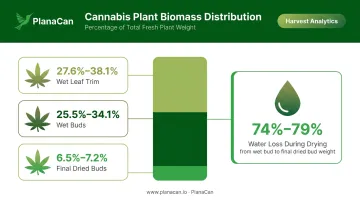
The dried flower figure looks extreme because water dominates fresh biomass. Buds lost roughly 74–79% of their wet weight during drying — a wet-to-dry ratio of 3.91:1 to 4.75:1. That water loss is not waste in the regulatory sense. It's physics.
The practical takeaway: calculate waste ratios on fresh weight and dry weight separately, or your numbers will be misleading when it comes to compliance reporting and yield forecasting.
How Grow Method and Training Affect the Ratio
Those reporting baselines don't hold constant across operations. Cultivation method meaningfully shifts how biomass is distributed across the plant:
- Indoor controlled environments consistently produce higher flower-to-biomass ratios due to optimized lighting, climate control, and precise feeding
- Outdoor grows generate more total biomass but a lower relative flower yield — more fan leaves, more structural mass, more to process or discard
- Plant training techniques (LST, ScrOG, topping, lollipopping) redirect the plant's energy toward productive flower sites
A 2024 controlled-environment cannabis study published in HortScience found that increasing shoot number from 4 to 16 raised the inflorescence-to-trim dry mass ratio from 2.1 to 4.2 — essentially doubling the proportion of saleable flower relative to trim through canopy architecture decisions alone. For a 10,000 sqft canopy, that ratio shift can represent tens of thousands of dollars in recoverable yield per harvest cycle.
Waste vs. Byproduct: A Useful Reframe
Not everything that isn't flower is waste. The more useful distinction:
- True waste — fan leaves, stems, stalks, roots, contaminated media — material with no practical commercial pathway
- Byproduct — sugar leaves, trim, extraction-grade biomass — material with measurable market value that gets destroyed when mixed into disposal streams prematurely
Keeping these streams separate — physically and in your records — is the first step toward capturing that value rather than hauling it to the dumpster.
Breaking Down Each Type of Cannabis Plant Waste
Fan Leaves
Fan leaves are the large, iconic leaves removed during defoliation and stripped at harvest. They have very low trichome density and minimal cannabinoid content. Their primary disposal routes:
- Composting (nutrient-rich organic input)
- Animal fodder in some agricultural contexts
- Raw cannabis juicing — niche but growing among wellness consumers
Fan leaves don't generate extraction revenue — cannabinoid content at this level doesn't justify processing costs at commercial scale.
Sugar Leaves and Trim
Sugar leaves emerge from within bud clusters and are coated with trichomes. This is where the economics shift. The Frontiers study found that leaves contained total cannabinoids of roughly 42–45 mg/g, compared to 120–126 mg/g in buds — about 35% of bud potency. Low relative to flower, but far from zero.
Colorado's official Average Market Rate (AMR) for Q2 2026 illustrates the commercial reality:
| Trim Category | AMR (Q2 2026) |
|---|---|
| Retail trim | $204/lb |
| Trim for extraction | $95/lb |
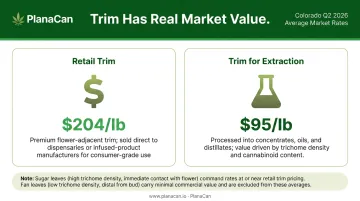
That's real revenue. Processors and extractors actively source trim. Mixing it into disposal streams before testing and segregating it is destroying an asset.
Stems, Stalks, and Roots
Stems and stalks are fibrous structural material with minimal cannabinoid content. Composting is the standard commercial route. Hemp fiber and hempcrete are sometimes cited as applications, but these are more relevant to industrial hemp operations than licensed THC cultivators.
Roots represent a meaningful share of fresh plant weight but have very limited commercial application in cannabis production. Composting is the practical disposal path.
Non-Plant Waste Streams
Once you've accounted for every part of the plant, there's still a second category of waste most operations underestimate. Plant material is only part of what commercial facilities must manage:
- Fertigation runoff — nutrient-laden wastewater with its own discharge requirements
- Used growing media — stone wool, coco coir, and soil each have different disposal considerations depending on contamination status
- Chemical and pesticide waste — triggers hazardous waste rules in most states
- Packaging waste — subject to consumer protection and environmental regulations at the retail level
Each stream has distinct compliance requirements. Treating them as interchangeable creates liability.
Turning Cannabis "Waste" Into Revenue
Trim and Sugar Leaves as Extraction Feedstock
The clearest revenue recovery opportunity. Trim can be processed into concentrates, hash, kief, tinctures, and infused products. State trim pricing varies significantly — Cannabis Benchmarks reported that from October 2023 to March 2024, California trim averaged 2.5% of flower price while Oregon trim averaged 10.2%. Market dynamics differ by state, so don't assume one state's pricing translates elsewhere.
Maintain clean segregation between sugar trim and fan leaves. Once they're mixed, you've reduced the value of both.
Fan Leaves and Stalks
Fan leaves have limited commercial value but aren't worthless:
- Compost them on-site or through a licensed organic waste facility
- Some farms use them as a feed supplement in agricultural operations where permitted
- Stalks compost well and can be chipped for mulch or bedding applications
The revenue potential here is low, but diverting this material from regulated cannabis disposal into composting reduces your disposal burden.
Wastewater Recirculation
Water recovery is an overlooked opportunity. The Resource Innovation Institute's water circularity research found that recirculating irrigation systems can reduce water consumption by 20–40%, and HVAC condensate recovery can supply a significant portion of facility water needs where treatment and compliance requirements are met.
The infrastructure investment is real, but at scale, the savings on water costs and wastewater disposal fees add up quickly.
Every input you recover is a cost you avoid — and that math compounds across trim, compost diversion, and water recirculation simultaneously.
Cannabis Waste Disposal: What Compliance Requires
The Core Standard: Unrecognizable and Unusable
Most regulated states require cannabis plant waste to be rendered "unrecognizable and unusable" before it leaves a licensed facility or enters ordinary waste channels. The most common method is grinding and mixing cannabis waste with non-cannabis material.
State-specific requirements vary:
| State | Mixing Requirement | Notes |
|---|---|---|
| Colorado | Minimum 50% non-cannabis waste by volume | All waste activity must be tracked under inventory controls |
| Michigan | 50% inert organic materials for compostable streams | Processing waste with solvents follows separate hazardous guidance |
| Illinois | 50% non-cannabis mixing standard for applicable waste | Disposal may go to permitted solid waste, composting, or anaerobic digestion |
| California | DCC defines cannabis waste and requires rendering unusable before disposal | CalRecycle guidance applies to failed-quality cannabis; verify current DCC rules |
| Oregon | OLCC publishes waste management guidance with special handling for pesticide failures | Verify current OLCC rules before implementing any SOP |
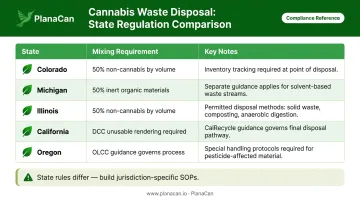
These state rules diverge enough that a single national SOP template will create compliance gaps. Build state-specific waste procedures for every jurisdiction you operate in — and review them whenever regulations update.
Hazardous vs. Non-Hazardous Cannabis Waste
How you classify cannabis waste determines both your disposal method and your cost exposure:
- Organic plant material without solvent contamination can typically be composted or sent to solid waste facilities after rendering unusable
- Material containing solvents, pesticide contamination, or other regulated substances requires licensed hazardous waste disposal — significantly more expensive and subject to tighter regulatory oversight
Documentation Is Non-Negotiable
State regulators cite documentation failures regularly in cannabis enforcement actions. Most states require:
- A written cannabis waste management plan
- Waste manifests for disposed material
- Track-and-trace system updates (METRC, BioTrack, or equivalent) for every disposal event
Disposing of waste correctly but failing to log it in your track-and-trace system creates the same compliance exposure as not disposing of it at all. The system record is the official record.
How Commercial Growers Can Reduce Cannabis Waste Over Time
Waste reduction is a cultivation discipline, not a one-time project. The operations that consistently improve their flower-to-waste ratio treat it the same way they treat any other KPI.
Start at the Planning Stage
The biggest gains happen before a plant goes into the ground:
- Strain selection — some cultivars produce denser, more efficient canopies with lower trim-to-flower ratios by genetics alone
- Training protocols — LST, ScrOG, topping, and lollipopping move biomass from low-value vegetative growth into productive flower sites
- Harvest timing — harvesting at peak cannabinoid expression minimizes the cost of waiting too long or cutting too early
- Feeding protocols — overfeeding drives excessive leaf growth without improving flower development
Track Waste Ratios as a KPI
Growers who record flower yield, trim weight, and discarded biomass per strain and per room gain something that instinct alone can't provide: a documented record of what's actually happening across cycles.
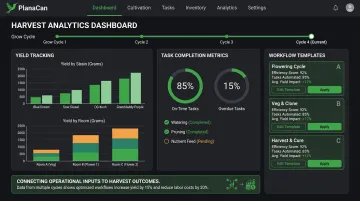
This is where a cultivation management platform like PlanaCan becomes useful. The harvest analytics dashboard tracks yield outcomes by strain, room, and batch — then correlates those outcomes with the operational inputs that preceded harvest: feeding records, task execution, environmental data.
Over multiple cycles, that data reveals which strains and rooms are driving higher waste rates and which protocols are producing the best flower-to-biomass outcomes.
PlanaCan also supports strain-specific and room-specific workflow templates for defoliation, lollipopping, and training protocols. Because these templates follow a "create once, deploy anywhere" model, every cultivator executes the same proven protocol regardless of which room they're working in — eliminating the inconsistency that leads to missed defoliations, overgrown canopies, and yield variance between rooms.
Garden First Cannabis, one of PlanaCan's clients, achieved a 36% increase in completed tasks and a 23% decrease in labor costs while managing 16 rotating harvests — outcomes that reflect what standardized, repeatable workflows deliver at scale.
Build It Into Your SOPs
Operations managing waste reduction informally — through tribal knowledge, whiteboard schedules, and memory — consistently underperform against those with documented, repeatable workflows. The gap isn't always visible in any single harvest, but it accumulates across cycles.
Waste reduction baked into SOPs compounds over time. Each cycle's data refines the next cycle's protocols — so the operation gets measurably leaner with every harvest, not just the ones where someone remembered to audit.
Frequently Asked Questions
What percentage of a cannabis plant is usable flower?
In peer-reviewed research, dried flower represented roughly 6.5–7.2% of total fresh plant weight. This figure reflects water loss during drying and varies by strain, training technique, and grow method. Commercial operators should calculate this ratio on their own harvest data rather than relying on a universal benchmark.
Can cannabis trim and fan leaves be used for anything?
Sugar leaves and trim contain trichomes — roughly 35% of bud cannabinoid concentration — and are actively sought by processors for concentrates, hash, and infused products. Fan leaves have minimal cannabinoid content and are best directed toward composting or permitted organic waste streams.
Does indoor vs. outdoor growing affect how much waste a cannabis plant produces?
Indoor cultivation under optimized lighting and climate control typically produces a higher flower-to-biomass ratio. Outdoor plants generate more total biomass, but flower represents a smaller proportion of that mass — often 10–20% less by ratio across a full harvest cycle.
What are the legal requirements for disposing of cannabis plant waste?
Most states require cannabis waste to be rendered "unrecognizable and unusable" before disposal, commonly through a 50/50 mix with non-cannabis material. Non-hazardous plant waste typically goes to composting or solid waste facilities, while material containing solvents or pesticide contamination triggers hazardous waste rules. Verify current regulations for every state you operate in, as requirements differ.
How can commercial growers reduce the amount of cannabis waste they produce?
Focus on plant training techniques that shift biomass toward flower, strain selection that suits your canopy architecture, and precise harvest timing. Above all, track flower yield, trim weight, and discarded biomass per harvest cycle — growers who measure waste ratios can identify which strains and practices drive inefficiency and adjust before the next cycle.
What happens to cannabis waste that is not disposed of properly?
Improper disposal can result in license suspension or revocation, regulatory fines, and potential criminal liability depending on the nature of the violation. Improperly disposed material that enters unauthorized channels also creates diversion risk, which regulators treat as a serious compliance failure.