The cost of that approach compounds quietly. When teams can't reference what actually happened in a previous cycle, they repeat the same mistakes: dropped tasks, inconsistent yields, and no clear picture of which protocols drove results. According to Whitney Economics' 2023 survey, only 24.4% of U.S. cannabis business licensees reported profitability — down from 42% the prior year. In that environment, operational inefficiency isn't just frustrating. It's a direct threat to survival.
This article covers what a harvest data management system is, why commercial cannabis operations specifically need one, which features matter most, and how the right platform turns raw harvest data into better crop decisions cycle after cycle.
Key Takeaways:
- A harvest data management system captures both operational and agronomic data to support evidence-based cultivation decisions
- Unmanaged harvest data causes repeated mistakes, team accountability gaps, and compliance exposure
- Customizable templates, visual scheduling, and automated notifications are the three non-negotiable features
- Cycle-over-cycle data comparison is how cultivators systematically improve yields — not trial and error
- PlanaCan's Garden First Cannabis case study documented a 36% increase in completed tasks and 23% decrease in labor costs
What Is a Harvest Data Management System?
A harvest data management system is a centralized platform that records, organizes, and surfaces data across every stage of the harvest cycle — from scheduling and task assignments to treatment protocols, strain performance, and yield outcomes. The goal is to give cultivators a factual basis for decisions rather than relying on memory or gut.
This is meaningfully different from general farm management or grain-tracking software. Those tools were built for commodity crops: field mapping, equipment logs, supply chain tracking. Cannabis cultivation doesn't fit that model.
A cannabis harvest spans weeks of carefully sequenced phases — pre-veg, veg, flower, dry, cure — with strain-specific care at each step, room-by-room scheduling, and team accountability requirements that don't exist in field agriculture. The data generated is equally distinct.
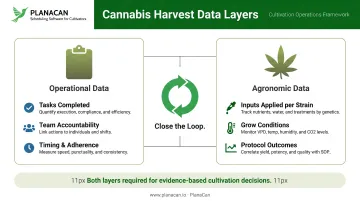
Two Layers of Harvest Data
Commercial cannabis harvest data falls into two categories:
- Operational data — what tasks were completed, by whom, when, and whether they were on time
- Agronomic data — what inputs were applied to which strains, under which conditions, and what results those inputs produced
Both layers matter. Operational data tells you whether your protocols were actually followed. Agronomic data tells you whether those protocols were the right ones. Without both, you can't close the loop between execution and outcome.
More Than Passive Record-Keeping
Modern harvest data systems go beyond logging what happened after the fact. They actively work within the daily routine, not around it:
- Structure workflows and enforce task sequencing
- Schedule recurring tasks across rooms and batches
- Push daily notifications so team members know exactly what needs doing
- Provide real-time visibility into what's in progress across the facility
Data collection becomes a live operational tool, not a separate report someone assembles at the end of each cycle.
The primary users are head growers, cultivation directors, multi-room facility managers, and MSO operations teams who need simultaneous visibility across one or more grows.
Why Commercial Cannabis Cultivators Need One
Cannabis cultivation runs in tight, overlapping cycles. Multiple strains at different growth stages in different rooms, with different treatment timelines, all running concurrently. At that complexity level, informal tracking doesn't fail occasionally — it fails predictably.
The Cost of Missing Data
When teams can't reference what happened in a previous cycle, they lose the ability to diagnose problems. Yields drop, and no one can say why. A strain underperforms for the third consecutive cycle, but there's no record of whether the protocol changed or the room conditions differed. Resources get allocated based on assumptions rather than evidence.
Research from controlled cannabis growing environments makes the stakes concrete: a 2024 Frontiers in Plant Science study found that enriched nutrition increased THC yield per square meter by up to 50.7% compared with control variants. The cultivation decisions being made — nutrient inputs, fertigation approach, harvest timing — directly affect what comes out the other end. Tracking those decisions is the only way to repeat what works.
Team Accountability
Knowing a task was scheduled isn't the same as knowing it was completed. Harvest data systems solve that gap by recording not just what was planned, but who did it and when. In commercial cannabis, a missed defoliation or delayed IPM application can affect the entire batch. Accountability at the task level is yield protection — and in a regulated facility, it's also audit protection.
Regulatory and Audit Exposure
State-licensed cannabis cultivators face specific documentation requirements. California requires cultivators to report planting, canopy movement, flowering, and harvesting within three calendar days, with records retained at least seven years. Michigan harvest batches must not exceed 50 pounds and must record strain, harvest date, and product type. Missouri requires daily entries including harvests, disposals, and transfers, with records kept five years.
A harvest data management system generates the operational records that support compliance documentation during inspections — not as a mandate, but as a practical byproduct of structured workflow management.
The Profitability Connection
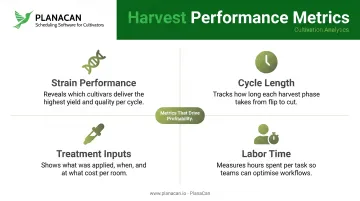
When cultivators can compare performance across multiple harvests, they gain the information needed to reduce waste and allocate resources more accurately. The metrics that matter most:
When cultivators can compare performance across multiple harvests, they gain the information needed to reduce waste and allocate resources more accurately. The metrics that drive those decisions:
- Strain performance — which genetics consistently deliver on yield and potency
- Cycle length — where time is being lost between flip and harvest
- Treatment inputs — what protocols correlate with better outcomes
- Labor time — which tasks are taking longer than planned and why
Operations that track this data improve cycle over cycle. Those that don't are left guessing.
Key Features to Look For in a Harvest Data Management System
Not all platforms are built for cannabis. Here are the features that actually matter for commercial cultivation operations.
Customizable Workflow Templates
Each cannabis strain may require a different care protocol across different phases. A system that forces one-size-fits-all scheduling will always produce gaps — a sativa requiring specific defoliation timing needs a different template than an indica on a different feeding schedule.
Templates should be:
- Strain-specific and treatment-specific — built once per workflow, not rebuilt each cycle
- Reusable across harvests — deploy to a new batch with a few clicks
- Refinable per cycle — updated based on what the previous harvest data showed
PlanaCan's template system follows a "create once, deploy anywhere, refine with each harvest" model. Templates can include task descriptions, data collection prompts (pH, EC, photo evidence), SOP documentation, and team assignments — so growers arrive at each task with full context, not just a checkbox.
Harvest Scheduling and Calendar Integration
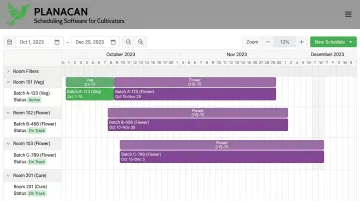
Visual scheduling tools — particularly interactive Gantt charts — let cultivation teams see every active harvest simultaneously. This matters when you're running four, six, or eight flower rooms on staggered cycles. A bird's-eye calendar view makes resource planning, room conflict prevention, and phase-day awareness manageable in ways that a spreadsheet cannot replicate.
PlanaCan's Gantt chart displays every active harvest schedule across the facility, filterable by room, phase, team, user, or batch.
Automated Team Notifications
Tasks get missed when communication depends on texts, whiteboard walk-throughs, or verbal check-ins. Automatic daily alerts remove that single point of failure. Push notifications via iOS and Android apps, plus email, keep cultivators informed before they walk into the grow.
Mobile Accessibility
Growers spend their days on the floor, not at desks. A platform without iOS and Android apps creates friction — and friction kills adoption. Mobile access should support task completion logging, data collection (pH, EC, notes, photos), schedule viewing, and real-time sync back to the manager dashboard.
Multi-Harvest and Multi-Room Visibility
Operations managing more than one active harvest need a consolidated view across all concurrent cycles. Without it, a cultivation director managing multiple rooms is still operating at single-grower scale even with a full team. Per-room phase tracking, cross-room scheduling visualization, and MSO-level consolidated dashboards are what enable genuine scale.
How to Use Harvest Data to Optimize Future Crop Decisions
Collecting data during a harvest cycle is only useful if it changes what you do in the next one. The mechanism for that is simple but rarely formalized: close the loop.
The Close-the-Loop Principle
At the end of each cycle, compare planned versus actual outcomes:
- Were tasks completed on time?
- Were treatments applied as scheduled?
- What did the yield look like per strain, per room?
That comparison is what makes the next cycle's template more accurate than the last one's. Without it, you're starting from scratch every time.
Strain Performance Insights
Data accumulated across multiple cycles reveals patterns that aren't visible in any single harvest. Which strains consistently outperform in specific rooms? Which protocols correlate with higher yield density? Which canopy densities work best per variety?
A 2026 Horticulturae study found area-based yields of 1,091 g/m² at 18 plants/m² with a 10-day vegetative regime versus 1,009 g/m² at 10 plants/m² with a 28-day regime — with THC concentrations holding steady regardless of density. Decisions like planting density and vegetative duration have measurable yield consequences. Tracking them across cycles is how cultivators move from guessing to knowing.
Resource and Labor Optimization
Labor is typically 30–50% of cultivation operating expenses. Without per-task labor visibility, it's impossible to identify which strains or phases consume disproportionate hours relative to their yield contribution.
Tracking labor time per harvest, task completion rates, and input usage across cycles lets cultivation managers surface specific inefficiencies, such as:
- A treatment protocol taking twice as long as scheduled
- A room that consistently logs more hours per cycle than comparable spaces
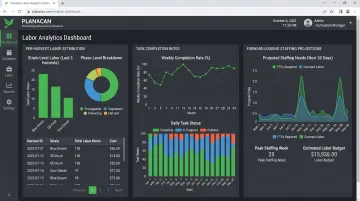
That visibility makes it possible to recalibrate staffing and scheduling before the next run starts. PlanaCan's labor analytics dashboard provides forward-looking labor projections based on historical phase-day data, so staffing decisions are made proactively rather than reactively.
Common Problems When Harvest Data Goes Unmanaged
Cycle Amnesia
When no structured record exists from the previous harvest, grow teams repeat the same mistakes. The same strain gets the same underperforming treatment. The same room scheduling conflict recurs. The same tasks get dropped because they weren't formally tracked. Without a system that surfaces what happened last time, even experienced growers have no way to course-correct.
Communication Breakdown
Harvest data stored on a whiteboard or in someone's head doesn't survive a sick day or a shift change. Critical operational knowledge — where a harvest stands, what still needs doing, who owns each task — disappears with the person who held it. Without a system that maintains that information independently of any individual, the whole team is exposed.
The Scaling Wall
A single-room operation might survive informal tracking. Add a second room, a second strain, or a second facility, and the complexity doesn't double — it multiplies. Concurrent harvests on different phase days, different treatment schedules, different team assignments: at that point, unmanaged harvest data becomes a direct constraint on growth.
MJBizDaily reported that active U.S. cannabis cultivation permits dropped 24% since 2023. In a tightening market, the cultivations that outlast consolidation are the ones with repeatable systems — not the ones relying on individual memory and manual coordination.
How PlanaCan Helps Cultivators Manage Harvest Data
PlanaCan is a cultivation management platform built specifically for commercial cannabis operations — designed so that harvest data isn't just stored, but actively structured into reusable templates, visual schedules, and automated team workflows.
Key capabilities relevant to harvest data management:
- Build custom templates for every strain and treatment step, version-controlled with timestamps so SOPs improve with each cycle
- View every active harvest schedule in one interactive Gantt chart, filterable by room, phase, team, user, or batch
- Push and email notifications go out automatically each day, keeping cultivators informed of assignments without manual follow-up
- Track full lifecycle from pre-veg through cure, with phase-day-specific task sets and independent room-level tracking
- Monitor labor attribution by strain and phase, compare yields across cycles, and project staffing needs from a single analytics dashboard
- Log task completions, collect data, and sync in real time from anywhere in the facility via iOS and Android apps
- Consolidate harvest visibility and propagate templates across multiple licensed sites with MSO-level multi-facility views
Those results are backed by a real client example: Garden First Cannabis, which manages 16 rotating harvests simultaneously using PlanaCan. Their outcomes: a 36% increase in completed tasks and a 23% decrease in labor costs. As co-founder Andreas Hero put it: "Simple to use, and effective. Our team knows what they need to do, and when to do it."
PlanaCan offers a free trial based on how long it takes your team to feel comfortable — not a countdown clock. No long-term contract is required, and the iOS and Android apps are included. The trial is designed to run alongside existing workflows, so you can evaluate fit without disrupting active cycles.
Frequently Asked Questions
What is a harvest data management system used for?
It's used to record, organize, and act on data generated during crop cycles — including task schedules, treatment protocols, strain performance, and team accountability. Cultivators get a factual record they can reference each cycle instead of starting from scratch.
Is a harvest data management system free to use?
Most dedicated platforms operate on a subscription or licensing model. Many, including PlanaCan, offer free trials so teams can evaluate fit before committing. The cost is typically offset by improvements in labor efficiency and yield consistency across cycles.
Can a harvest data management system track PTO?
Harvest data management systems focus on cultivation workflows and crop outcomes rather than HR functions like PTO. Workforce scheduling integrations vary by platform. Operations with complex HR requirements may need a separate workforce management tool alongside their cultivation system.
What data should be tracked in a cannabis harvest management system?
Core data types to track include:
- Harvest schedules and room or zone assignments
- Strain-specific treatment protocols
- Task completion by team member
- Input records (nutrients, IPM applications)
- Yield outcomes per cycle
Most states also require batch-level records covering strain, harvest date, and weight for regulatory compliance.
How does a harvest data management system improve crop yields?
Standardizing workflows, preventing missed tasks, and comparing results cycle-over-cycle lets cultivators refine protocols systematically rather than relying on trial and error. Each harvest builds a more accurate template for the next.
How is cannabis harvest data management different from general farm management software?
General farm management tools are built for commodity crops and focus on field mapping, equipment, and supply chains. Cannabis-specific platforms are designed around multi-week indoor grow cycles, strain-level protocols, room scheduling, phase-day task sequencing, and team accountability — none of which map cleanly onto agricultural software built for row crops or orchards.