Introduction
Running three rooms with two strains and a six-person team? A notebook stops working around the second harvest. By the third, you're guessing why Room B underperformed — and the answer is sitting in data that was never recorded.
Commercial cannabis cultivation fails at the record-keeping layer more often than it fails at the growing layer. Multiple rooms, concurrent harvests, and rotating team members demand consistency that informal notes can't provide.
When logs are inconsistent, the consequences are operational: missed tasks, yield variability, and decisions made on memory instead of data.
This guide addresses what separates a commercial grow log template from a personal diary. A commercial template is a standardized operational tool: it drives team accountability, enables data-driven decisions, and creates a repeatable blueprint for every harvest.
Here's what we'll cover:
- Why grow logs matter at commercial scale
- What data to track across rooms and cycles
- How to build a standardized template
- How often your team should be logging
- The mistakes that quietly cost cultivators yield cycle after cycle
Key Takeaways
- A standardized template creates consistency across rooms, strains, and team members — enabling reproducible yields across every cycle
- Track five core data categories every cycle: environment, nutrients/watering, plant health, training/treatments, and harvest outcomes
- Log environmental data daily, capture every key growth milestone, and complete a full post-harvest review after each batch
- Commercial operations require structured fields, batch IDs, and assigned responsibilities — not informal notes
- The operations that improve fastest treat their grow logs as active feedback tools — not static records
Why a Cannabis Grow Log Template Matters for Commercial Operations
At single-room scale, a skilled cultivator can hold most operational context in their head. At commercial scale — multiple rooms, concurrent harvests, rotating team members — that stops working.
Memory and informal notes create inconsistency that compounds across every harvest cycle. A standardized grow log becomes the single source of truth that ties every cultivation decision to a documented outcome.
The Yield Reproducibility Problem
When a harvest performs well, the goal is to reproduce it. Without records, that high-performing run was a lucky accident — not a repeatable process. When cultivators can trace the exact conditions, nutrient inputs, and intervention points of a strong harvest, those parameters become the benchmark for every future run.
A 2023 peer-reviewed cannabis deficiency trial found that single-element deficiencies caused substantial yield losses before symptoms were even visible:
- N deficiency: 72% reduction in floral yield
- P deficiency: 63% reduction
- K deficiency: 52% reduction
- Ca deficiency: 44% reduction
- Mg and S deficiencies: 33–34% reduction
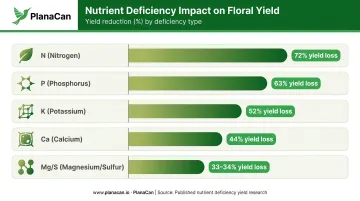
Visible symptoms didn't appear until weeks 3–4 after deficient conditions began. Timestamped feed and environmental records from those earlier weeks are what make root-cause diagnosis possible — without them, it's guesswork.
Compliance and Regulatory Context
Commercial cannabis operations across all 13 major US markets reviewed — including CA, CO, MI, NY, NJ, OH, MA, and IL — carry official cultivation-facing record, inventory, or seed-to-sale requirements. California requires records retained for at least 7 years; Ohio mandates 5 years under OAC Rule 3796:2-2-08.
A structured grow log supports compliance directly. Platforms like PlanaCan operate as a cultivation operations layer that complements METRC, BioTrack, and Leaf Data Systems — capturing operational documentation (SOPs, task records, environmental data) while state systems handle plant-tag-level inventory tracking. The two work in parallel, not in competition.
Team Accountability
That same documentation infrastructure that supports compliance also drives internal accountability. When tasks and observations are assigned to specific cultivators with timestamps, grow logs make it immediately visible which steps were completed, which were missed, and who handled what. The "I thought someone else did it" gap closes.
Garden First Cannabis, using PlanaCan's structured approach, achieved a 36% increase in completed tasks while managing 16 rotating harvests simultaneously — a direct result of making task execution visible and accountable across the team.
What to Track in a Cannabis Grow Log Template
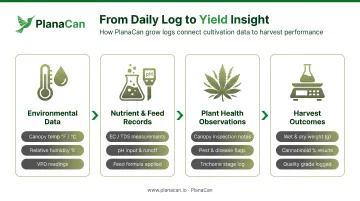
The value of a grow log is proportional to what gets recorded. Commercial operations need broader, more structured data categories than a single-plant hobbyist. Five core categories cover everything that drives yield outcomes.
Environment and Climate Data
Daily environmental readings form the baseline record that everything else gets compared against. Every commercial grow log should capture:
- Temperature — day and night ranges, not just a single daily reading
- Relative humidity — day/night highs and lows
- VPD (vapor pressure deficit) — stage-specific targets matter here; Cannabis Science and Technology cites commonly used cannabis VPD targets of 0.8–1.1 kPa in vegetative growth and 1.0–1.5 kPa in flowering
- CO2 levels — where supplementation is used; ambient air sits around 400 ppm, with significant yield benefits reported above 700–800 ppm in controlled environments
- HVAC or environmental equipment changes — any setpoint adjustments made that day
Recording high/low ranges — not just averages — is essential for catching dangerous swings. Cannabis Business Times warns that humidity conditions favorable for powdery mildew can develop within a single 24-hour period. A daily average reading won't catch that overnight spike.
Nutrient and Watering Records
Pair every feed event with the following data points:
- Input pH and input EC (mS/cm or PPM)
- Runoff pH and runoff EC
- Feed volume per plant or zone
- Watering frequency and any dry-back targets
- Nutrient product changes and rate adjustments
Tracking both input EC and runoff EC reveals whether the plant is consuming nutrients or accumulating them in the root zone. Rising substrate EC over time is a clear signal that fertilizer is accumulating beyond plant demand — often detectable in the log weeks before visible symptoms appear in the canopy.
Organic and synthetic programs require different tracking priorities. Synthetic programs demand tighter EC monitoring given the direct salt accumulation risk. Organic programs require closer attention to timing and input sourcing, where microbial activity and organic matter breakdown introduce more variability.
Plant Growth, Health, and Harvest Observations
Weekly during veg, biweekly during flower, log:
- Canopy height and internodal spacing
- Training techniques applied (topping, LST, defoliation) with date and room
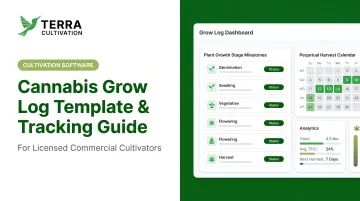
- Significant growth milestones: flip to flower, first pistil formation, trichome color progression
Stress events require their own entries — log these immediately when observed, separate from the routine weekly record:
Stress event log entries:
- Symptom description and which room/batch it appeared in
- Suspected cause
- Corrective action taken and date
Because cannabis symptoms can appear 2–3 weeks after the underlying problem began, the timestamp on the observation and the timestamp on the suspected root cause are both critical for accurate diagnosis.
At harvest and post-harvest, capture:
- Wet weight by room or batch
- Dry weight and drying conditions (temperature, RH, days to target moisture)
- Final moisture content — commercial cured whole-bud cannabis typically targets 10–15% water content
- Cure timeline and quality observations
- Lab test data where available
These harvest outcome records are what the entire grow log builds toward. Cross-referencing final yield against the environmental and nutrient conditions from weeks 3–6 of flower reveals which variables actually moved the needle — and which adjustments to carry forward into the next cycle.
How to Structure a Standardized Grow Log Template for Your Team
A commercial grow log template is a standardized operational tool — not just a record of what happened. It removes ambiguity, makes data searchable, and enables meaningful comparison across batches and rooms.
Essential Header Fields
Every grow log entry — daily environmental check, feeding event, training observation, or pest scouting record — should include these identifiers:
| Field | Purpose |
|---|---|
| Batch or Harvest ID | Links the entry to a specific run |
| Room or Zone Number | Enables room-level comparison |
| Strain Name | Required for strain-specific benchmarking |
| Cultivation Phase | Germination / Veg / Early Flower / Late Flower / Flush / Harvest |
| Calendar Date + Week Number | Locates the entry within the cycle |
| Cultivator Name | Assigns responsibility to a specific team member |
Without these identifiers, data from different rooms and strains cannot be meaningfully compared. An observation logged without a batch ID and room number is useless for post-harvest analysis.
Digital vs. Paper at Commercial Scale
Paper and personal spreadsheets work for a single-room, single-grower operation. They break down when 5–20 team members need to log consistently across multiple rooms. The failure modes are predictable: version conflicts, missing entries, illegible handwriting, and data gaps that compromise post-harvest analysis.
Digital tracking solves for all of these, but the platform matters. When evaluating a digital solution for commercial use, look for:
- Standardized fields that every team member fills in the same way
- Multi-user access with role-based permissions
- Multi-room visibility from a single dashboard
- Notification systems that prompt daily logging without requiring a manager to chase entries
- Audit-defensible records with timestamps and user attribution
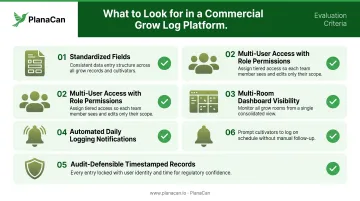
PlanaCan's custom template builder lets commercial cultivation teams build a standardized grow log template once, capturing every data field relevant to a specific strain or treatment protocol, then deploy it across every room and harvest with automatic daily notifications.
Rather than reconstructing yesterday's data from memory, cultivators log at the point of work through iOS and Android apps, building a per-batch operations record in real time.
How Often Should Your Grow Log Be Updated?
A grow log completed from memory two days later is not a grow log — it's a reconstruction. The fields that suffer most are the ones that matter most: feed volumes, observation timestamps, and symptom onset dates.
Daily mandatory entries:
- Environmental readings (temperature, humidity, VPD)
- Any watering or feeding that occurred
- Visible plant health observations
Same-day logging is the single most important habit for log accuracy. If it didn't get logged today, that entry is already a guess.
Milestone-based entries (log as they occur):
- Training events — topping, defoliation, canopy adjustments
- Pest or disease detection and treatment application
- Light schedule changes
- Flip to flower
- Nutrient program transitions
Each milestone entry should specify the room, batch, phase day, and cultivator — not just "defoliated Room 2."
Post-harvest review (mandatory close-out for every batch):
Most commercial teams skip this step — which is exactly why the same problems show up run after run. A post-harvest review entry should include:
- Final yield by room and batch
- Key environmental averages for the cycle (temperature, humidity, VPD ranges)
- Any stress or deficiency events and how long they took to resolve
- Drying and cure outcomes (conditions, timeline, final moisture)
- At least 2–3 specific SOP changes to implement on the next run
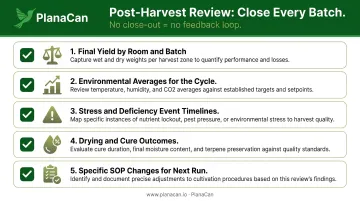
That last bullet is what separates a documentation habit from a continuous improvement system. No close-out means no feedback loop.
Common Grow Log Mistakes Commercial Cultivators Make
No Standardized Format Across the Team
When each cultivator logs differently — or doesn't log at all — records become incomparable. One grower tracks EC in mS/cm, another in PPM, a third leaves it blank. A head grower records feed volumes by zone; a fill-in shift records them by room. The data exists, but it can't be used to improve anything.
Fixed fields, consistent units, and required entries by phase remove the variability that makes batch comparison impossible. Without that structure, you can't compare one cycle to the next — or one room to another.
Delayed Logging
Entries completed 24–48 hours after the fact rely on memory. The fields most vulnerable to memory-based inaccuracy are exactly the ones that matter most for post-harvest analysis:
- Exact feed volumes and EC readings
- Observation timestamps (when did the symptom first appear?)
- Symptom onset dates relative to input changes
A supervisor alert system — like PlanaCan's automated overdue task notifications — shows managers which rooms have incomplete daily logs before the window closes. That's the difference between catching a gap same-day and chasing down recall errors a week later.
Collecting Data Without Reviewing It
This is the most common strategic failure. Teams log diligently through a cycle, then move directly into the next run without ever conducting a structured post-harvest analysis. The same environmental swings, the same nutrient timing errors, the same pest pressure in the same room — cycle after cycle.
A productive post-harvest review compares:
- Planned vs. actual environmental conditions by week
- Nutrient input records against plant consumption signals
- Stress and deficiency event timelines against when corrections were made
- Final yield against all of the above
That comparison produces specific, actionable SOP changes — not vague commitments to fix unidentified problems. PlanaCan's harvest analytics dashboard lets cultivation directors run this comparison across batches, rooms, strains, and cycles. Documented data becomes the basis for concrete protocol updates, not guesswork going into the next run.
Conclusion
At commercial scale, a cannabis grow log template connects every daily cultivation decision to measurable outcomes. It's the difference between knowing why a harvest succeeded and guessing.
The template is the starting point. Real value comes from reviewing what the data reveals, updating SOPs accordingly, and carrying those improvements into the next cycle. That process only works if logging is consistent and review is structured — which is where the system behind the log matters.
PlanaCan turns grow log data into action: custom strain and treatment templates, Gantt-chart scheduling, automated team notifications, and harvest analytics that make each cycle more informed than the last.
Frequently Asked Questions
What should be included in a cannabis grow log template?
A complete template covers five core categories: environment/climate data, nutrient and watering records, plant growth and health observations, training and treatment events, and harvest outcome data. Every entry should include header fields — batch ID, room number, strain name, cultivation phase, date and week number, and the cultivator's name — to make records comparable across batches.
How often should a commercial cultivation team update their grow log?
Environmental and feeding data should be logged the same day — not reconstructed from memory the next morning. Milestone events (training, pest treatment, stage transitions) should be recorded as they occur, with room, batch, and phase noted. Close every batch with a post-harvest review entry before the next cycle begins.
What is the difference between a grow log and a grow journal?
A grow journal is a personal, informal record used by individual home growers. A grow log template is a standardized document built for commercial team use — with fixed fields, batch identifiers, and user attribution that makes records comparable across cycles and defensible during audits.
How do grow logs support cannabis compliance and regulatory record-keeping?
Most US states require commercial cannabis operations to maintain cultivation records for audit readiness and seed-to-sale tracking. A structured grow log with timestamped entries, batch IDs, and input records makes compliance reporting faster and more defensible during inspections — and complements METRC or BioTrack reporting rather than duplicating it.
Can a digital grow log platform replace paper tracking in a commercial operation?
Yes, for operations above single-room scale, digital platforms are better suited. They enforce standardized fields, give multiple team members simultaneous mobile access, and eliminate the gaps caused by lost notebooks, illegible handwriting, or conflicting spreadsheet versions — problems paper simply can't solve at scale.
How do you use grow log data to improve yields from one harvest to the next?
After each batch, compare environmental averages, nutrient inputs, and stress event timelines against final yield. Identify what differed between high- and low-performing rooms, then translate those findings into defined SOP adjustments — specific changes to feed schedules, environmental targets, or training timing with measurable benchmarks, not general intentions.