Introduction
Licensed cannabis cultivation is more competitive than it's ever been — and most operations that fail don't fail because of bad genetics or wrong nutrients. They fail because of broken workflows, inconsistent execution, and teams without clear direction.
The operational problems show up the same way across facilities: missed tasks, inconsistent harvests, scheduling chaos, and head growers carrying everything in their heads. According to a 2023 Cannabis Business Times survey of 127 qualified cultivation owners and employees, only 39% reported profitable operations — with 53% still losing money.
This guide is built for commercial cultivators — head growers, cultivation directors, and facility owners — who want to move past reactive growing. It covers the core operational pillars of a structured grow: scheduling, SOPs, team accountability, harvest planning, and the tools that tie it together.
Key Takeaways
- Commercial cannabis success depends on operational discipline, not just horticultural skill
- Repeatable SOPs and team accountability matter more than any single technique
- Perpetual harvest scheduling requires purpose-built tools; spreadsheets fail once you're managing two or more flower rooms
- Tracking yield per square foot, completed tasks, and labor costs per cycle reveals where efficiency is leaking
- Operations that treat each harvest as a learning event consistently outperform those that skip the review
What Is a Commercial Pot Growing Operation?
A commercial cannabis grow is a licensed production facility — not just growing at larger scale. The operational difference from home cultivation is significant.
What separates commercial from personal cultivation:
- State cultivation license with canopy-specific tier requirements
- Team-based workflows across multiple simultaneous grow stages
- Seed-to-sale compliance obligations (Metrc, BioTrack, or Leaf Data Systems in most states)
- Product destined for a licensed retail market with quality and consistency standards
- Yield targets that must justify the full cost of operation
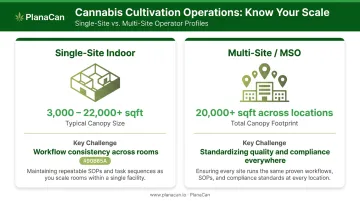
Most licensed operations fall into one of two structural models, each with its own execution challenges:
| Structure | Typical Canopy | Key Challenge |
|---|---|---|
| Single-site indoor | 3,000–22,000+ sqft | Workflow consistency across rooms |
| Multi-site / MSO | 20,000+ sqft across locations | Standardizing quality and compliance everywhere |
California's Department of Cannabis Control reported 60.6 million square feet of canopy capacity across licensed cultivators in 2024. Massachusetts alone had capacity for 4.57 million square feet as of December 2025. At that scale, consistent execution — not just grow knowledge — separates profitable operations from struggling ones.
What to Know Before Running a Commercial Cannabis Grow
The Operational Burden Is Larger Than Most Expect
Running a commercial cultivation means managing a licensed facility, coordinating a team across multiple simultaneous grow stages, maintaining state compliance documentation, and hitting yield targets — all at once. This is a managed business operation that happens to involve plants, not horticulture at scale.
A 2024 expert benchmark from Bickel Consulting recommends 1 full-time cultivation employee per 1,000 sqft of vegetative plus flowering canopy when automated irrigation and environmental controls are in place. Manual irrigation or environmental monitoring can double that headcount. A 25,000 sqft operation maps to roughly 25 people — including a cultivation director, IPM lead, propagation team, harvest team, and facilities staff.
Head Growers Are Mostly Managing, Not Growing
The day-to-day reality skews heavily toward management, not plant care. A head grower's time typically goes to:
- Scheduling tasks across multiple grow stages
- Directing staff and resolving floor-level issues
- Maintaining compliance documentation and records
- Triaging environmental or IPM problems before they cascade
Operations that treat the head grower as the primary caretaker rather than a workflow manager tend to see missed tasks and quality inconsistencies as canopy and team size grow.
Timeline Expectations Should Be Conservative
Most commercial operations do not reach full efficiency in their first several harvest cycles. Refining strain-specific workflows, stabilizing environmental controls, and building team accountability takes time. A realistic baseline: budget 6–12 months before workflows stabilize and yields become predictable. Model profitability timelines on that assumption, not your best-case harvest.
Critical Setup Decisions That Determine Commercial Success
Licensing and Compliance Infrastructure
Licensing requirements are state-specific and tiered by canopy size. California's tiers run from Specialty Cottage (up to 500 sqft) through Large (22,000+ sqft). Massachusetts runs 11 tiers from 5,000 sqft through 100,000 sqft. Most states also require registration with a state-mandated seed-to-sale tracking system.
Metrc currently holds regulatory contracts across 28 US states, DC, Guam, and the US Virgin Islands, including California, Michigan, Massachusetts, Ohio, and Nevada. BioTrack and Leaf Data Systems cover additional markets. Build your compliance infrastructure before the first plant goes in the ground — retrofitting it is costly and operationally disruptive.
Engage a cannabis licensing attorney early. Massachusetts publishes a 90-day window for provisional license decisions, but post-provisional inspections and final approvals add additional time. Total timelines vary considerably by state and application type.
Facility Layout and Environmental Systems
HVAC, lighting, and room segmentation decisions made at buildout are expensive to reverse. An analysis of 84 indoor cannabis facilities by the Resource Innovation Institute found that facilities using LED flowering lights had 34% better area-based electric efficiency than double-ended HPS facilities. Getting these systems right at buildout pays off — retrofitting inefficient infrastructure mid-operation disrupts harvests and burns capital you can't recover.
Strain Selection and Genetic Strategy
Select strains based on operational fit, not just market demand. Key evaluation criteria:
- Flowering time and room turnover implications
- Canopy management needs (training intensity, height management)
- Yield consistency across multiple runs — not just peak performance
- Pest and mold susceptibility under your facility's environmental profile
Document your strain performance criteria before running new genetics. This gives you a structured basis for rotating underperformers out and scaling proven strains up.
Compliance and Cultivation Tech Stack
Before your first plant enters propagation, identify:
- Which compliance software integrates with your state's tracking system
- What your cultivation management solution will be for daily workflow execution
- How your team will document treatments, feeding schedules, and harvest data
Choosing the wrong tools early creates compounding problems at scale. State compliance systems like Metrc track what happened for regulators. A cultivation operations platform like PlanaCan handles what needs to happen each day — keeping your team aligned, your workflows documented, and your harvest schedule on track.
How to Run a Commercial Pot Growing Operation — Step by Step
This section covers the core operational phases of a commercial grow, from propagation through post-harvest, with a focus on execution decisions that affect yield consistency and team performance.
Step 1 – Build Your Propagation and Genetics Program
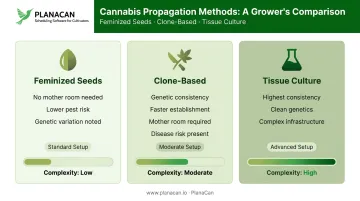
Decide early whether you're running feminized seeds, clones from mother plants, or tissue culture. Each has trade-offs:
- Feminized seeds: No mother room required, lower pest/disease risk, but genetic variation between plants
- Clone-based programs: Genetic consistency, faster establishment, but require a dedicated mother room and introduce disease risk if not managed carefully
- Tissue culture: High consistency, clean genetics, but more complex infrastructure requirements
For perpetual harvest models, your propagation program must be precisely sized to your flower room capacity. If weekly propagation throughput doesn't align with the cadence of rooms entering flower, the entire schedule breaks.
Step 2 – Manage Vegetative and Pre-Flower Stages for Canopy Efficiency
Environmental targets during veg directly affect flowering room yield. Undertrained or underdeveloped plants entering flower are one of the most consistent causes of commercial yield underperformance.
Key veg targets:
- Temperature: 70–85°F
- Humidity: 50–70% RH
- Light cycle: 18/6
- VPD: 0.8–1.2 kPa (adjust for canopy stage)
Plant training methods — LST, topping, SCROG, and SOG — should match your strain characteristics, room design, and plants-per-square-foot target. The right method is the one that fits your specific facility — and gets documented as an SOP.
Step 3 – Execute the Flowering Stage and Monitor for Problems
Transition to 12/12 light cycle for photoperiod strains and shift your environmental targets: slightly lower temperatures and humidity, bloom-specific nutrient ratios higher in phosphorus and potassium, and more rigorous pest and disease monitoring as canopy density increases.
On harvest timing: A 2025 experiment evaluating 25 drug-type cannabis genotypes found that 22 of 25 reached peak total cannabinoid concentration and yield at the mostly-amber or fully-amber trichome maturity stages. Harvest timing is genotype-specific — there is no universal rule. Trichome and pistil monitoring are among the most consequential skills on your cultivation team.
Step 4 – Establish Repeatable SOPs for Every Cultivation Stage
Precise harvest timing means nothing if your team can't execute it consistently. For every stage — propagation, veg, flower, IPM, flush, harvest — there should be a written protocol any trained team member can follow without relying on the head grower being present.
The most common early-stage failure: protocols live in the head grower's memory or informal notes. That's a single point of failure. When that person is unavailable or leaves, tasks get missed, treatments drift, and batch quality suffers. Cultivation management software built around SOP workflows directly addresses this risk by keeping protocols accessible, assigned, and trackable by anyone on the team.
SOPs should cover:
- Specific tasks for each phase-day
- Exact product rates and application timing for feeding and IPM
- Environmental targets and acceptable ranges
- Quality checkpoints and escalation triggers
Step 5 – Harvest, Dry, Cure, and Plan the Next Cycle
Drying targets: Peer-reviewed research supports 18–21°C and 50–55% RH as standard commercial drying conditions. Drying speed directly affects terpene retention — slower, controlled drying at stable humidity preserves volatile terpenes better than rapid moisture reduction.
At commercial scale, drying room capacity and throughput must be planned as carefully as flower room capacity. A harvest bottleneck at the drying stage is a common operational constraint that compounds across cycles if not addressed at buildout.
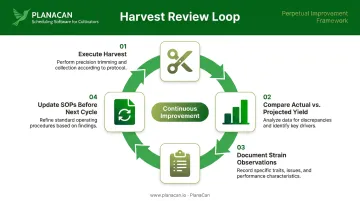
Use each harvest as a structured review: Compare actual yield against projected yield, document strain-specific observations, and update your SOPs before the next cycle starts. Operations that build this review into standard process — rather than leaving it informal — close the gap between projected and actual yield faster with each harvest.
How to Standardize Operations, Build Team Accountability, and Scale
The Real Bottleneck Is Operations, Not Horticulture
As canopy grows and team size increases, informal coordination — text messages, verbal instructions, whiteboards — creates missed tasks, inconsistent treatment applications, and accountability gaps that compound across cycles. The plant science is rarely the ceiling. Operations are.
The 2023 Cannabis Business Times cultivation survey identified increasing yield (30%), achieving desired terpene/cannabinoid content (28%), and pest control (28%) as top reported challenges. All three are directly affected by workflow consistency and SOP adherence.
Build a Scheduling System That Doesn't Depend on Memory
Standardizing your operation starts with a scheduling system that maps every task across every room and every week — from feeding schedules and IPM applications to transplant days and harvest windows. Nothing should depend on someone remembering.
PlanaCan is built for commercial cannabis teams managing this complexity. It includes:
- Custom workflow templates for each strain and treatment — built by your team, refined with each harvest
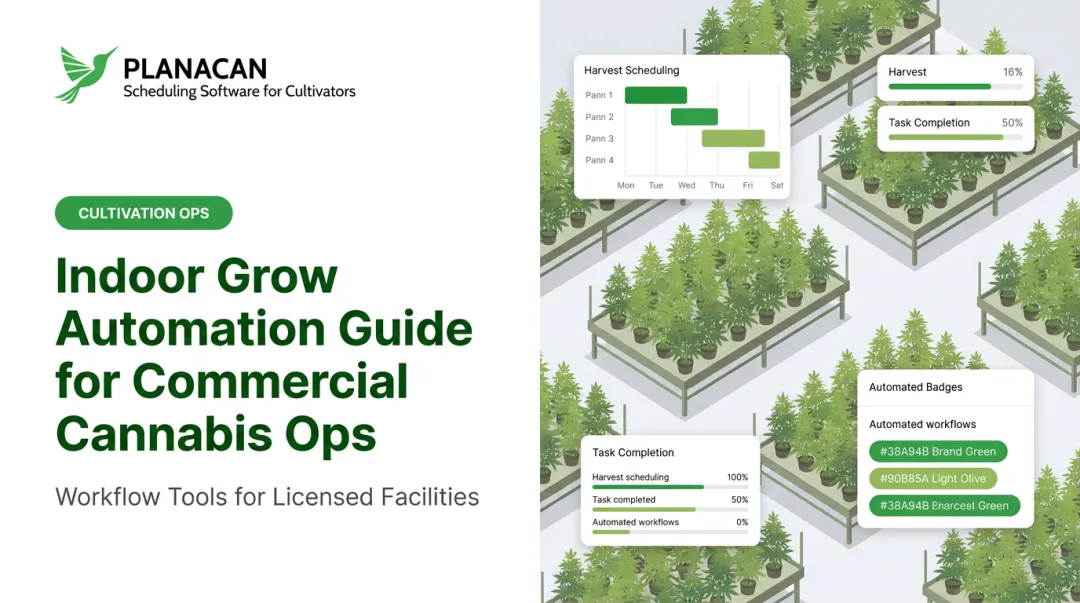
- An interactive Gantt chart to view all harvest schedules across every room at a glance, with drag-and-drop rescheduling that shifts downstream tasks automatically
- Automatic daily notifications via push notification or email so every team member knows what needs to get done without the head grower chasing anyone down
- Mobile execution via iOS and Android apps that work offline on the grow floor
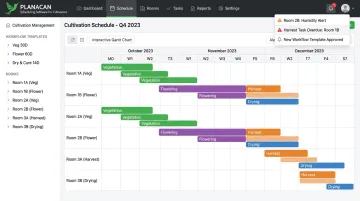
Garden First Cannabis, a PlanaCan customer managing 16 rotating harvests simultaneously, achieved a 36% increase in completed tasks and a 23% decrease in labor costs — outcomes tied directly to standardizing workflows and automating team communication.
Track the Metrics That Actually Matter
The numbers that reveal operational health across cycles:
- Completed tasks per week — Is execution consistent, or are things routinely falling through?
- Yield per square foot per cycle — Are you improving, holding steady, or regressing?
- Labor hours per pound — Where is labor cost concentration, and is it improving?
- Days from propagation to harvest — Are cycle times consistent, or are delays accumulating?
Tracking these across cycles shows where efficiency is leaking and where refinements are working. Patterns you can't see in a single harvest become obvious at cycle three or four — that's where meaningful adjustments happen.
Before You Expand, Confirm Operations Can Run Without You
Before adding rooms, increasing canopy, or opening a second location, test whether your current operation can run consistently without the head grower or founder present for a full week. If it can't, the constraint is operational infrastructure, not square footage. Fix the systems first, then scale into them.
Frequently Asked Questions
How profitable is a commercial cannabis growing operation?
Profitability varies significantly by state market conditions, canopy size, and operational efficiency. A 2023 industry survey found only 39% of qualified cultivation respondents reported profitable operations. Operations with standardized workflows and lower labor cost per pound tend to outperform those relying on manual coordination — research margin benchmarks specific to your state market before setting revenue projections.
What licenses are required to run a commercial cannabis grow operation?
Licensing is state-specific and typically includes a cultivation license (tiered by canopy size), seed-to-sale tracking registration (Metrc, BioTrack, or Leaf Data Systems), local zoning permits, and sometimes separate processing licenses. Engage a cannabis licensing attorney early — application timelines vary by state and can delay launch by months.
How many plants can a commercial cannabis operation grow at once?
Plant count limits vary by state and license type — some states regulate by plant count, others by canopy square footage. Commercial operations typically run a perpetual harvest model where multiple rooms are at different growth stages simultaneously, meaning there is rarely a single "total plant count" that captures the full scope of the operation.
What is the biggest operational challenge in running a commercial cannabis grow?
Team coordination and workflow consistency are the most persistent operational challenges. Missed tasks, inconsistent treatment applications, and scheduling gaps are harder to resolve than plant health issues and directly impact yield and product quality. Most of these problems trace back to relying on informal communication rather than structured, documented workflows.
How do you maximize yield in a commercial indoor grow?
Dial in environmental controls (VPD, light intensity, CO2), select strains suited to your facility's design, maximize canopy coverage through consistent plant training, and execute feeding and IPM protocols without deviation. Consistency across cycles matters more than any single technique.
How long does it take to break even on a commercial cannabis cultivation operation?
Break-even timelines depend heavily on startup capital, state licensing costs, canopy size, and local wholesale pricing. Plan for at least several harvest cycles before operations are fully optimized and revenue is stable — most operations refine their workflows significantly during the first year.