
That gap creates real problems: inconsistent product grades across shifts, quality that walks out the door when a good trimmer leaves, and batch-level compliance gaps that are nearly impossible to trace back to a root cause. When something goes wrong — a grade mix-up, an unexpected moisture deviation, a batch that doesn't reconcile in Metrc — "we have good trimmers" isn't an answer.
This article is written for commercial cultivators managing grow teams of five or more people, multi-room operations, and MSOs who need trimming to perform consistently across staff, shifts, and harvest cycles. It covers what belongs in a trimming SOP, how the commercial trimming process should be structured, how to standardize the wet vs. dry decision, and where SOP gaps most commonly create quality or compliance problems.
Key Takeaways
- Trimming SOPs lock institutional knowledge into repeatable procedures — so nothing walks out when a trimmer does
- The wet vs. dry trim decision must be driven by drying room RH targets and documented — not decided shift by shift
- A complete SOP covers moisture specs, grading criteria, sanitation schedules, PPE, and batch documentation
- Hand and machine trim require fundamentally different SOP structures with different QA gates and cleanup protocols
- SOPs are living documents — refine them with data from each harvest cycle, not once and never again
What a Commercial Cannabis Trimming SOP Should Include
A trimming SOP isn't just a technique guide. For commercial operations, it's the document that defines what acceptable output looks like, who is responsible for each step, and what records prove it happened correctly.
Colorado MED compliance guidance explicitly requires licensees to document how plants are cured and trimmed, how they are weighed, where weight and tag information is recorded, and how waste is logged by Harvest Batch. That structure — scope, procedures, documentation — is the right framework for any commercial trimming SOP, regardless of state.
Scope and Purpose
Define upfront:
- Which product types the SOP covers (whole flower, smalls, trim/shake)
- Which team roles are responsible at each step
- What quality acceptance criteria apply to finished output
- What batch documentation is required for state track-and-trace compliance
Materials, Equipment, and PPE
List required tools, acceptable substitutes, and inspection standards:
- Trimming tools: spring-action scissors, bucking machines, trim trays, grading tables, calibrated scales
- PPE: nitrile gloves, hair and beard covers, sleeves, and hearing protection when machine trimming
- Sanitation supplies: isopropyl alcohol, food-safe cleaning agents, designated clean/dirty tool zones
- Inspection standard: document when tools must be replaced or removed from rotation
CDC/NIOSH findings detected delta-9-THC on all 27 surface wipe samples taken in cannabis production areas and flagged repetitive hand-trimming as a musculoskeletal risk — both facts that justify PPE requirements and ergonomic controls in your SOP, not just standard practice.
Moisture and Environmental Specifications
This is the section most operations skip, and it's the one that causes the most downstream problems.
Too wet means trichome smearing and elevated mold risk. Too dry means brittle trichome loss and sugar leaves that curl and resist clean manicuring. Neither problem shows up immediately — both show up in your grade recovery numbers.
Document in your SOP:
- Acceptable water activity (aw) range for finished flower: ASTM guidance identifies 0.55 to 0.65 aw as the acceptable range; Washington state regulations flag anything above 0.65 aw as exceeding the limit for usable cannabis
- Drying room setpoints before dry trim: industry cultivation benchmarks target 55–65°F and 50–60% RH
- How moisture readiness is verified before the trim shift begins (not assumed)
Quality Grading Standards
Colorado MED notes that if flower and trim are separated and treated differently post-harvest, each distinct process requires its own SOP and separate Test Batch. That means grading criteria need to be documented — a verbal standard only your senior trimmer carries is a compliance gap waiting to surface during an audit.
Define in writing:
- Grade categories (A-grade whole flower, B-grade, smalls/popcorn, trim/shake) with visual or size thresholds
- How borderline grade calls are resolved — two-trimmer verification is a practical standard
- What triggers a rework pass vs. an immediate grade-down decision
- Photo references for each grade tier, updated when market standards shift
Batch Documentation and Record-Keeping
Every trimming SOP needs to answer: how does this batch move from intake weight to finished output weight, and where is every pound accounted for?
Per Colorado MED and Metrc guidance, plant material packaged from a harvest batch is deducted from that batch and placed into new packages. Michigan CRA best practices state that physical and electronic inventory weights must match exactly. Your SOP needs to specify how those weights are captured at trimming — not reconstructed later.
PlanaCan addresses this directly by building documentation checkpoints into the trimming task itself, so batch records are captured during execution rather than pieced together afterward. Trimmers log completions through the iOS/Android mobile app; managers see the operational record in real time.
The Commercial Trimming Process: Step-by-Step SOP Flow
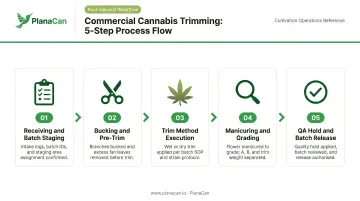
A well-structured trimming SOP follows a defined sequence. Skipping steps — especially quality verification and documentation steps — is the most common source of batch errors and compliance gaps in commercial operations.
Step 1: Receiving and Batch Staging
Before any trimming begins:
- Verify harvest batch IDs, wet or dry weights, and any applicable records against what was received
- Quarantine batches that don't meet incoming moisture or quality specs — don't start trimming a batch that isn't ready
- Sanitize all carts, tables, and containers
- Open a batch record noting shift start time, assigned trimmers, and room conditions (temperature and RH)
Step 2: Bucking and Pre-Trim
- Separate flowers from stalks using bucking machines or by hand
- Handle gently — rough handling at this stage damages trichomes before trimming even starts
- Use stainless-steel or food-safe trimming surfaces
- Sanitize tools between batches per the SOP sanitation schedule
- Direct stem waste to the designated discard stream; weigh and log it if required by your state
Step 3: Trim Method Execution
Your SOP must pre-specify the trim method for each product tier — this decision cannot be left to trimmer discretion on the day.
Method selection guide based on drying room RH:
| Drying Room RH | Recommended Method |
|---|---|
| Above 60% RH | Wet trim |
| 50–60% RH | Partial wet trim |
| Below 50% RH | Dry trim |
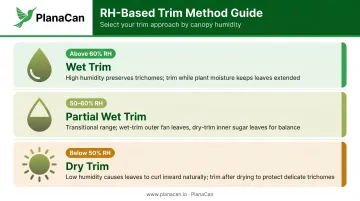
Both the method choice and rationale belong in the SOP — consistency across harvests requires documented decisions, not remembered ones.
For machine trimming specifically, GreenBroz explicitly states that wet trimming is not recommended in their dry trimmers because wet material can promote bacteria growth. If you're running a tumble machine, your SOP must specify the acceptable moisture window for machine intake.
Step 4: Manicuring and Grading
- Trim sugar leaves to the bud surface without cutting into the calyx layer
- "Bud flush" trimming removes protruding leaf material while protecting trichome coverage; over-trimming cuts into the bud itself, reducing visual appeal and potency
- Sort into grade bins (A, B, smalls, trim) per the written criteria in your SOP
- Use two-trimmer verification for borderline grade calls
Step 5: QA Hold and Batch Release
- Weigh finished output by grade category
- Enter weights into batch records and your state track-and-trace system
- Place finished goods in QA hold until water activity specs are confirmed (target: 0.55–0.65 aw)
- Document the release sign-off and note any deviations from target recovery rates
Tracking yield by grade over time is the only way to pinpoint where a recovery problem originates — trimming, drying, or cultivation. Without grade-level weights logged at this step, that diagnostic simply isn't possible.
Hand Trimming vs. Machine Trimming: How SOPs Differ by Method
The hand vs. machine decision comes down to economics, not quality. Hand trim SOPs fit premium whole flower destined for top-shelf markets where artisan appearance justifies the labor cost. Machine trim SOPs fit mid-market flower, pre-roll feedstock, or high-volume operations where throughput requirements make hand trimming economically unsustainable.
The throughput difference is substantial. Twister's manufacturer ROI model estimates hand trimming at roughly 0.3 lb/hr per person at $25/hr fully burdened labor — approximately $84/lb. By comparison, the Twister T-Zero PRO is rated at 100–200 lb/hr dry; the GreenBroz Model M Lite at 9 lb/hr dry; Tom's Tumbler 1600HC at 10 lb/hr dry and 30 lb/hr wet. These are manufacturer figures, not independent benchmarks, but the order-of-magnitude difference is real.
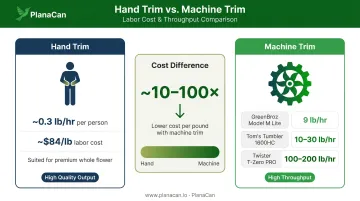
That cost gap is what drives method selection — and it's what your SOP needs to reflect. Once the economics point in a direction, the SOP requirements for each method are distinct.
What a Hand Trim SOP Must Specify
- Trimmer station setup: table height, ergonomic requirements, scissor sanitation rotation schedule
- Individual trimmer quality check rate (define an internal rate — no universal standard exists)
- Maximum consecutive hours before mandatory break
- How to maintain quality consistency across a full crew over multi-day harvest processing windows — trimmer fatigue is a real grade-consistency problem by day two
What a Machine Trim SOP Must Specify
- Acceptable moisture window for machine intake — this is critical because incorrect moisture is the primary cause of over-trimming or under-trimming in tumble machines
- Feed rate settings for each product tier
- Cleaning and sanitation cycle frequency — machines accumulate resin rapidly and need structured teardown between batches
- Post-machine QA check rate to catch over-trimming before the batch is graded — Twister notes that throughput should be reported as dry trimmed weight with no more than 10% touch-up required
Validating the Right Choice
Don't lock in a method without data. Run the same batch through both methods, then compare:
- Net yield by grade category
- Bag appeal (visual assessment by a consistent evaluator)
- Cost per finished pound
Document the pilot results and use them to lock the method decision into the SOP for that product tier. With documented results tied to a specific product tier, the method decision becomes a standing SOP entry — not a conversation that restarts at every harvest.
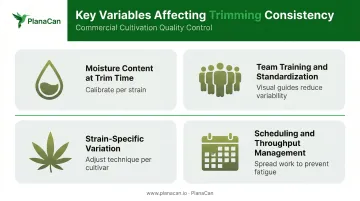
Key Factors That Affect Trimming Consistency
Even a well-written SOP produces inconsistent results if the following inputs aren't actively managed:
- Moisture content at trim time — the single most controllable variable. Calibrate the acceptable moisture window per strain and document it; don't assume what worked for one cultivar transfers to another
- Team training and standardization — trimmer-to-trimmer variability is one of the largest sources of grade inconsistency in commercial operations. Visual grading guides and regular quality checks reduce this more reliably than depending on experienced trimmers to self-regulate
- Strain-specific variation — some cultivars grow with minimal sugar leaf coverage (faster trim, more consistent A-grade yield); others are densely leafed or have airy bud structures requiring adjusted technique and extended time. SOP templates should include strain-specific notes rather than treating all cultivars identically
- Scheduling and throughput management — concentrating a large harvest into one extended shift leads to trimmer fatigue and rising grade inconsistency as the day wears on. Spreading trim work across multiple days with clear team assignments prevents this. PlanaCan lets operations managers schedule trimming tasks across days, assign them to specific team members, and send automated notifications — so the right trimmers show up to the right room without manual coordination every harvest cycle
Common SOP Failures and Misconceptions
Treating Trimming as a Technique Problem
The most common failure is investing in experienced trimmers but never writing down what "correct" looks like. When that trimmer leaves, the quality standard goes with them. New staff can't be onboarded to a standard that exists only in someone's hands.
The Method-Quality Misconception
Machine trim does not automatically produce inferior product. Hand trim does not automatically produce superior product. A machine trim SOP with the correct moisture window, feed rate controls, and post-trim QA gates can consistently hit premium-tier specifications. Sloppy hand trimming with no quality gates produces inconsistent, over-trimmed flower regardless of technique.
The method doesn't determine quality — the SOP does.
SOP Obsolescence
Trimming SOPs written once and never updated become liabilities. Strains change, equipment changes, staff changes, and market quality standards evolve. Build a review cadence into the document itself:
- Review after every harvest cycle at minimum
- Review whenever strains, equipment, or key staff change
- Maintain version control with a change log so everyone on the team is working from the current standard
That last point — version control with a change log — is where most paper-based SOPs fall apart. PlanaCan handles this at the platform level: templates are version-controlled and time-stamped, updates apply only to future deployments without overwriting historical batch records, and the "create once, deploy anywhere, refine with each harvest" model is built into how it works.
Frequently Asked Questions
What should a cannabis trimming SOP include?
A complete trimming SOP covers batch documentation, moisture and environmental specs, equipment and PPE requirements, step-by-step procedures for each trim method, quality grading criteria with visual standards, sanitation schedules, and QA hold-and-release procedures. State track-and-trace requirements — intake weights, grade-split weights, waste logs — belong inside the SOP itself, not in a separate administrative process.
How do commercial cannabis operations decide between hand trimming and machine trimming?
Base the decision on product tier, throughput targets, labor availability, and cost per finished pound. Hand trim suits premium whole flower; machine trim suits mid-market flower and pre-roll feedstock. Run a side-by-side pilot on the same batch, document the results, and lock the method into the SOP for that product tier — not something to re-litigate every harvest.
What are standard quality grading criteria used during commercial cannabis trimming?
Commercial operations typically sort into A-grade whole flower (dense, well-formed buds, visible trichome coverage, minimal leaf), B-grade (smaller or less uniform flower), smalls/popcorn, and trim/shake. Most state programs leave grade definitions to facility SOPs, so your written size thresholds and photo references are the actual standard — define them clearly enough that any trimmer applies them consistently.
How often should cannabis trimming SOPs be reviewed and updated?
After every harvest cycle at minimum. Formal version control should track who made changes and when, so the team is always working from the current document. Review the SOP whenever strains, equipment, staffing, or state regulatory requirements change — don't wait for the scheduled review if something shifts mid-cycle.
What PPE and sanitation standards apply in a commercial cannabis trimming room?
Standard PPE includes nitrile gloves, hair and beard covers, sleeves, and hearing protection during machine trim. Scissors get isopropyl alcohol cleaning on a defined rotation during hand trim shifts; machines get full teardown and sanitization between batches. Use color-coded zones to separate clean and dirty tools, and track environmental conditions where state cGMP standards require it.
How does the trimming method affect compliance with state track-and-trace requirements?
The trim method itself doesn't change track-and-trace obligations. Both hand and machine trim require accurate batch intake weights, grade-split documentation, net output weights by category, and waste manifests for stems and trim. These records must be captured at the trimming step — reconstructing them afterward creates reconciliation errors and audit exposure.