Whether you're a home grower wanting to stay within personal limits or a commercial operator managing thousands of square feet of canopy, the rules differ significantly — and 2026 brings additional updates worth knowing.
This guide covers the personal vs. commercial cultivation distinction, the current licensing landscape (including the permit freeze on new standalone cultivation licenses), key operational requirements, new law updates effective in 2026, and what non-compliance actually costs.
Key Takeaways
- 6-plant personal limit applies per private residence under California law (HSC 11362.2), regardless of how many adults live there
- Alameda County's 10-permit commercial cultivation ceiling is effectively full — no new standalone cultivation permits are currently available
- All commercial licensees must use Metrc, California's statewide track-and-trace system
- Canopy limits are strict: outdoor sites need a 25-acre minimum parcel with a 1-acre canopy cap; indoor operations max out at 22,000 sq ft
- The Alameda County CDA can visit licensed sites unannounced at any time — surprise inspections are standard practice
Personal vs. Commercial Cannabis Cultivation in Alameda County
The 6-Plant Baseline
California Health & Safety Code 11362.2 permits adults 21 and older to grow up to six living plants at a single private residence. That limit applies to the residence (not per adult), so a household with three adults still caps at six plants total.
Beyond the plant count, state law sets two additional conditions: plants must be in a locked space, out of sight from any public place, and any cannabis produced beyond 28.5 grams must remain secured on the premises.
What Alameda County Adds
Alameda County has not enacted a blanket prohibition on outdoor personal cultivation, meaning both indoor and outdoor growing are permitted for personal use. The key conditions:
- Plants cannot be visible from outside the residence
- Security measures must prevent access by minors
- The cultivator must be the property owner or have the owner's written permission
Under California law (HSC 11362.1), adults 21+ may give cannabis away to other adults within statutory limits without compensation. Selling without a license, however, is prohibited regardless of quantity.
Medical Cannabis Personal Cultivation
Qualified patients with a physician's recommendation under Prop. 215 may cultivate beyond the standard six-plant limit. Three things to know before doing so:
- The DCC confirms a physician's specific recommendation can support a higher plant count
- Local jurisdictions retain significant authority to restrict that allowance
- Alameda County applies a conservative interpretation — verify current local rules before exceeding six plants
When Commercial Rules Apply
Any cultivation that involves sales, distribution, or operates beyond personal use triggers an entirely separate licensing pathway. That pathway runs through both the DCC at the state level and the Alameda County Community Development Agency (CDA) — and both approvals are required before any commercial activity begins.
State and County Licensing Requirements for Commercial Cultivators in 2026
The Two-Tier Requirement
Commercial cultivation in Alameda County requires:
- A state cultivation or microbusiness license from the California DCC
- A county cultivation permit from the Alameda County CDA under Chapter 6.106
- A Conditional Use Permit (CUP) based on land use zoning under Title 17
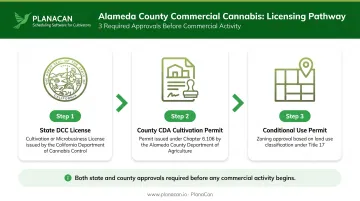
Neither state nor county authorization is sufficient on its own. The DCC requires a valid state license before any commercial activity begins. Alameda County's CDA requires local authorization alongside it.
The Permit Availability Reality
Alameda County's ordinance caps standalone cultivation permits at 10, and those permits are currently all issued. The RFP process concluded in late 2017, and no new standalone cultivation permits are available as of 2026.
The CDA is currently accepting applications for:
- Cannabis delivery operations
- Testing laboratories
- Combined Cannabis Operation (CCO) licenses
To receive notification if new cultivation openings become available, contact the CDA's commercial cannabis email update list directly via acgov.org/cda.
The Combined Cannabis Operation Alternative
For cultivators entering through an existing related license — or those pursuing a multi-use operation from the outset — the Combined Cannabis Operation (CCO) license under Chapter 6.109 offers a viable route. Under a CCO, the following limits apply:
- The county issues up to 14 CCO licenses
- A CCO must cover at least three commercial cannabis operations on one premises (cultivation, distribution, manufacturing, and/or retail)
- Cannabis canopy under a CCO cannot exceed 10,000 square feet
Zoning and CUP Requirements
Cultivation is a conditional use restricted to specific zones:
| Cultivation Type | Zone | Canopy Cap | Parcel Requirement |
|---|---|---|---|
| Outdoor commercial | A (Agricultural) | 1 acre | 25 acres minimum |
| Indoor / mixed-light | A district | 22,000 sq ft | Secure enclosed structure |
| Combined Cannabis Operation | C-1, C-2 (via CCO) | 10,000 sq ft | Per Chapter 6.109 |
All cannabis must be invisible from outside the property perimeter under any commercial cultivation permit type.
Fee Schedule
The figures below come from a 2021 CDA ordinance summary — verify current amounts directly against Section 6.106.220 of the Alameda County Code of Ordinances before filing, as fee schedules can be updated:
- Application fee: ~$8,000 (RFP process)
- Final selection fee: ~$4,000
- Issuance fee: ~$2,000
- Annual regulatory program fee: ~$30,000
- Renewal fee: ~$3,200
- CUP application deposit: ~$5,000
Renewals must be filed before license expiration. Check current CDA renewal deadlines directly with the agency — the DCC state renewal window opens 60 days before expiration, and local timelines may differ.
Operational Compliance Requirements for Licensed Cultivators
Setback Rules
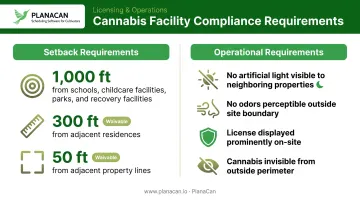
Licensed cultivation sites must maintain minimum distances from surrounding uses:
- 1,000 feet from K–12 schools, licensed childcare centers, parks, playgrounds, drug and alcohol recovery facilities, and public recreation centers
- 300 feet from residences on adjacent parcels (waivable with written consent from the adjacent owner)
- 50 feet from any adjacent property line with different ownership (also waivable in writing)
These setbacks are verified in Alameda's zoning ordinance and apply from cultivation site to the closest point of the protected use.
Security, Lighting, and Odor
Alameda County zoning materials confirm cultivators must demonstrate effective security, safe working conditions, and prevention of theft and diversion. Additional confirmed requirements:
- No artificial light visible from neighboring properties between sunset and sunrise
- No odorous gases, dust, or particulate matter perceptible outside the site boundary
- The license must be displayed prominently on-site
Employee Eligibility
Under Alameda County ordinance provisions (6.106.060 and 6.106.100), anyone convicted of a felony in the preceding three years may not work at a cannabis cultivation facility. Licensees must also:
- Maintain a current registry of all employees, contractors, and volunteers
- Make that registry available to the CDA upon request
Inventory and Track-and-Trace
All annual and provisional state licensees must use Metrc, California's CCTT-METRC system. It records every movement of cannabis inventory through the supply chain, from cultivation through final sale.
Key Metrc obligations for cultivators:
- Record all plant and product movement in real time
- Track cannabis waste through final disposal (waste must be rendered unusable before disposal)
- Ensure records are current and accessible during any CDA inspection
Licensed products are also subject to testing for pesticides, mold, and mycotoxins through state-regulated testing laboratories.
Unannounced Inspections
The Alameda County CDA may conduct surprise inspections without prior notice. A 2025 county code enforcement document confirmed the county conducts up to two compliance inspections per year per licensee. That same report identified 10 illegal grow operations in 2024. Cultivators should maintain inspection-ready documentation at all times.
What's New: 2026 California Cannabis Cultivation Law Updates
DCC-2025-01-R: Cultivation Updates and Sanitation Standards
The most significant 2026 regulatory change for California cultivators is DCC-2025-01-R, "Cultivation Updates; Sanitation Standards," approved and filed April 28, 2026, effective July 1, 2026. Alameda County licensed cultivators should review their cultivation SOPs and sanitation protocols against the final rule text before the effective date.
AB 2188 and Employment Compliance
AB 2188 (Gov. Code § 12954), operative since January 1, 2024, prohibits employers from discriminating against employees based on off-duty cannabis use or test results showing non-psychoactive cannabis metabolites. For cultivation businesses, this directly shapes hiring practices and HR policies — but the law's scope has limits.
What the law does not cover:
- Possession, use, or impairment at the worksite
- Employees in building and construction trades
- Positions requiring a federal background investigation or security clearance
- Testing required under federal/state law or as a condition of federal funding, licensing, or contracts
The statute does not include a broad "safety-sensitive" exemption. The actual exemptions are narrower and more specific than many employers assume.
Tax Landscape in 2026
The tax structure affecting California cultivators has seen meaningful changes heading into 2026:
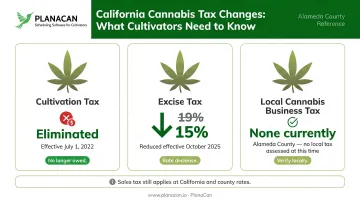
- Cultivation tax: Eliminated effective July 1, 2022 — still the case in 2026
- Excise tax: Reduced from 19% to 15% effective October 1, 2025, per AB 564 (CDTFA)
- Local cannabis business tax: Unincorporated Alameda County does not currently impose a separate local cannabis business tax
- Sales tax: Still applies at applicable California and county rates
Penalties for Non-Compliance in Alameda County
Personal Cultivation Violations
Growing more than six plants falls under California Health & Safety Code 11358. For adults, this is a misdemeanor carrying:
- Up to 6 months in county jail
- A fine up to $500, or both
Felony exposure under HSC 11358 is tied to specific factors — prior serious or violent felony convictions, prior 11358 violations, or specified environmental violations — not simply to quantity alone.
Commercial License Non-Compliance
Operating without a valid county permit or state license, failing inspections, or violating operational requirements (odor, lighting, employee eligibility) exposes licensees to fines, license suspension, or revocation. The county flagged 10 illegal operations during 2024 compliance inspections.
Common triggers for enforcement action include:
- Visible cannabis from outside the property
- Unregistered employees or contractors
- Metrc records that don't match physical inventory
- Lighting or odor violations identified during or between inspections
What a Permit Violation Costs Your Business
Enforcement doesn't end with fines. In a market with only 10 available cultivation permits, the downstream consequences of a violation can outlast any penalty:
- Permit renewal becomes significantly harder after documented violations
- Investor and banking relationships erode when compliance history is questioned
- In this capped-license market, losing a permit is permanent — there is no reapplication path
Managing Compliance Day-to-Day: Staying Audit-Ready
Knowing the rules is step one. The harder part is building the operational systems that prove compliance during a surprise inspection.
Alameda County's CDA can show up unannounced. When that happens, what regulators see is documentation — not what you know. Cultivators who assign clear task accountability and maintain timestamped records are better positioned than those piecing records together after the fact.
How PlanaCan Supports Cultivation Compliance
PlanaCan is a commercial cultivation management platform designed for licensed operations running 3,000+ square feet of canopy. It operates as a cultivation operations layer that complements Metrc — it doesn't submit data to Metrc directly, but it builds the operational documentation record that regulators expect to see alongside Metrc's plant-tag data.
Specific features relevant to Alameda County compliance:
- Custom SOP templates are version-controlled and timestamped — every deployment generates a record of what was done, by whom, and when
- The Harvests Tab renders an interactive Gantt chart across multiple rooms or facilities, giving inspectors a clear view of operational control
- Automated daily notifications keep teams executing on schedule, reducing the incomplete tasks that leave records with gaps
- Per-batch operations logs capture pH, EC, environmental data, and IPM applications in a continuous, chronological record for each batch
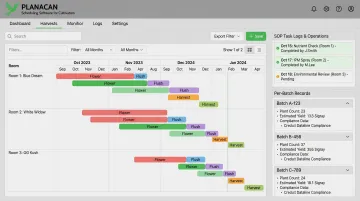
Garden First Cannabis, a PlanaCan customer, reported a 36% increase in completed tasks and a 23% decrease in labor costs after implementing the platform — both metrics that directly affect inspection readiness and operational efficiency.
PlanaCan does not replace Metrc or provide direct state compliance reporting. For California cultivators managing DCC requirements, the two systems run in parallel — Metrc handles plant-tag data and state reporting; PlanaCan handles the operations record that sits alongside it.
Building an Internal Audit Cadence
Beyond any software platform, cultivators should:
- Run internal audits monthly at minimum, checking Metrc records against physical inventory
- Keep all employee records and certifications current and accessible
- Maintain a direct communication channel with the Alameda County CDA for permit renewal timelines and ordinance updates
- Review DCC rulemaking updates at cannabis.ca.gov on a quarterly basis
Frequently Asked Questions
Who is exempt from AB 2188 for cannabis cultivation compliance in Alameda, CA?
Under Government Code 12954, verified exemptions apply to workers in the building and construction trades, employees requiring federal background investigations or security clearances, and anyone subject to federally mandated drug testing. There is no blanket "safety-sensitive" exemption in the statute.
Do you need a cannabis cultivation license in Alameda, CA?
Yes. Commercial cultivators must hold a state cultivation license from the California DCC and a county permit from the Alameda County CDA, plus a Conditional Use Permit. As of 2026, the county's 10-cultivation-license cap is effectively full and no new standalone cultivation permits are being accepted.
What are the new cannabis cultivation compliance laws in California for 2026?
The most significant 2026 update is DCC-2025-01-R (Cultivation Updates; Sanitation Standards), effective July 1, 2026. The excise tax also dropped to 15% as of October 2025. For current DCC rulemaking, visit cannabis.ca.gov.
What are the penalties for growing more than six cannabis plants in Alameda, CA?
Exceeding the 6-plant personal limit is a misdemeanor under HSC 11358 — up to 6 months in county jail and fines up to $500. Felony exposure applies for prior serious convictions, repeated violations, or environmental violations. Commercial cultivation without a valid county permit risks license revocation, fines, and criminal liability.
Can cannabis be grown outdoors commercially in Alameda County?
Outdoor commercial cultivation is permitted only with a CUP specifically authorizing it, on a parcel of at least 25 acres, with a cannabis canopy not exceeding 1 acre. The entire premises must be secured so cannabis is not visible from outside the property, and a secure enclosed structure must be present on-site for drying, curing, and storage.
Does Alameda County have its own cannabis track-and-trace requirements?
Alameda County requires all licensees to maintain current inventory records in California's statewide track-and-trace system — Metrc (CCTT-METRC). This covers all cannabis movement from cultivation through transfer and disposal. Records must be current and available during any CDA inspection, which may be unannounced.