Introduction
Many cannabis operators use "cultivation" and "production" interchangeably. Treating them as the same thing creates real problems: misallocated costs, licensing violations, and operational blind spots that erode margins.
State regulators treat these as separate licensed activities with different facility requirements, compliance obligations, and cost structures.
A business operating under a cultivation license cannot legally extract concentrates or manufacture edibles without an additional manufacturing license in most US states.
This guide breaks down exactly what each term means, where one ends and the other begins, how costs are tracked differently across both phases, and what a well-managed handoff between them looks like in commercial cannabis operations.
Key Takeaways:
- Cultivation spans seed or clone through harvest; production starts where cultivation ends
- Most US states issue separate licenses for cultivation and manufacturing/production
- Blending the two cost centers makes it nearly impossible to identify margin inefficiencies
- The harvest handoff is where cultivation data quality directly shapes production outcomes
- Standardized cultivation workflows produce more consistent raw material for downstream production
What Is Cannabis Cultivation?
Cultivation is the licensed practice of growing cannabis plants from seed or clone through harvest. Every activity tied to the living plant — from genetic selection through harvest — falls within cultivation's scope.
California's statutory definition is one of the broadest: cultivation includes planting, growing, harvesting, drying, curing, grading, and trimming ((Business and Professions Code Section 26001)). Massachusetts similarly licenses cultivators to cultivate, process, and package marijuana for transfer to other marijuana establishments.
Core Activities Within Cultivation
The primary tasks that fall under cultivation include:
- Genetic selection and propagation: sourcing seeds or clones, managing a mother room, and selecting strains for each cycle
- Vegetative growth management: training, topping, and developing the canopy for maximum light penetration
- Environmental control across lighting, HVAC, humidity, and CO2 supplementation
- Integrated pest management (IPM): both preventive programs and reactive responses to pest or disease pressure
- Harvest execution: cutting, bucking, and initial handling of the harvested material
Cultivation ends the moment the plant is cut. What follows — drying, curing, and further processing — belongs to a different operational phase, though where exactly that line falls varies by state. Those distinctions directly affect which license types apply, which is why understanding the KPIs used to measure cultivation output matters before crossing into production territory.
How Cultivation Is Measured
Commercial cultivation performance is tracked through specific KPIs:
- Canopy square footage — the primary regulatory and operational unit (Massachusetts caps cultivators at 100,000 sq ft; Illinois at 210,000 sq ft)
- Yield per canopy sq ft — RII's PowerScore benchmarks show 115 g/sq ft for greenhouses and 199 g/sq ft for indoor facilities
- Harvest cycle frequency — controlled environments support more repeatable scheduling than seasonal outdoor production
- Resource productivity — kWh per sq ft, water consumption per gram of yield
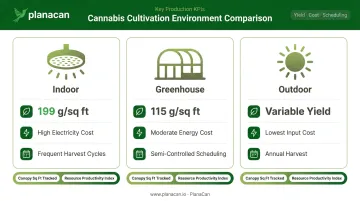
The cultivation environment — indoor, greenhouse, or outdoor — directly shapes these benchmarks and cost structures. An indoor operation running 199 g/sq ft carries dramatically different electricity costs than an outdoor operation harvesting once annually.
What Is Cannabis Production?
Production (sometimes called manufacturing) is the phase that begins after harvest. It encompasses post-harvest processing and the transformation of raw cannabis material into sellable products.
State regulatory frameworks define these boundaries precisely. Nevada, for instance, licenses a cannabis production facility to acquire, possess, manufacture, deliver, transfer, supply, or sell cannabis products. California draws the line at the point where activity shifts from handling plant material to compounding, blending, extracting, infusing, packaging, or labeling.
Core Activities Within Production
Key activities in the production phase include:
- Post-harvest drying and curing — moisture reduction and flavor/potency development
- Trimming and packaging — preparing finished flower for retail
- Extraction and concentrate manufacturing — ethanol, CO2, hydrocarbon, or solventless methods
- Infused product manufacturing — edibles, tinctures, topicals, pre-rolls
- Quality testing — third-party lab compliance testing by analyte class
- Final product fulfillment — batch labeling, packaging, and transfer to distribution
In most US state regulatory frameworks, production or manufacturing is a separate license type from a cultivation license. Michigan, for example, separates growers from processors — a processor purchases material from growers and produces infused products, while the grower license covers cultivation only.
How Production Performance Is Measured
Production KPIs differ from cultivation metrics:
- Extraction yield — cannabinoid recovery percentage by method and input material quality
- Batch potency variance — consistency of cannabinoid concentration across production runs
- Finished-unit yield from biomass — how many sellable units a given weight of input produces
- Compliance pass rates by analyte class (single-analyte pass rates are not equivalent to overall compliance pass rates)
- Rework and destruction rates from failed batches or compliance failures
Cultivation vs. Production: Key Differences Explained
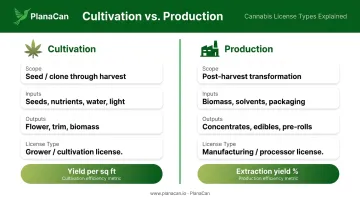
The fundamental distinction is straightforward: cultivation grows the plant; production transforms what the plant produces. But that simple statement has significant operational and regulatory implications.
| Dimension | Cultivation | Production |
|---|---|---|
| Scope | Living plant from seed/clone through harvest | Post-harvest transformation into sellable product |
| Primary Inputs | Seeds/clones, nutrients, water, light, labor | Biomass/flower, solvents, packaging, manufacturing labor |
| Primary Outputs | Harvested and cured flower, trim, biomass | Flower packs, concentrates, edibles, topicals, pre-rolls |
| Facility Requirements | Grow rooms, irrigation, HVAC, canopy space | Extraction equipment, clean rooms, packaging lines |
| Regulatory License | Cultivation/grower license | Manufacturing/processor/production license |
| Key KPIs | Yield per sq ft, canopy utilization, harvest frequency | Extraction yield, batch consistency, cost per unit |
The Handoff Point
In a vertically integrated operation, cultivation and production are sequential but distinct departments — each with its own budget center, staffing, and compliance obligations. In a cultivation-only operation, the product handed to a processor or distributor is the harvested and cured flower itself.
Team accountability separates cleanly at this boundary:
- Cultivation teams own plant health, canopy management, and hitting target yields
- Production teams take that yield and convert it into compliant, market-ready product with minimal waste
A Common Source of Confusion
Some state licenses use "production" to mean the entire vertical operation including growing. Others use it exclusively for post-harvest processing. Arizona's marijuana establishment framework, for example, includes both cultivation and manufacturing authority under a single establishment definition — but the definitions still distinguish the two activities internally.
Before building your chart of accounts, designing your facility, or drafting your compliance program, confirm exactly how your state regulatory body defines these terms — the wrong assumption can create misaligned license scopes or reporting gaps.
Cost of Cultivation vs. Cost of Production
Separating these two cost centers is one of the most important — and most commonly neglected — financial disciplines in commercial cannabis.
Cost of Cultivation
Cost of cultivation covers every expense tied to growing the plant:
- Grow team labor (planting, training, IPM, feeding, harvest execution)
- Nutrients, growing media, and cultivation inputs
- Electricity for lighting and HVAC
- Water and irrigation infrastructure
- Seeds or clone stock
- Pest management materials and labor
- Facility overhead for grow rooms
- Plant tracking and cultivation-specific compliance costs
For context on what these costs look like at scale: Cannabis Business Times reported that Glass House Brands reached a Q3 2024 greenhouse cultivation cost of $103/lb. That's a named-company case study for a large-scale greenhouse operator — not an industry average — but it illustrates how significantly cultivation costs vary by environment type.
Cost of Production
Cost of production covers all expenses incurred after harvest to convert biomass into sellable product:
- Trimming and post-harvest labor
- Drying and curing infrastructure and overhead
- Extraction equipment amortization
- Packaging materials and labeling
- Third-party testing fees
- Manufacturing labor
- Batch failures, rework, and product destruction costs
Why Separation Matters
Tracking these two categories separately tells you where to look when margins move. An operator who blends cultivation and production costs into a single line item cannot identify where inefficiencies exist. If margins are falling, the problem could be any of these:
- Yield-per-plant — a cultivation issue
- Extraction efficiency — a production issue
- Packaging costs — a production issue
Cannabis Business Times has noted that inventory costing is one of the industry's most misunderstood and financially critical processes. That problem is compounded when cultivation and production costs are never separated in the first place.
Build separate cost centers from day one. Untangling blended accounting mid-operation is significantly harder than maintaining the distinction from the start.
Licensing and Compliance: Why the Distinction Matters
US regulated cannabis markets generally treat cultivation and manufacturing as distinct license categories with different premises, SOPs, and compliance evidence requirements.
| State | Cultivation License | Production/Manufacturing License |
|---|---|---|
| California | Cultivation license (growing through drying/curing/trimming) | Manufacturing license (extraction, infusion, packaging, labeling) |
| Colorado | Retail cultivation facility | Retail products manufacturer |
| Michigan | Grower license | Processor license |
| Nevada | Cannabis cultivation facility | Cannabis production facility |
| Illinois | Cultivation center / craft grower | Infuser organization |
| Massachusetts | Marijuana cultivator | Marijuana product manufacturer |
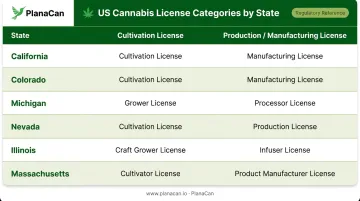
Operating under the wrong license category carries real consequences. California requires a valid DCC license before performing any commercial cannabis activity and publicly publishes enforcement actions. Crossing license boundaries can trigger:
- Product quarantine or destruction
- Monetary fines and citations
- License suspension or revocation
For multi-state operators, this licensing puzzle compounds quickly. The same activity, such as "processing" or "packaging," can fall under cultivation in one state and manufacturing in another. MSOs entering new markets should:
- Build a state-by-state activity matrix mapping every physical task to the license that covers it
- Review that matrix with legal counsel before operations begin
- Update the matrix whenever state regulations change
Optimizing the Cultivation-to-Production Pipeline
The transition from cultivation to production is the most consequential handoff in a cannabis operation. Data quality at harvest directly determines what's possible in production.
What Happens at a Poor Handoff
When cultivation teams don't maintain accurate records or communicate clearly at harvest:
- Production planners can't forecast staffing, equipment, or processing capacity
- Batch-to-batch variability in moisture content and potency creates inconsistent extract yields
- Compliance documentation gaps create audit exposure
- Waste and rework rates increase because production teams are working with unknown-quality inputs
What a Well-Managed Handoff Looks Like
A strong cultivation-to-production handoff includes:
- Accurate harvest records — yield by batch, room, and strain
- Batch traceability data — identifiers that carry forward from cultivation into production batches (as required by systems like Metrc, where production batches are created from harvest batch transfers)
- Quality assessment at harvest — moisture content observations, visual grading, trichome maturity records
- Clear task accountability — documented records of who executed what on each batch, so production planners know the provenance of incoming material
How Cultivation Management Software Supports the Pipeline
Commercial cultivation teams that standardize their workflows produce more consistent raw material and reduce unpredictable production outcomes. When every harvest cycle follows the same documented protocol, the material entering production stays predictable — and predictable inputs mean fewer surprises downstream.
Platforms like PlanaCan are built specifically for this purpose. PlanaCan's template library covers the full cultivation lifecycle from propagation through cure, with phase-day-driven task scheduling that fires the right tasks at the right time on every harvest.
The platform captures environmental data, IPM records, feed logs, and task completion timestamps at each step — building a per-batch operations log that serves both internal optimization and regulatory compliance.
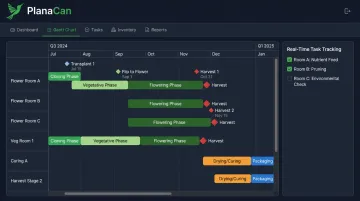
For production planners, PlanaCan's interactive Gantt chart gives a bird's-eye view of every harvest schedule across all flower rooms, with key dates and phase breaks visible weeks in advance. That visibility lets trim crews, drying room managers, and extraction schedulers prepare for incoming material — not scramble to react to it.
Garden First Cannabis, a PlanaCan customer managing 16 rotating harvests simultaneously, reported a 36% increase in completed tasks and a 23% decrease in labor costs after implementing the platform. When cultivators know exactly what to do and managers can see completions in real time, the handoff to production stops being a bottleneck and starts being a checkpoint.
Frequently Asked Questions
What is the difference between cultivation and production?
Cultivation refers to growing cannabis plants from seed or clone through harvest. Production (or manufacturing) refers to the post-harvest transformation of raw cannabis material into sellable products such as flower, concentrates, or edibles. In most US regulated markets, these are separate licensed activities.
What does cultivation mean?
Cultivation means the deliberate growing and tending of cannabis plants through all lifecycle stages: germination or cloning, vegetation, flowering, and harvest. The goal is producing quality cannabis biomass for commercial use.
What is the difference between cost of cultivation and cost of production?
Cost of cultivation covers all expenses tied to growing the plant: labor, inputs, lighting, water, and grow facility overhead. Cost of production covers expenses incurred after harvest to process and package plant material into market-ready products: extraction, packaging, testing, and manufacturing labor.
What is the difference between cultivation and plantation?
A plantation typically refers to large-scale agricultural land growing crops at scale. Cultivation refers to the full set of practices used to grow and tend a crop. In cannabis, cultivation is the preferred industry term for the entire plant-growing process regardless of operation size.
Does a cannabis business need separate licenses for cultivation and production?
In most US regulated cannabis markets, yes. Cultivation and manufacturing are separate license categories with different regulatory requirements, and operators must hold the appropriate license for each activity they perform. Requirements vary significantly by state.
How does cultivation quality affect cannabis production outcomes?
Harvested cannabis quality (potency, moisture content, consistency, and cleanliness) directly determines what's possible in the production phase. Poor cultivation practices produce variable raw material, leading to unpredictable extraction yields, batch inconsistencies, and higher compliance risk downstream.