Introduction
Most commercial cultivators understand they need track and trace software — it's a legal requirement, not a choice. What's less clear is exactly what these systems do, which platform your state mandates, and where compliance reporting ends and actual cultivation management begins.
That confusion is expensive. Cultivators who expect Metrc or BioTrack to run their grow operations are setting themselves up for missed tasks, inconsistent SOPs, and yield problems that compliance software will never fix.
This guide covers how cannabis track and trace works, what state-mandated platforms actually require, and — most importantly for commercial operations — what those platforms leave completely unaddressed when you're managing multiple rooms, teams, and harvest cycles.
Key Takeaways
- Cannabis track and trace software is a state-mandated compliance tool, not an operational management platform
- The two dominant US systems are Metrc (28 regulatory contracts) and BioTrack, but requirements vary by state
- Core features to prioritize: Metrc/BioTrack integration, real-time inventory tracking, and automated compliance reporting
- Track and trace covers regulatory reporting only — cultivators also need dedicated cultivation management software to handle scheduling, team accountability, and yield optimization
What Is Cannabis Track and Trace Software?
Cannabis track and trace software is a digital system that assigns unique identifiers — RFID tags or barcodes — to plants and packages, recording every compliance event from planting through harvest through sale, and reporting that data to a state regulatory authority.
California defines its system as the statewide program to record cannabis inventory and movement "from seed to sale." Massachusetts describes it as a rigorous inventory control system tracking cultivation, processing, and sales. Both definitions point to the same core function: a regulator-facing system of record, not an operator workflow tool.
State Systems vs. Commercial Software
These two categories serve very different masters:
- State-mandated platforms (Metrc, BioTrack) are government enforcement tools that give regulators real-time visibility into cannabis supply chains
- Commercial cannabis software (seed-to-sale platforms like Canix, Distru, GrowFlow) syncs with those state platforms through an API, providing a more operator-friendly interface
- Using Metrc's own commercial product is optional — you're required to report into the state system, not required to use any specific third-party software to do it
What Data Gets Captured
Track and trace records the regulatory-facing facts: strain and grower information, plant growth stage, harvest data, package creation, weight, waste records, and sale data. This data primarily serves regulators — it proves your inventory matches your records and that nothing left your facility without documentation.
"Track and trace" and "seed-to-sale software" get used interchangeably, but they're not the same. Seed-to-sale platforms cover the full supply chain through retail; track and trace refers specifically to the compliance reporting layer.
How Cannabis Track and Trace Works for Cultivators
Tagging Plants and Packages
According to Metrc's plant and package guide, all Metrc tags use proprietary RFID technology and are used for inventory, audit, and inspection purposes. Illinois further clarifies that plant tags track from immature growth through harvest, while package tags track cannabis once it's been packaged.
Tagging timing varies by state. Oregon's 2024 batch-tagging bulletin shows state-specific exceptions tied to plant height and flowering stage — another reason why software that handles state-by-state configuration matters. In Oregon, licensees purchase RFID tags directly at 25–45 cents per tag.
Two main scanning methods exist in practice:
- Barcode scanners — lower cost, widely used, but labor-intensive for large plant counts
- RFID scanners — faster for bulk scanning, built into Metrc's tag infrastructure
Choose based on your operation size and workflow. A 3,000 sqft single-room facility may manage fine with handheld barcode scanning. At 20,000+ sqft, the time cost of manual scanning adds up quickly.
Reporting Compliance Events
Every compliance event follows the same sequence: a grow team member completes an action (moving plants from veg to flower, recording waste, completing a harvest), and that event gets reported into the state system.
There are three ways to do this:
- Direct manual entry into Metrc or BioTrack
- Spreadsheet upload via the state portal
- Automated reporting through integrated seed-to-sale software
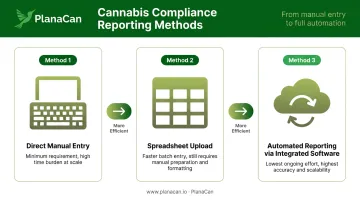
Manual reporting satisfies the minimum requirement but becomes a significant time burden at commercial scale. New York's OCM has made the trajectory clear: manual retail inventory and sales reporting ends May 5, 2026, replaced by fully integrated automated reporting.
Automation cuts duplicate data entry and the error risk that comes with end-of-day manual reconciliation.
Audits and Accountability
During a state compliance audit, regulators cross-reference your physical plant and product inventory against what's recorded in the state system. Discrepancies in count, weight, or location trigger consequences.
The stakes are real:
- California DCC can issue fines up to $5,000 per violation for licensees, and up to $30,000 for unlicensed activity — with all compliance actions published publicly
- Oregon OLCC classifies misrepresentation of Metrc data as a Category III violation, carrying a 10-day suspension or $1,650 fine
California's enforcement records show these aren't theoretical risks — published violations are searchable by license number, meaning audit failures are visible to regulators, partners, and prospective buyers alike.
State-Mandated Track and Trace Systems: Metrc, BioTrack, and Beyond
Metrc reports 28 regulatory contracts and 500,000+ users, making it the most widely used state-mandated system in the US. It assigns plant and package tags and generates real-time reports for regulators. States using Metrc include California, Colorado, Michigan, Massachusetts, Nevada, Oregon, Arizona, and others.
BioTrack operates as the mandated platform in states including Connecticut and New Mexico. It functions similarly to Metrc with a different interface and API — relevant for multi-state operators who need software that syncs with both systems rather than just one.
Not every state uses the same platform, and some have switched systems entirely. Here's where each stands today:
| Platform | Current Status |
|---|---|
| Metrc | 28 regulatory contracts; dominant US platform |
| BioTrack | Mandated in Connecticut, New Mexico, and others |
| New York | Now uses Metrc (not BioTrack, despite older references) |
| Illinois | Transitioned from BioTrack to Metrc in 2025 |
| Washington | Uses Cannabis Central Reporting System (CCRS), neither Metrc nor BioTrack |
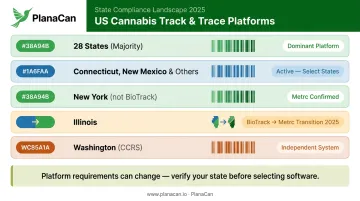
Illinois shows what these transitions look like in practice. Metrc announced its Illinois contract on February 4, 2025, becoming the fourth state where it replaced an incumbent vendor. Cultivators whose software was tightly built around BioTrack's API had to adapt quickly.
Before selecting any compliance software, verify the current mandated platform in every state where you operate — and prioritize platforms that can handle system transitions.
Key Features to Look for in Cannabis Track and Trace Software
Metrc and BioTrack Integration
State-mandated platforms like METRC and BioTrack handle the official compliance reporting — but the cultivation software layered on top determines how accurate and complete that data is before it's ever submitted. Good integration looks like:
- Minimal manual data input per compliance event
- Batch reporting for high-volume harvests
- Automatic error flagging before submissions go to the state
A poorly integrated system doesn't eliminate manual work — it just moves it downstream, where errors are harder to catch.
Real-Time Inventory Tracking
Real-time plant and package inventory visibility helps you catch discrepancies before they become violations. Periodic manual counts leave gaps; automated tracking flags a weight discrepancy the day it happens — not during an audit two weeks later.
Automated Compliance Reporting and Alerts
Good compliance software generates required state reports automatically, flags non-compliant events before submission, and notifies the relevant team members. Automation cuts the duplicate reporting and data-entry errors that pile up with end-of-day manual reconciliation.
Scalability for Multi-Room and Multi-Site Operations
Software that works for a 3,000 sqft single-room operation must also handle 20,000+ sqft across multiple facilities without degrading performance. Commercial cultivators need:
- Multiple location support with separate inventory views
- User permission levels (cultivators vs. managers vs. compliance officers)
- Batch processing for large plant counts across rooms
Mobile Access
Grow teams work on the floor, not at a desk. iOS and Android apps that allow compliance events to be logged in real time reduce delays and the errors that accumulate when data entry waits until end of day. An action recorded immediately after it happens is more accurate and more audit-defensible than one reconstructed six hours later.
Why Track and Trace Alone Isn't Enough for Commercial Cultivators
Metrc, BioTrack, and most seed-to-sale platforms are built for regulatory enforcement, not operational management. They record what happened and report it to the state. They don't help you plan grow schedules, standardize treatment protocols, assign team tasks, or optimize room-by-room workflows.
Consider a 10,000 sqft facility running 5 strains across 3 flower rooms on a perpetual harvest schedule. That operation can be fully Metrc-compliant — every plant tagged, every harvest reported — while simultaneously struggling with:
- No real-time task visibility — cultivators don't know what's due in each room without checking a whiteboard or group text
- Inconsistent SOP execution — the same strain treatment varies room to room because protocols exist on paper, not embedded in daily workflows
- Perpetual harvest coordination failures — with 3 rooms on staggered cycles, scheduling becomes a spreadsheet problem where tasks fall through the cracks
- Zero labor visibility — no data on which strains consume more labor per gram of yield, or which cultivators are productive vs. struggling
- Yield variance with no explanation — harvests fluctuate, but there's no operational data trail connecting decisions to outcomes
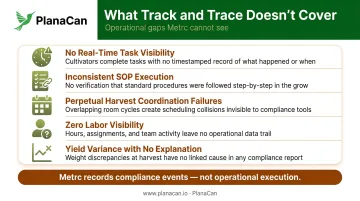
Metrc records that a harvest happened. It doesn't record whether the team followed the right protocol, collected environmental data at each phase, or executed tasks consistently across the cycle.
Where PlanaCan Fits
This is the operational gap PlanaCan addresses. While Metrc handles compliance reporting, PlanaCan functions as the cultivation management layer: built for the day-to-day work that actually runs the grow.
- Custom workflow templates for every strain and treatment, version-controlled and embedded in daily task workflows
- Interactive Gantt chart scheduling across all harvest cycles and rooms, with one-click calendar deployment across pre-veg through cure phases
- Automatic daily notifications alerting team members to their tasks, with alerts for overdue or unresolved items
- Harvest analytics tracking yield outcomes per strain, room, and cycle — connecting operational inputs to results
- Labor tracking per user, task, and phase, providing visibility into the 30–50% of cultivation OpEx that labor typically represents
Garden First Cannabis, a PlanaCan customer, achieved a 36% increase in completed tasks and 23% decrease in labor costs while managing 16 rotating harvests — outcomes that compliance software alone cannot produce.
These are not competing tools. Metrc reports compliance events to the state; PlanaCan ensures the cultivation work gets done correctly, consistently, and with an audit-defensible record at the operations level. Running both means your facility stays compliant and your grow team stays coordinated.
Frequently Asked Questions
What is the track and trace software for cannabis?
Cannabis track and trace software is a state-mandated system that assigns unique tags to plants and packages, then records every compliance event from cultivation through sale. It gives regulators real-time inventory visibility and prevents diversion outside the licensed supply chain.
What software do dispensaries use?
Dispensaries primarily use retail POS-integrated seed-to-sale platforms such as Flowhub, Treez, or Dutchie, all of which sync with state track and trace systems. Cultivators have different software needs — focused on grow management, team accountability, and compliance reporting rather than point-of-sale transactions.
Is Metrc the same as cannabis track and trace software?
Metrc is the most widely used state-mandated track and trace platform in the US, but "track and trace software" also refers to third-party commercial platforms that integrate with Metrc. Using Metrc's own commercial product is optional — you're required to report into the state system, not required to use any specific software to do it.
Do all US states require the same cannabis track and trace system?
No. Most states use either Metrc or BioTrack, but Washington uses its own Cannabis Central Reporting System (CCRS), and requirements can change — Illinois transitioned from BioTrack to Metrc in 2025. Multi-state operators must confirm the mandated platform in each state and ensure their software can sync with whichever system applies.
What happens if a cannabis cultivator fails a track and trace audit?
Discrepancies between physical inventory and state system records can result in fines, license suspensions, or revocations. California can issue fines up to $5,000 per violation; Oregon classifies Metrc data misrepresentation as a violation carrying a 10-day suspension or $1,650 fine.
How does cultivation management software differ from track and trace software?
Track and trace software handles regulatory compliance reporting — what the state requires you to document. Cultivation management software handles day-to-day operational workflows: scheduling, task management, team accountability, labor tracking, and yield optimization.