The operators surviving that compression aren't necessarily the best growers. They're the most consistent ones.
Running a profitable commercial grow demands more than cultivation knowledge. It requires capital planning before you break ground, regulatory compliance baked into every process, and repeatable operational systems that hold together across team changes, harvest cycles, and facility expansions.
This guide covers the full picture — from licensing and facility setup to workflow standardization and multi-site scaling — written for operators who are building a business, not just a garden.
Key Takeaways
- Commercial cannabis cultivation is capital-intensive, with all-in buildout costs ranging from $250 to $600 per square foot
- Licensed cultivators must operate within state track-and-trace systems and maintain seed-to-sale documentation from day one
- Section 280E taxes cannabis operators on gross profit, not net income, so tight cost control determines whether a facility stays profitable
- Vertical grow systems can increase facility output by 50–100%+ without adding floor space
- Operations that scale consistently outperform those that stall on process discipline, not genetics or equipment
What Is a Commercial Cannabis Grow Operation?
A commercial cannabis grow is a state-licensed cultivation business that produces cannabis at scale for wholesale distribution, retail sale, or vertical integration into dispensary or manufacturing operations. It differs from a medical caregiver grow or personal cultivation in its regulatory requirements, capital structure, and the sheer operational complexity involved.
Facility Models and Their Tradeoffs
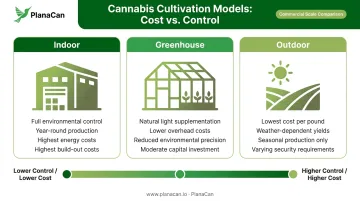
| Model | Key Advantage | Key Challenge |
|---|---|---|
| Indoor | Full environmental control, year-round production | Highest energy and build-out costs |
| Greenhouse | Natural light supplementation, lower overhead | Less environmental precision than indoor |
| Outdoor | Lowest cost per pound | Weather-dependent, seasonal, security requirements vary by state |
Most licensed commercial operations are indoor or greenhouse-based, with outdoor cultivation limited to specific states and license types. Beyond facility type, operators choose between single-facility businesses and multi-site or vertically integrated structures. That structural choice shapes licensing strategy, financing requirements, and how operations scale — so it's worth settling early.
What to Know Before Running or Scaling a Commercial Grow
The Capital Reality
Commercial grow buildouts are expensive. According to Next Big Crop, all-in construction costs run $250–$600 per square foot, with equipment (lighting, HVAC, racking) adding another $50–$300 per square foot on top of construction.
State licensing fees compound those costs. Examples by state:
- California: $3,935 application fee + $35,410 for the license itself (small indoor cultivation)
- Michigan: $3,000 nonrefundable prequalification fee + $24,000 for a Class C grower license
- New York: Tier 5 indoor license starts at $100,000, with additional canopy-based fees above 50,000 sq ft
Before approaching investors or lenders, operators should model a full 12-month pre-revenue cash need — factoring in the gap between facility opening and first sellable harvest, plus ongoing compliance costs while revenue ramps.
The 280E Tax Burden
Cannabis businesses cannot deduct ordinary operating expenses under federal tax law. Section 280E applies because marijuana remains a Schedule I controlled substance — meaning operators pay federal income tax on gross profit rather than net income.
Cost of goods sold can offset gross receipts, but payroll, marketing, rent, and most operational overhead cannot be deducted.
That constraint makes operational efficiency the most important financial lever available to a commercial cultivator.
Compliance Is an Operating Requirement, Not a Checkbox
Every licensed US cultivator must operate within their state's track-and-trace system. METRC holds 30 regulatory contracts across states including California, Colorado, Michigan, Massachusetts, Missouri, and Nevada. BioTrack covers Hawaii and others. Illinois transitioned to METRC as its official inventory tracking system in July 2025.
These platforms require full seed-to-sale documentation — every plant movement, harvest, transfer, and destruction logged in real time. Designating a compliance owner and building SOPs around reporting requirements before operations begin is table stakes — gaps in logging create audit exposure that can threaten your license.
How to Set Up and Run a Commercial Cannabis Grow — Step by Step
Step 1: Licensing, Financing, and Facility Selection
Most state applications require:
- Detailed business plan
- Security plan
- Cultivation SOP documentation
- Proof of adequate financial resources
- State residency and ownership disclosures (requirements vary)
Application windows and license caps differ significantly between established markets (California, Colorado, Oregon) and emerging markets (Ohio, Minnesota, New York). Working with a cannabis attorney familiar with the target state's program improves application outcomes, especially in states with merit-based scoring.
On financing: traditional federal banking is inaccessible for most cannabis businesses. Primary capital paths include cannabis-specific lenders, private equity, and structured investment agreements. Build your capital model before approaching investors, and account explicitly for the facility-to-first-harvest gap in your projections.
Step 2: Facility Design and Canopy Maximization
The foundational facility decisions are:
- Room layout — dedicated veg, flower, clone, and drying/curing rooms
- Grow medium — soil, coco coir, or hydroponic systems
- Lighting — LED vs. HPS, with significant energy and yield implications
Experienced operators consistently recommend one approach: choose a proven setup and run it consistently rather than experimenting with multiple systems during startup. Variance in methodology creates variance in output.
Vertical grow systems are the most accessible canopy expansion lever within an existing footprint. According to Pipp Horticulture, single-tier HPS setups yield 90–120 g/sqft, while two-tier LED systems yield 132–160+ g/sqft by facility footprint — a 50%+ output increase without adding square footage.
Step 3: Genetics, Propagation, and Harvest Cycle Strategy
At commercial scale, propagation method has significant cost and consistency implications:
- Clones from mother plants — lower upfront cost, risk of disease transfer from compromised mothers
- Feminized seeds — consistent genetics per seed run, no mother room required
- Tissue culture — genetically identical, disease-free plant stock at high volume; requires skilled lab staff and purpose-built infrastructure
The scale potential of tissue culture is substantial. Phinest Cannabis's Sacramento facility produces up to 18 million fully rooted tissue-culture clones annually from 40,000 square feet of nursery space.
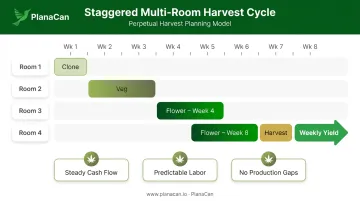
Propagation decisions feed directly into harvest scheduling. Structuring a staggered, continuous harvest model — with multiple rooms cycling through vegetative and flowering stages on offset schedules — produces consistent weekly or biweekly output. Large, infrequent harvests create cash flow gaps and unpredictable labor spikes; staggered cycles eliminate both.
Step 4: Hiring, Training, and Structuring Your Grow Team
Core roles in a commercial operation:
- Head Grower / Cultivation Director — overall cultivation strategy, environmental management, yield accountability
- Grow Technicians — daily task execution across rooms
- Compliance Officer — track-and-trace reporting, documentation, inspection readiness
- Post-Harvest / Trim Team — harvest processing, drying, curing, quality control
Define responsibilities before hiring. Accountability gaps that form early compound as the team grows, and they're far harder to correct at 20 employees than at 5.
Training must be documented and standardized from day one. Team members onboarded to written SOPs produce more predictable outcomes than those trained informally. A repeatable onboarding process is also essential for scaling — if the training lives only in one person's head, every new hire starts from zero.
How to Scale a Commercial Cannabis Grow Operation
The core principle of scaling: replicate what already works. MJBizDaily quotes cultivation leaders noting that "managing people and keeping the operation consistent" are the most important factors in cultivation — and that brands producing reliable flower at scale are winning in compressed markets.
The more variables kept constant during expansion (feeding schedules, environmental parameters, workflows), the more consistent and predictable the results.
Scaling Within an Existing Facility
Before committing to new licenses or locations, most operations have room to grow within their current footprint:
- Convert underutilized ancillary space into production rooms
- Add vertical grow systems to existing flower rooms
- Improve canopy utilization through plant training (SOG, SCROG)
- Tighten veg-to-flower cycle timing to increase annual harvest turns
These changes require less capital, fewer regulatory approvals, and less operational disruption than a new license — and they test whether your systems can handle higher output before you're managing multiple facilities.
Expanding to New Licenses or Markets
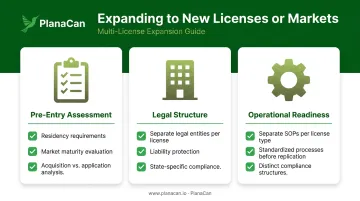
Before entering a new state or applying for additional licenses:
- Assess residency and ownership requirements for the target state
- Evaluate market maturity — emerging markets have fewer competitors but lower initial demand; established markets have proven consumer bases but more price compression
- Determine whether acquiring a struggling existing operation offers a faster path than applying from scratch
Multi-state operators typically establish separate legal entities per license for liability protection and operational clarity. Each state's regulatory environment is distinct enough that a single operating entity creates unnecessary compliance risk.
Expanding into manufacturing, distribution, or retail introduces entirely new regulatory and operational requirements. Treat each license type as its own business:
- Maintain separate SOPs and compliance structures per license type
- Avoid assuming cultivation workflows transfer directly to manufacturing or retail
- Build standardized processes at your current scale before replicating them across new facilities — the systems that keep one site consistent are the same ones that make multi-site growth manageable
Standardizing Operations and Managing Your Team at Scale
SOPs are the infrastructure of a scalable grow. Every cultivation step — propagation, feeding schedules, IPM treatments, environmental adjustments, harvest timing — should be written, tested, and executed identically across every room and facility. Undocumented processes become inconsistent processes the moment a key employee leaves or a new site opens.
Building Systems That Survive Team Changes
The problem with informal operations is fragility. When your head grower is the only person who knows the feeding schedule, you don't have a system — you have a person. And people leave.
Effective scaling requires:
- Written SOPs for every cultivation phase, referenced at point of execution
- Documented onboarding so new team members reach baseline performance faster
- Task-level accountability so managers know what was done, by whom, and when — without walking every room
Multi-Room Scheduling and Workflow Management
As harvest cycles multiply, managing which rooms are in which stage, which tasks are due, and which team members are responsible becomes unmanageable in a spreadsheet. Each room added multiplies that complexity.
Cultivation management platforms like PlanaCan are built specifically for this problem. PlanaCan allows commercial grow teams to:
- Build custom workflow templates for every strain and treatment protocol
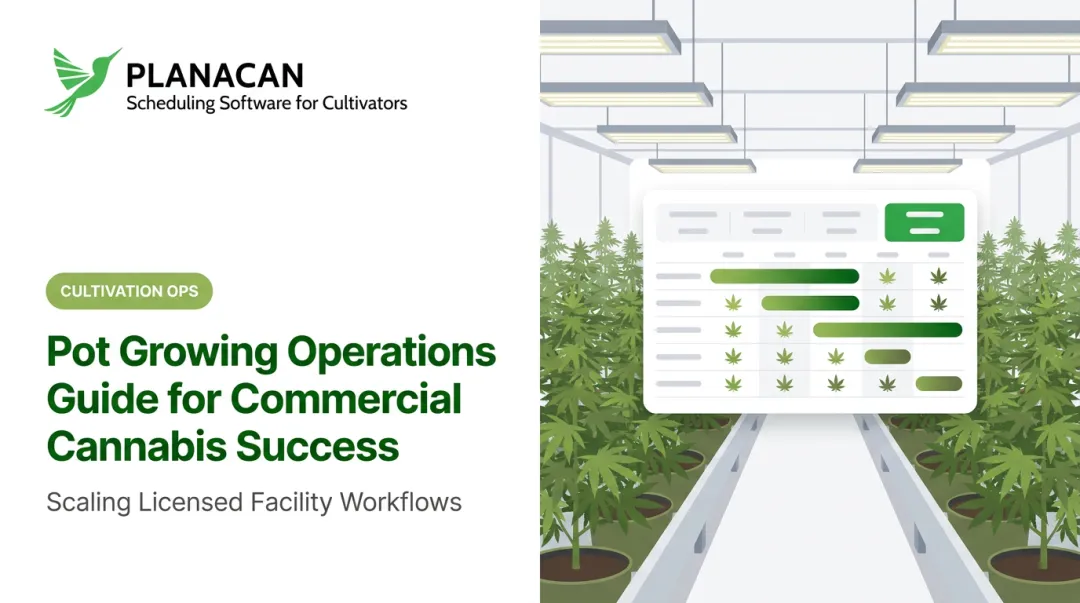
- Visualize all active harvest schedules across rooms in a single Gantt chart view
- Send automatic daily task notifications to team members
- Track task completion in real time through iOS and Android mobile apps
- Monitor labor load, individual performance, and overdue tasks through a dedicated labor analytics dashboard
Garden First Cannabis, using PlanaCan to manage 16 rotating concurrent harvests, achieved a 36% increase in completed tasks and a 23% reduction in labor costs. Their team's assessment: "Simple to use, and effective. Our team knows what they need to do, and when to do it."
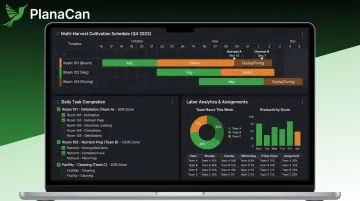
PlanaCan functions as the cultivation operations layer that runs day-to-day execution underneath METRC, BioTrack, or other state track-and-trace systems. The two platforms serve different purposes, and most serious commercial operations use both.
IPM as a Consistency Requirement
Integrated Pest Management should be built into standard operations before you expand — not treated as a reactive protocol after problems appear. The Massachusetts Cannabis Control Commission's cultivation guidance explicitly requires cultivators to limit contamination from mold, fungus, bacterial diseases, rot, pests, and pesticides.
Proactive IPM elements the Commission outlines include monitoring, scouting, pest-management planning, and recordkeeping.
Establishing a proactive beneficial insect program, setting environmental thresholds, and documenting treatment protocols before expansion prevents the pest and disease issues that routinely derail quality during rapid scaling. If your IPM documentation isn't built before you open Room 5, you'll be scrambling to contain problems that should have been prevented.
Team Accountability at Scale
Managers cannot physically oversee every room or location. Without systems that surface missed work and maintain clear communication, quality degrades — not because the team is careless, but because there's no mechanism to catch what falls through.
Operations that build accountability structures early — clear role definitions, documented workflows, task tracking — retain more institutional knowledge and weather turnover with far less disruption. When a cultivator leaves, the SOP stays. When a task is missed, the system flags it before the next day's work is affected.
Frequently Asked Questions
How profitable is cannabis cultivation?
Margins are thin: Whitney Economics reported only 24.4% of US cannabis businesses were profitable in June 2023, down from 42% the prior year. Energy costs can hit 48% of operational expenses for indoor grows, and Section 280E eliminates most standard business deductions, making cost control the primary lever for profitability.
What are the startup costs for a commercial cannabis grow?
All-in buildout runs $250–$600 per square foot for commercial indoor facilities, with equipment (HVAC, lighting, racking) adding $50–$300 per square foot on top of that. State licensing fees range from a few thousand dollars to six figures depending on the market. Model at least 12 months of pre-revenue cash need before approaching investors or lenders.
How do I get a commercial cannabis cultivation license?
Cultivation licensing is state-regulated — there is no federal pathway. Most states require a detailed application including a business plan, SOP documentation, security plan, and proof of financial resources. Residency and ownership requirements vary by state. Engaging a cannabis attorney early in the process is strongly recommended, particularly in states with competitive merit-based scoring.
What is the difference between indoor, greenhouse, and outdoor commercial grows?
Indoor offers full environmental control and year-round production but carries the highest energy and build-out costs. Greenhouse uses natural light supplemented by climate control at lower operating cost, with less environmental precision. Outdoor is the most cost-effective per pound but is subject to weather, seasonal constraints, and security requirements that vary by state regulation.
How many employees does a commercial cannabis grow need?
Team size scales with canopy and harvest volume — an early-stage operation typically starts with a head grower plus a small technician team, adding roles as production increases. A well-structured team with clear roles and documented SOPs will consistently outperform a larger, less organized one.
What software do commercial cannabis growers use to manage operations?
Commercial grows typically use two categories of software: state-mandated track-and-trace platforms (METRC, BioTrack) for compliance reporting, and cultivation management software for scheduling, SOPs, and team coordination. The two serve different purposes and work alongside each other. PlanaCan is built for the operational layer, complementing state systems rather than replacing them.