Many growers inherit a system rather than choose one. They take over a facility built by someone else, or they scale a hobby setup into a commercial operation without stepping back to ask how it will affect scheduling, resource use, or team accountability once headcount grows.
This guide covers what a cultivation system actually is, the major types in commercial use, the components every system needs regardless of method, and how platforms like PlanaCan help growers run these systems with less guesswork.
Key Takeaways
- A cultivation system combines growing method, environment, and operational workflow, not just the medium plants grow in
- Soil, hydroponic, aeroponic, and aquaponic systems each carry distinct labor, cost, and control trade-offs
- Canopy size and automation level should drive your system choice, not the reverse
- Standardized templates and scheduling tools reduce variability across rooms and locations
- PlanaCan users have seen a 36% increase in completed tasks and a 23% decrease in labor costs
What Is a Cultivation System?
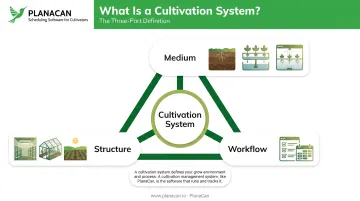
A cultivation system is the combination of growing method, environment, and operational workflow used to take a plant from clone or seed to harvest. The term covers more than soil versus hydro: the medium, the structure, and everything that happens around them. Three components define any cultivation system:
- Medium: soil, hydroponic, or aeroponic root-zone technology
- Structure: indoor, greenhouse, or outdoor environment
- Workflow: the feeding schedules, treatment protocols, and labor process that keeps the method running consistently A cultivation system is the growing method itself. A cultivation management system is the software or process that runs the operational side of that method: scheduling, task tracking, and team communication. Growers sometimes use the terms interchangeably, but they solve different problems.
Why Standardization Matters at Scale
Licensed cultivation capacity varies widely by state, and utilization gaps are common. California's Department of Cannabis Control reported 82.3 million sq ft of maximum licensed capacity in 2024, against just 60.6 million sq ft of actual built-out canopy, a roughly 36% utilization gap according to ERA's analysis. That gap reflects, in part, how hard it is to build a repeatable system that scales cleanly. Consider a 20,000 sq ft indoor hydroponic facility. The system is more than the Deep Water Culture setup. It includes the irrigation schedule, the feeding cadence tied to plant phase, and the daily workflow that keeps every room on the same clock. Miss that operational layer, and the best hydroponic infrastructure in the world won't perform consistently.
Types of Cultivation Systems
Soil-Based Systems
Growing in living soil or soil-amended media remains popular for flavor and terpene development. Soil-grown cannabis also requires fewer fertilizer inputs than hydroponic cannabis, according to a Washington State/UC Berkeley environmental review.
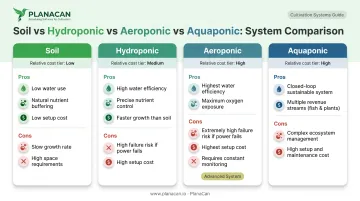
- Pros: forgiving of minor mistakes, simpler nutrient chemistry, natural flavor profile
- Cons: slower nutrient uptake, more manual labor, less precise control at scale
Hydroponic Systems
Hydroponics delivers nutrient-rich water directly to roots without soil. Common commercial setups include Deep Water Culture (DWC), where roots stay submerged continuously, and Ebb & Flow, where a pump intermittently floods and drains the root zone.
Oklahoma State University Extension notes hydroponics offers more control over nutrients and pH, faster growth, and reduced soil-borne pests. Tradeoffs include higher cost, specialized skill needs, and rapid pathogen spread if a closed system fails.
DWC growers need dissolved oxygen above 5 mg/L to avoid root stress.
- Pros: precise nutrient and pH control, faster growth, fewer soil-borne pests
- Cons: higher cost, steeper skill curve, fast pathogen spread when systems fail
Aeroponic Systems
Aeroponics suspends roots in air and mists them with nutrient solution at short intervals. That setup maximizes root-zone oxygen and can speed growth, but commercial use stays limited because the equipment is sensitive.
A pump or timer failure can stress or kill a crop fast. When misting fails, reduced root-zone oxygen sharply cuts growth and nutrient uptake.
- Pros: high root-zone oxygen, rapid growth potential
- Cons: failure-sensitive hardware, uncommon at commercial scale, little recovery time if misting stops
Aquaponic Systems
Aquaponics combines fish waste with plant growth in a symbiotic loop. It remains niche in cannabis but draws interest from sustainability-focused operators.
A 2025 study found aquaponics produced 22% lower midpoint and 15% lower endpoint life-cycle environmental impacts than hydroponics for vegetative hemp. The study did not measure flowering yield, and economic scalability is still unproven.
- Pros: lower life-cycle environmental impact in early research, strong sustainability story
- Cons: niche adoption, limited flowering-yield data, unclear economics at scale
Environment-Based Classification
Beyond medium, structure matters just as much:
- Indoor: full artificial light control, minimal pest pressure, highest predictability, highest energy cost
- Greenhouse: blends natural and supplemental light, lower energy cost, more exposure to seasonal swings
- Outdoor: lowest infrastructure cost, highest pest and weather exposure, least predictable harvest timing
Method choice still collides with production reality. Michigan-based Rair Co. runs aeroponic cannabis at production scale, with cultivation manager Steven Preece noting how hard reliable flower production is at scale regardless of system.
Environment mix is shifting too. A 2022 Cannabis Business Times survey found 28% of commercial respondents grew in greenhouses using combined natural and supplemental lighting.
Key Components Every Cultivation System Needs
Regardless of medium or structure, every commercial system needs the same operational backbone:
- Consistent scheduling for feeding, treatments, and environmental checks across every room, every day
- Standardized templates by strain and treatment type, so room-by-room execution doesn't drift into inconsistent guesswork
- Team communication and task tracking that prevent missed work, especially once you're running multiple rooms or sites
Trade guidance from Cannabis Business Times recommends roughly one full-time cultivation employee per 1,000 sq ft of canopy, assuming automated irrigation and climate controls. Manual watering and manual climate data collection can push that staffing need up substantially, in some cases doubling it. That staffing gap is the real cost of a weak operational layer. Missed tasks and inconsistent execution drive labor up long before the medium becomes the problem.
How to Choose the Right Cultivation System
Your canopy size should guide system complexity, not the other way around.
- Assess your scale. A 3,000 sq ft single flower room doesn't need the same automation stack as a multi-state operation running 20,000+ sq ft.
- Factor in budget and labor. Hydroponic and aeroponic systems demand more monitoring skill and capital; soil and greenhouse approaches trade precision for lower overhead.
- Weigh your climate. Outdoor and greenhouse systems depend heavily on regional weather patterns; indoor systems trade energy cost for control.
- Plan for replication. Multi-state operators need systems that can be standardized across locations, not reinvented at each site.
Curaleaf's experience scaling across 19 states shows why replication belongs in the decision. The company ran R&D, identified best practices, and migrated sites toward a shared cultivation standard. That work is still evolving, even with significant resources—so pick a system you can document, train, and repeat across rooms or states.
Managing Your Cultivation System with Technology
Here's the uncomfortable truth: most commercial grows don't lose efficiency because they picked the wrong medium. They lose it on the operational side, in scheduling gaps, missed treatments, and communication breakdowns between shifts.
This is where PlanaCan fits. It's a grower-first cultivation management platform built to run the operational layer of any cultivation system. It leaves your growing method in place and standardizes how your team executes it.
What that looks like in practice:
- Build custom templates for every treatment, strain, and cultivation step, then deploy them across rooms
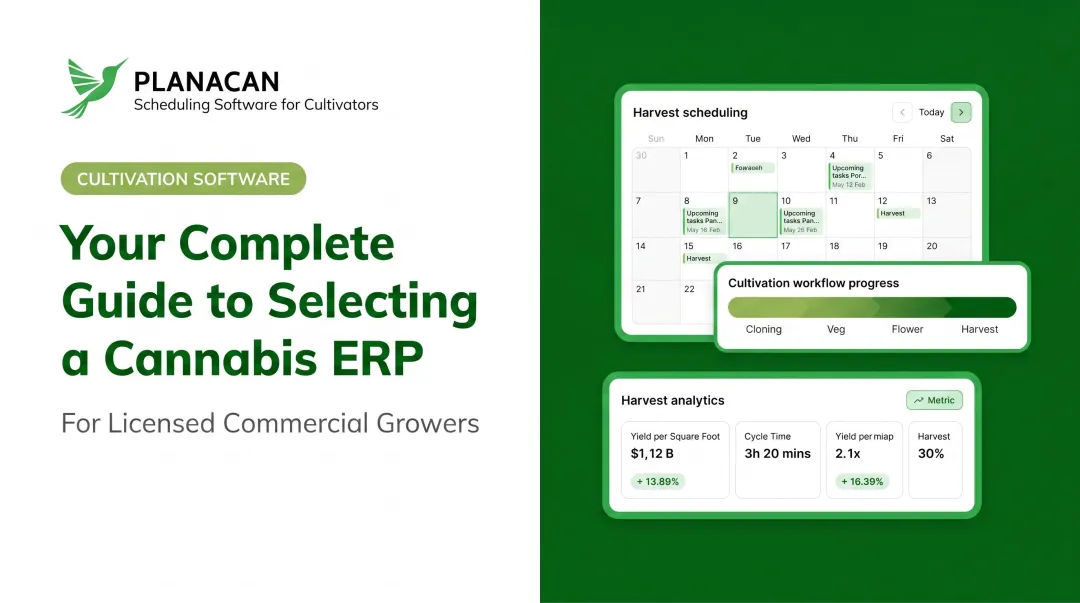
- View every harvest schedule across your entire facility on an interactive Gantt chart, organized by room, phase, team, or batch
- Get automatic daily notifications, delivered by push or email, so every team member knows exactly what's due that day
- Execute tasks on the floor using offline-capable iOS and Android apps, syncing once you're back on Wi-Fi
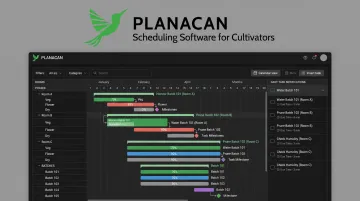
Garden First Cannabis, a PlanaCan customer managing 16 rotating harvests, reported a 36% increase in completed tasks and a 23% decrease in labor costs after adopting the platform. Their feedback was direct: "Simple to use, and effective. Our team knows what they need to do, and when to do it."
PlanaCan doesn't replace METRC or BioTrack. It sits alongside your state compliance reporting as the daily operations layer, handling scheduling, task completion, and labor tracking while your track-and-trace system handles the required state records.
Common Challenges in Cultivation Systems
Even well-designed systems run into predictable friction points:
- Inconsistent execution. Treatment schedules drift between rooms or shifts, and that inconsistency is a leading cause of yield variability, even when the underlying method is sound.
- Environmental control failures. A 2025 controlled-growth-chamber study found high relative humidity (78-98%) delayed flowering by three weeks and cut total biomass by 75.3% compared to lower-humidity conditions. Missed tasks compound this risk quickly.
- Irrigation timing gaps. Research on outdoor hemp production shows overwatering can create anaerobic root conditions and root rot, while underwatering caps yield well below potential.
- Scaling across facilities. MSOs trying to replicate a successful system across multiple sites face the same challenge Curaleaf did: local practices differ, and standardization takes real implementation work, often multiple growth cycles, not a single memo.
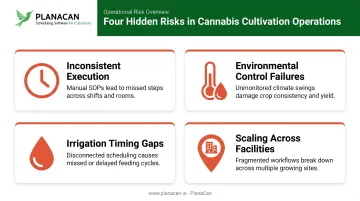
A sound medium does not prevent these failures. They show up when the operational layer cannot keep pace with the physical system.
Frequently Asked Questions
What is a cultivation system?
A cultivation system is the combination of growing method, environment, and operational workflow used to grow plants commercially, from clone or seed to harvest. It covers the grow medium, the facility setup, and the day-to-day workflow that runs both.
What are the different types of cultivation systems?
The main types are soil-based, hydroponic, aeroponic, and aquaponic systems, each with different labor and control trade-offs. Environment further classifies systems as indoor, greenhouse, or outdoor.
What is an example of a cultivation system?
A common example is an indoor hydroponic flower room on an automated feeding and irrigation schedule. Standardized treatment templates and daily task scheduling keep the team aligned.
How do commercial growers standardize their cultivation systems across multiple rooms or locations?
Growers typically build custom templates by strain and treatment, then deploy them consistently through cultivation management software. This keeps execution uniform even as room count or facility count grows.
What is the difference between a cultivation system and cultivation management software?
A cultivation system is the growing method itself—soil, hydroponic, or aeroponic—plus its environment. Cultivation management software is the operational tool, like PlanaCan, used to schedule and run that method day to day.
How does technology improve the efficiency of a cultivation system?
Automated scheduling, daily notifications, and task tracking reduce manual coordination work and catch missed tasks before they affect yield. PlanaCan customers have reported measurable gains, including a 36% increase in completed tasks.