Introduction
Running a commercial cannabis cultivation facility in 2026 is less about growing skill and more about operational discipline. A missed feeding, a delayed defoliation, a compliance gap that slipped through the cracks — in a multi-room facility running staggered harvest cycles, these aren't minor inconveniences. They compound into measurable yield loss and, in regulated markets, potential license violations.
The market pressure makes this worse. According to Cannabis Business Times, 53% of surveyed cultivators were not profitable in fiscal 2023, and wholesale price compression continues — Michigan flower prices dropped 16% in 2025 alone. Margins are thin. Operational waste is no longer affordable.
This guide covers the five pillars of effective cultivation facility management: environmental controls, scheduling and workflow, team accountability, sanitation, and regulatory compliance. It's written for commercial cultivators managing 3,000–20,000+ square feet of canopy — operations running real team structures, multiple rooms, and the scheduling complexity that comes with both.
Key Takeaways
- Effective facility management rests on five pillars: environmental control, scheduling, team accountability, sanitation, and compliance
- Standardized SOPs and workflow templates drive consistent yields and make operations scalable
- Labor represents 30–50% of cultivation operating expenses; scheduling software is the most direct way to cut that cost
- Ongoing environmental obligations — not just licensing — are where most cultivations fall short on compliance
What Cannabis Cultivation Facility Management Covers in 2026
Facility design (building and equipping the grow space) and facility management (the ongoing operational oversight of people, plants, processes, and compliance) are different disciplines. This guide covers management — the work that happens every day after the build-out is complete.
Three Facility Types and Their Management Complexity
| Facility Type | Primary Function | Management Complexity |
|---|---|---|
| Cultivation facility | Growing, harvesting, drying, curing | Foundational compliance, environmental control, team workflows |
| Processing/extraction facility | Post-harvest extraction, concentrate manufacturing | Separate licensing, C1D1/C1D2 requirements, additional safety protocols |
| Vertically integrated operation | Both cultivation and processing | Compound complexity across all regulatory layers |
Most of this guide applies to cultivation facilities. Processing operations require separate state licenses in California, Colorado, and Michigan, with their own safety and environmental classifications — a scope covered briefly here but not in depth.
Why 2026 Adds New Management Pressure
MJBizDaily projected $123.6 billion in total US economic impact from regulated marijuana in 2025. More legal markets, however, mean more licensed competition and higher consumer quality expectations. The operators weathering margin compression are the ones running tight, efficient facilities — operational discipline, not just cultivation skill, is what separates them.
Environmental Controls & Facility Design Essentials
HVAC and Climate Control
HVAC is the single most operationally critical system in any cultivation facility. According to the Resource Innovation Institute, HVAC represents 30–60% of indoor operating expense — and when it fails, it doesn't just cost money. It costs crops.
Key variables to manage continuously:
- Temperature — Cannabis thrives between 25–30°C; deviations stress plants and invite pathogen pressure
- Relative humidity — Stage-specific targets prevent powdery mildew and botrytis
- VPD (Vapor Pressure Deficit) — Juvenile plants target ~0.8 kPa; late-stage plants target ~1.3–1.4 kPa
- CO2 levels — Supplementation is standard in commercial indoor grows; sensor-based monitoring is required at scale
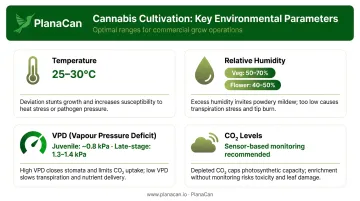
Drift in any one of these parameters, left undetected for even a few hours, can compromise an entire room's yield. At commercial scale, automated sensor monitoring isn't a luxury — it's the difference between catching a problem at 2 AM and discovering crop damage at morning walkthrough.
Lighting Systems
Light spectrum directly affects cannabinoid and terpene profiles at different growth stages, making fixture selection an agronomic decision, not just an energy decision.
LED adoption has accelerated: 78% of commercial cultivators now use LEDs in veg and 77% in flower, according to Cannabis Business Times' 2024 lighting research. HPS flower use dropped 40 percentage points since 2016. The efficiency data supports the shift — indoor operations using LED in flower achieved 34% better average electric EUI than non-LED operations.
Before committing to fixtures, verify that the specific product has documented performance data for cannabis cultivation. Not all horticultural LEDs perform equivalently in a commercial grow environment.
Room Layout and Workflow Design
Lighting decisions and floor planning are tightly linked — the fixture type affects heat load, which shapes HVAC placement, which constrains how rooms can be staged. A well-planned floor plan separates growth stages (propagation, veg, flower, drying/curing) to reduce cross-contamination risk and improve team movement efficiency. Modular layouts that support stage isolation are best practice for both compliance and scalability.
Poor layout creates invisible costs:
- Cultivators walking longer routes between tasks
- Contamination moving between rooms on equipment or clothing
- Teams working around each other during overlapping harvest and transplant cycles
Air Filtration and Ventilation
HEPA and carbon filtration serve dual purposes — plant health and regulatory compliance. Carbon filtration controls VOC and odor emissions during cultivation, which local regulators increasingly require, particularly in facilities with neighboring buildings. Some states — Minnesota, for example — explicitly identify carbon filtration as an expected odor-control technology for licensed cannabis businesses.
Spore trap testing, conducted monthly at minimum, helps catch fungal pressure before a full outbreak develops. Pairing filtration records with spore trap results also supports audit documentation if a regulator questions your environmental controls.
Security Infrastructure
Security is both a compliance requirement and an asset protection strategy. State requirements vary but include concrete minimums:
- California: Video surveillance at minimum 1280 x 720 resolution, 90-day recording retention (CCR 15044)
- Colorado: 40-day recording retention
- Michigan: Commercial-grade locks or electronic/keypad access, alarm systems, escorted non-employees, secured restricted storage areas
Access control systems (keycards, biometrics, PIN entry) and continuous surveillance coverage of all canopy and entry areas are baseline expectations in every regulated market.
Grow Scheduling & Workflow Management
Scheduling is the operational backbone of a commercial grow. In a facility running multiple rooms with staggered harvest cycles, an untracked task doesn't stay isolated — a missed feeding, a delayed flush, a skipped IPM application ripples forward into yield loss and team confusion across every subsequent cycle.
Why Manual Tools Break Down at Scale
Whiteboards, spreadsheets, and shared calendars work fine for a single room. They fall apart when you add rooms, strains, and a team of five or more cultivators. Specific failure points:
- No real-time synchronization between manager and floor cultivators
- No automatic alerts when tasks are due or overdue
- No per-task accountability record (who did what, and when)
- No audit trail for regulatory inspections
- Version conflicts when multiple people edit the same spreadsheet
- No template re-deployment across perpetual harvests
PlanaCan customers put it plainly: managing a commercial cannabis grow on spreadsheets and group texts works until your second or third room — then the cracks compound faster than you can patch them.
Cultivation-Specific Scheduling Software
The alternative is software built for how cultivation actually works — perpetual harvests, strain-specific protocols, multi-room visibility.
Core capabilities that distinguish cultivation-specific platforms from generic project tools:
- Multi-room Gantt view — See every harvest schedule across all rooms from a single screen
- Automated daily notifications — Tasks reach team members via iOS and Android apps and email, no manual morning follow-up required
- Supervisor overdue alerts — Issues surface by room before they compound across the cycle
- Strain-specific templates — Build a protocol once, deploy it across every harvest that uses that strain, and updates apply automatically going forward
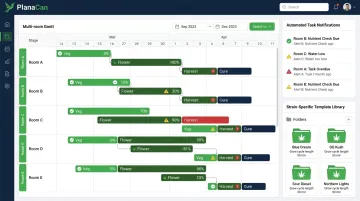
That last point is what makes consistency scalable. When protocols live in templates rather than individuals' heads, quality doesn't shift based on who's on the floor that day.
Metrics That Indicate Scheduling Efficiency
Once scheduling software is in place, track these to confirm improvement:
- Completed task rate — Events completed vs. assigned, by user and by room
- Labor hours per phase — Attribution by task, room, strain, and batch
- Harvest yield by batch — Using the KPI formula: total yield in grams ÷ total cultivation footprint = grams per sq ft
Garden First Cannabis documented the impact of structured scheduling through PlanaCan: 36% increase in completed tasks, successful management of 16 rotating harvests simultaneously, and a 23% decrease in labor costs — with labor representing 30–50% of cultivation operating expenses, that last figure translates directly to margin.
Team Management, SOPs & Accountability
The Staffing Reality
Vangst's 2025 Cannabis Jobs Report found US legal cannabis employment lost ground despite revenue growth, driven by regulatory pressures and declining operator margins. Operations that depend on institutional knowledge held by individual team members — rather than documented SOPs — are exposed when staff transitions happen.
What Effective SOPs Look Like
An SOP that says "water plants when dry" is not an SOP. Effective cultivation SOPs document every repeatable process with enough specificity that any trained team member can execute to the same standard:
- Exact nutrient ratios, EC targets, and pH ranges by strain and stage
- IPM scouting protocols, including what to look for and how to document findings
- Sanitation sequences for each room entry and tool use
- Harvest procedures from flush timing through dry-down targets
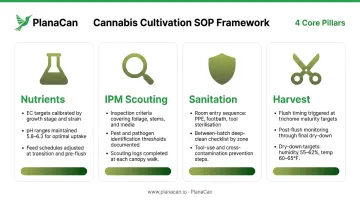
Michigan's Cannabis Regulatory Agency requires licensees to maintain SOPs and correct deficient ones within one business day of identified noncompliance. SOPs aren't optional; they're auditable records.
Embedding SOPs Into Daily Execution
Having auditable records means nothing if SOPs never reach the person doing the work. The gap most operations struggle with isn't writing SOPs — it's getting them to the cultivator in the grow room, at the moment of execution. PlanaCan addresses this by embedding SOPs directly into assigned tasks on cultivators' mobile devices. When a task fires, the relevant SOP is attached. Completion includes SOP confirmation, creating a timestamped record that the work was done and done to documented standards.
Role-based access ensures floor cultivators see their task-specific responsibilities while head growers and managers have dashboard-level visibility across rooms, labor analytics, and overdue task alerts.
Onboarding and Operational Continuity
Structured onboarding — built on the same SOP templates used for daily execution — reduces ramp-up time and protects consistency during staff transitions. Operations expanding across rooms, facilities, or licenses need onboarding that scales on its own, without a manager shadowing every new hire through their first two weeks.
Sanitation, Pest Management & Facility Hygiene
The same warm, humid environment optimal for cannabis growth is equally optimal for mold, mildew, and fungal pathogens. In a licensed commercial facility, reactive management isn't an option. By the time visible symptoms appear, contamination has already progressed.
What the Research Shows
Peer-reviewed research on cannabis facility microbiology found greenhouse air samples reaching 30 CFU per petri dish versus a maximum of 1 CFU in indoor samples. Mechanical trimming increased Penicillium and Cladosporium frequency from 5–10 CFU to 25–30 CFU. Studies have documented Aspergillus niger, Penicillium, and Fusarium oxysporum in unsterilized coco coir.
Michigan's testing guidance sets 10,000 CFU/g as the action limit for total yeast and mold. California and Colorado both mandate microbial impurities testing for flower. A contaminated batch triggers a compliance event, not just a production loss.
Daily and Deep-Clean Sanitation Program
A proactive sanitation program includes:
- Removal of fallen plant matter and standing water after every room entry
- EPA-registered disinfectants on all surfaces and tools between uses
- Foot sanitizer stations at all room entries
- Regular spore trap testing on a scheduled (not reactive) basis
- Documented sanitation logs with timestamps and responsible parties
Integrated Pest Management (IPM)
Massachusetts Cannabis Control Commission guidance defines IPM as combining monitoring, sanitation, physical barriers, action thresholds, and treatment protocols as a last resort.
EPA-registered pesticides are federally prohibited on cannabis, and many state-specific bans extend beyond federal law. Cultivators cannot default to conventional pesticide applications — IPM's preventive framework is often the only compliant approach available.
Core IPM program components:
- Scheduled scouting (weekly at minimum, more frequently during high-risk periods)
- Environmental monitoring for temperature and humidity excursions that increase pest pressure
- Biological controls where approved
- Documented treatment protocols with product, rate, and application records
Regulatory & Environmental Compliance for Cannabis Facilities
Most cannabis operators understand they need a state cultivation license. Fewer understand the full scope of environmental regulations that apply independently of cannabis licensing. That gap is where serious violations occur.
The Environmental Compliance Layer
Federal and state environmental agencies regulate cannabis cultivation facilities whether or not those agencies have cannabis-specific programs. Depending on facility size, activities, and location, applicable regulations may include:
- NPDES permits (EPA) — For wastewater discharge to waters of the United States; cultivation wastewater may trigger permitting depending on discharge method
- RCRA hazardous waste — Small quantity generators produce 100–1,000 kg/month; large quantity generators exceed 1,000 kg/month; both face generator requirements
- EPCRA Tier II reporting — Required under Section 312 for chemical storage above threshold quantities
- SPCC plans — Apply to facilities with backup generators meeting oil-storage and discharge-risk criteria
- Title V air permits — Apply to major sources with potential emissions exceeding 100 tons per year of regulated pollutants
- State/local air and odor permits — Minnesota PCA explicitly states air permits may be required and identifies VOC controls as expected compliance measures
The Most Common Compliance Failure Mode
Environmental compliance data from California's DCC and other state records show a consistent pattern: operators who obtain required permits but fail to follow through on ongoing obligations — monitoring, recordkeeping, annual training, permit renewals — face some of the most severe violations. Obtaining the permit opens the door; what regulators actually audit is everything that happens after.
A complete compliance calendar for a cultivation facility should include:
- Cannabis license renewal deadlines by state
- Annual environmental permit reporting dates
- Scheduled monitoring and sampling requirements
- Staff training renewal dates
- Tier II reporting deadlines (March 1 annually under EPCRA)
Designate a Compliance Owner
A compliance calendar only works if someone owns it. Every licensed cultivation facility should designate a compliance officer — internal or external — responsible for tracking requirements across both cannabis-specific and environmental agencies.
That person's core responsibilities typically include:
- Maintaining the master compliance calendar with all permit and reporting deadlines
- Conducting or coordinating staff training on environmental obligations
- Serving as the primary contact for agency inspections and information requests
- Flagging changes in state or federal regulations that affect facility operations
Distributing compliance awareness beyond one person matters too. Environmental inspectors look for evidence that more than one member of the team understands the facility's obligations — not just the person holding the title.
Frequently Asked Questions
What is a cannabis cultivation facility?
A cannabis cultivation facility is a licensed site where cannabis plants are grown, harvested, dried, and cured under controlled conditions. These facilities range from small boutique operations to large commercial grows and must comply with state and local licensing, security, environmental, and operational requirements.
What is a cannabis processing facility?
A processing facility handles post-harvest work: extraction of oils, manufacturing of concentrates, edibles, and other cannabis-derived products. It requires a separate license from cultivation in most states. This guide focuses specifically on cultivation facility management rather than processing operations.
How do you manage multiple grow rooms simultaneously?
Staggered harvest scheduling, standardized SOPs per room, and a centralized scheduling system are the core building blocks. Platforms like PlanaCan give managers visibility across all rooms simultaneously, tracking task completion, flagging overdue work, and keeping each room on its own optimized timeline without manual daily check-ins.
What licenses are required to operate a cannabis cultivation facility in the US?
Requirements vary by state but typically include a state cultivation license, a business license, and zoning or land-use approval — with states like California, Colorado, and Michigan using tiered structures based on canopy size or plant count. Verify current requirements with your state's cannabis regulatory authority before applying.
What are the most common compliance mistakes cannabis cultivation facilities make?
Two failures repeat consistently: (1) not knowing the full scope of environmental regulations that apply beyond cannabis licensing — particularly EPA, air quality, and wastewater requirements — and (2) obtaining required permits but failing to fulfill ongoing obligations like recordkeeping, scheduled monitoring, and annual training renewals.
What technology do commercial cannabis cultivators use to manage their operations?
Most commercial operations run a layered stack: state track-and-trace systems (METRC, BioTrack, Leaf Data Systems) for compliance reporting, environmental sensors for climate monitoring, and cultivation management platforms like PlanaCan for scheduling, SOP management, and team task tracking. Compliance reporting and operational execution serve different functions and require different tools.