Introduction
Running a commercial cannabis cultivation means coordinating teams of 5 to 20+ staff across multiple rooms, managing treatment protocols on thousands of square feet of canopy, and tracking concurrent harvest cycles — simultaneously.
Most grow teams are doing this with spreadsheets, whiteboards, and group texts. That works until it doesn't. A missed IPM treatment, a task that fell through the cracks on shift change, a schedule change that nobody communicated — these mistakes cost real money.
The right cannabis grow app doesn't just organize your to-do list. It gives your entire team one shared system everyone works from, holds every person accountable without constant manual follow-up, and generates the data you need to run a tighter operation every cycle.
This guide covers the best apps purpose-built for licensed commercial cultivators in 2025–2026, evaluated on scheduling depth, team accountability tools, mobile usability, and how well each one holds up at production scale.
Key Takeaways
- Most cannabis apps are built for home growers — commercial operations need platforms designed for teams, multi-room visibility, and accountability at scale
- Top platforms each fill a different role: scheduling/workflow (PlanaCan), seed-to-sale compliance (Canix, Trym), quality management (GrowerIQ), sensor-driven irrigation (AROYA), and AI analytics (Growgoyle)
- Commercial facilities typically need one cultivator per 1,000 sq ft — a 10,000 sq ft operation means 10+ people to coordinate
- Choosing the wrong app creates more administrative overhead, not less
- Start by identifying your biggest operational bottleneck before evaluating platforms
What Commercial Cannabis Cultivators Actually Need from a Grow App
Walk through any app store search for "cannabis grow app" and you'll find no shortage of plant journals, feeding logs, and strain trackers. These tools serve home growers well. They don't serve a 10,000 sq ft licensed facility with a team of 15 and six concurrent harvest cycles.
Commercial operations have requirements that home-grower tools simply weren't designed to meet. A useful commercial platform needs to solve problems across four distinct operational categories:
| Category | What it covers |
|---|---|
| Grow scheduling & team management | Task assignment, daily accountability, multi-room calendar visibility |
| Regulatory compliance | Seed-to-sale tracking, METRC/BioTrack integration, audit trails |
| Environmental monitoring | Sensor integration, substrate data, climate alerts |
| Data analytics | Post-harvest reporting, labor costs, yield trends by strain or room |
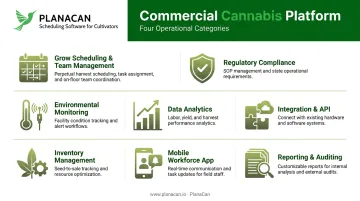
No single platform excels at all four — which is why pinpointing your biggest operational gap before you evaluate tools saves time. The apps below each address at least one of these categories at genuine commercial scale.
Best Cannabis Grow Apps for Commercial Cultivators
PlanaCan
PlanaCan is a cultivation management platform built specifically for commercial cannabis operations — designed to standardize workflows, eliminate missed tasks, and get grow teams working from a synchronized schedule. It serves facilities from single-room operations at 3,000 sq ft all the way to multi-state operators managing 20,000+ sq ft across multiple sites.
Three interconnected features work together as a system:
- Custom workflow templates — built per strain, treatment, and growth phase; create once, deploy to any room, refine each cycle
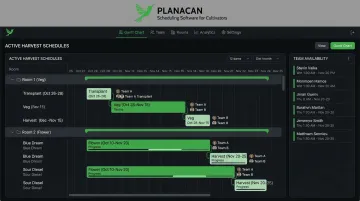
- Interactive Gantt chart — a bird's-eye view of every active harvest schedule across all rooms simultaneously, with drag-and-drop rescheduling and automatic downstream task shifting
- Automatic daily notifications — pushed to iOS and Android or sent via email, scoped to each team member's assignments so everyone knows exactly what needs to happen that day
The platform is designed to run alongside compliance tools like METRC, BioTrack, and Leaf Data Systems — not replace them. PlanaCan handles the cultivation operations layer (scheduling, SOPs, labor tracking, yield analytics) while state-mandated systems handle regulatory reporting.
Based on results from Garden First Cannabis, a documented PlanaCan customer managing 16 rotating harvests, the platform produced a 36% increase in completed tasks and a 23% decrease in labor costs. PlanaCan presents these as outcomes from a real customer case study and as representative benchmarks; prospective customers should contact PlanaCan directly for full methodology details.
| Category | Details |
|---|---|
| Key Features | Custom strain and treatment templates, Gantt chart harvest scheduling, automatic daily team notifications, iOS and Android mobile apps, multi-room and multi-site support, labor and yield analytics |
| Best For | Commercial cultivators with 3,000–20,000+ sq ft focused on team coordination, scheduling accountability, and workflow standardization — as a complement to their compliance stack |
| Pricing | Tiered per-user subscription model; specific pricing is quote-based. Flexible free trial (typically 1–2 weeks, grower-paced until the team feels confident); no long-term contract required. Contact sales@planacan.io for current rates. |
Canix + Trym
Canix acquired Trym on January 27, 2026, combining Canix's Y Combinator-backed ERP foundation with Trym's cultivation-specific tools into one vendor offering. The combined platform serves over 650 cannabis facilities across six countries, making it one of the most widely deployed seed-to-sale ERP options for licensed cultivators.
Where this platform excels is regulatory compliance as the operational backbone:
- Direct METRC integration with real-time webhooks for plant, harvest, package, and transfer updates
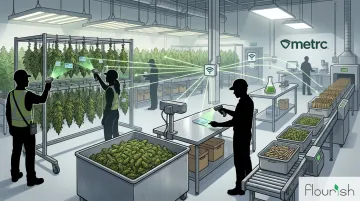
- Trym's Touchless Harvesting workflow — a mounted device scans plant tags, a Bluetooth scale sends weight automatically, and data submits to METRC with one click
- Full ERP coverage including CRM, labeling, manufacturing, climate monitoring, and root-zone data
Documented outcomes from vendor case studies include approximately 20 labor hours saved weekly at Ladybug Farms after replacing spreadsheet-based workflows, and 680 plants processed in under four hours at a 20,000 sq ft facility using Touchless Harvesting. Both figures come from vendor-published case studies.
Note: Canix's current website contains conflicting customer counts (650+ and 1,000+), and public sources have not confirmed that all Trym features are fully migrated into a single technical application. Evaluate the current product state during a demo.
| Category | Details |
|---|---|
| Key Features | Seed-to-sale ERP, METRC integration with real-time webhooks, Touchless Harvesting, RFID scanning, climate and root-zone monitoring, CRM and manufacturing modules |
| Best For | Multi-state operators and licensed cultivators where METRC compliance and full ERP functionality are the primary driver |
| Pricing | Canix is facility-specific and requires a demo quote. Trym's Touchless Harvesting starts at $140/month. |
GrowerIQ
GrowerIQ positions itself as the only seed-to-sale platform with a natively integrated Quality Management System — combining CAPAs, deviation tracking, SOP management, QA batch approvals, and electronic signatures within the same interface as cultivation, manufacturing, ERP, and CRM. The "only" claim is from GrowerIQ's own materials and hasn't been independently verified, but the QMS feature set itself is well-documented. The platform won Software of the Year at the 2024 GrowUp Awards (per GrowerIQ's own announcement).
GrowerIQ is validated as a METRC integrator across 10 US jurisdictions and is best suited for operators who treat quality and compliance as competitive advantages — particularly those managing multiple SOPs, deviation reporting, or rigorous internal audit requirements.
A published customer case study from Christina Lake Cannabis reports 16% revenue growth, 81% higher inventory value, and a 7.9% gross margin improvement while managing a 105,000 kg harvest. These figures are from a vendor-hosted case study.
| Category | Details |
|---|---|
| Key Features | Integrated QMS (CAPAs, deviations, SOPs, digital signatures), seed-to-sale tracking, facility sensor integration, ERP and CRM, METRC integration across 10 jurisdictions |
| Best For | Operators prioritizing integrated quality management and compliance without managing multiple disconnected systems |
| Pricing | No public pricing; demo required. Contact via groweriq.ca. |
AROYA
AROYA, built by Addium, is the leading commercial sensor and substrate monitoring platform for cannabis cultivation. It runs on proprietary TEROS ONE substrate sensors that measure pore-water EC, volumetric water content, and temperature in real time — generating high-volume irrigation data that drives crop steering decisions.
This is not a standalone app. AROYA requires purchasing Addium's hardware stack alongside the software subscription, making it a precision infrastructure investment rather than a software tool you trial in a week.
When deployed properly, it delivers:
- Continuous substrate data feeding irrigation automation decisions
- Multi-room, multi-site environmental monitoring from a single interface
- In 2026, AROYA added an AI "second brain" feature that scans facility data, detects emitter failures, isolates affected zones, and generates step-by-step incident reports
Vendor-published outcomes include a 20% yield increase at Shango and 21% revenue growth in year one, 72% by year two at SKORD Marijuana. No independent controlled study has been published to verify these figures. Pricing requires direct contact with sales; AROYA's FAQ confirms that subscription need depends on facility-specific factors.
| Category | Details |
|---|---|
| Key Features | TEROS ONE substrate sensors, real-time irrigation and EC data, AI-driven pattern analysis and incident reporting, yield consistency monitoring, multi-room support |
| Best For | Multi-room commercial cultivators with budget for a full proprietary hardware stack, prioritizing irrigation precision and environmental data |
| Pricing | Hardware purchase required in addition to software subscription. No public pricing; contact AROYA sales directly. |
Growgoyle
Growgoyle is an AI-native cultivation platform designed for commercial indoor operations with teams of 3–15 employees and up to 10 sites. It integrates scheduling, batch journaling, photo-based canopy analysis, environmental monitoring, and post-harvest analytics into a single system that learns from the operator's own grow data over time.
The most distinctive commercial feature is AI Batch Analysis — after harvest, the system generates a Goyle Score and three specific improvement opportunities, with phase-by-phase breakdown across yield, quality, environment, drying, and efficiency. The photo analysis feature flags nutrient deficiencies, pests, and light stress from a phone photo in approximately 60 seconds.
Growgoyle reports an internal 21.7% yield increase following a pot-size change at its founder's facility. No external named customer case study has been published as of this writing.
Note: Growgoyle's website currently shows conflicting information about trial duration (7-day vs. 30-day full Pro trial). Confirm directly before planning an evaluation.
| Category | Details |
|---|---|
| Key Features | AI scheduling, batch journaling, 60-second photo canopy analysis, environmental monitoring, post-harvest AI analytics (Goyle Score, phase-by-phase breakdown) |
| Best For | Operators who want AI integrated throughout the cultivation workflow — not bolted onto legacy software — with built-in post-harvest reporting |
| Pricing | Core: $499/month (up to 10 flowering batches). Pro: $999/month (up to 25 batches). Free trial available; confirm duration directly. |
How We Chose the Best Cannabis Grow Apps for Commercial Cultivators
Every app on this list was chosen because it solves a real commercial operational problem at scale. The most common mistake cultivators make is downloading a tool built for hobbyists (basic plant diaries, single-user feeding logs, strain trackers) and expecting it to coordinate a team, manage multiple rooms, or hold anyone accountable across a shift.
Evaluation criteria used:
- Addresses commercial complexity — Multi-room, multi-team licensed operations have different demands than a home grow tool with a commercial pricing tier stapled on.
- Supports team accountability — Assigns tasks, sends notifications, tracks completion, and logs who did what and when across your entire facility.
- Connects with your existing stack — Integrates with compliance systems (METRC, BioTrack), sensors, or ERP tools already in use at your facility.
- Publishes measurable outcomes — The vendor provides real-world performance data from actual customers: labor savings, yield improvements, compliance track record.
- Accessible onboarding — A grow team without a technical background can get up and running quickly, without a dedicated IT implementation.
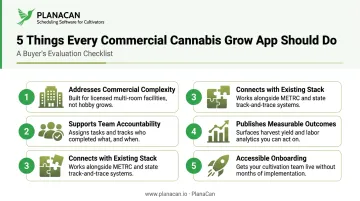
No app on this list scores perfectly across all five criteria. That's by design. A cultivator whose primary bottleneck is METRC compliance has different needs than one whose team is missing tasks across four flower rooms. Use these criteria to identify which gap your operation needs to close first, then match the tool accordingly.
Conclusion
Commercial cannabis cultivators are not well-served by apps designed for home growers, and downloading the wrong tool adds busywork without fixing what's actually broken.
Before evaluating any platform, identify which operational gap is costing you the most:
- Missed tasks and scheduling chaos → Look at PlanaCan
- METRC compliance and seed-to-sale reporting → Look at Canix + Trym
- Quality management and SOP enforcement → Look at GrowerIQ
- Irrigation precision and substrate data → Look at AROYA
- AI-driven post-harvest analytics → Look at Growgoyle
For many commercial operations, team coordination is the root issue — missed tasks, inconsistent workflows, and scheduling gaps that compound across every harvest cycle.
If that's where your operation struggles, PlanaCan offers a flexible free trial, paced to your team's comfort with the platform. Start with a Discovery Call at planacan.io/contact or reach out directly at sales@planacan.io.
Frequently Asked Questions
What is the best cannabis grow app for commercial cultivators?
The best app depends on your primary operational need. PlanaCan leads for scheduling and team accountability; Canix + Trym for seed-to-sale compliance and METRC reporting; GrowerIQ for integrated quality management; and AROYA for sensor-driven irrigation precision. No single platform wins across every category — the right choice comes down to your specific bottleneck.
How is a commercial cannabis grow app different from a home grow journal app?
Commercial apps are built for team coordination, multi-room visibility, task assignment, compliance reporting, and scalable workflows. Home apps focus on individual plant tracking, feeding logs, and grow diaries — they don't scale past one or two people and have no accountability layer.
Do commercial cannabis grow apps integrate with METRC?
Compliance-focused platforms like Canix + Trym and GrowerIQ offer direct METRC integration. Scheduling and workflow tools like PlanaCan are designed as a complementary operations layer — they run alongside METRC rather than replacing or duplicating its reporting function.
What features should a commercial cannabis grow app have for multi-room operations?
At minimum, look for:
- A Gantt chart or calendar view showing all active harvest cycles simultaneously
- Template-based scheduling that deploys per room or strain independently
- Task assignment and team notifications scoped by room or phase
- Harvest tracking across concurrent cycles without schedules crossing over
How much does commercial cannabis cultivation management software cost?
Pricing varies widely — Growgoyle publishes rates ($499–$999/month), while Canix, AROYA, and GrowerIQ require direct sales contact for quotes. Hardware-dependent platforms like AROYA also layer sensor and equipment costs on top of software fees. Request a trial or demo before committing to any platform.
Can a cannabis grow app help reduce labor costs?
Scheduling and accountability platforms reduce labor costs by cutting wasted time, missed tasks, and the overhead of chasing status updates. PlanaCan's documented outcome from Garden First Cannabis shows a 23% decrease in labor costs; contact PlanaCan at sales@planacan.io for methodology details relevant to your operation size.