Introduction
Cannabis compliance software gets discussed constantly in industry circles — but most of that conversation centers on dispensaries. POS integration, purchase limits, customer records. Retail compliance is well-documented. Cultivation compliance, less so.
That gap matters. Commercial cultivators face a completely different regulatory environment than dispensaries, and the tools they need reflect that difference. Plant-level tagging, harvest batch records, pesticide application logs, waste documentation, transfer manifests — these obligations don't map onto retail compliance tools, and generic guidance doesn't serve cultivators well.
This guide covers the full picture for cultivators: what cannabis compliance software actually is, the different tool categories available, what features matter operationally, and where cultivation management platforms like PlanaCan fit into the stack alongside state track-and-trace systems.
Key Takeaways:
- Cannabis compliance software covers two layers: state-mandated track-and-trace systems and operator-facing operational platforms
- Cultivators face obligations (plant tagging, pesticide logs, harvest records) that differ fundamentally from retail requirements
- Inventory and recordkeeping violations consistently rank among the top inspection findings in states like Illinois
- Cultivation management software creates the operational paper trail that state systems don't capture
- Real-time, in-room task logging via mobile produces the most defensible compliance records
What Is Cannabis Compliance Software?
Cannabis compliance software covers any digital tool that helps licensed cannabis businesses meet state and local regulatory obligations — through tracking, documentation, reporting, and workflow management.
Two distinct categories fall under that definition, and confusing them leads to buying the wrong tool.
Two Distinct Categories
| Category | Examples | Who Built It For |
|---|---|---|
| State-mandated track-and-trace | METRC, BioTrack, Washington CCRS | Regulators |
| Operator-facing operational software | Canix, Distru, PlanaCan | Cannabis businesses |
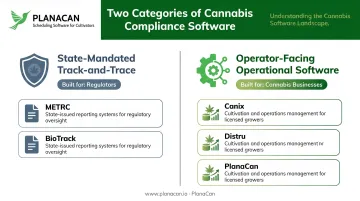
State-mandated systems are not optional business tools — they are government-required reporting infrastructure. METRC reports 30 regulatory contracts across the US, with verified deployments in California, Colorado, Illinois, New York, Montana, New Jersey, and Maine, among others. BioTrack reports 12 government contracts, currently serving Florida and New Mexico as official state systems. These platforms exist to give regulators visibility into product movement, tax accountability, and diversion prevention.
Operator-facing software is what businesses choose to manage internal workflows, documentation, and the day-to-day work that runs a licensed operation. This category includes seed-to-sale ERPs, cultivation management platforms, and document management systems — each serving a different slice of the operation.
Why This Distinction Matters for Cultivators
Cultivators face a compliance landscape distinct from dispensaries. Their obligations center on:
- Plant-level RFID tagging (individual tags for flowering plants, group tags for immature lots)
- Harvest batch documentation and weight reporting
- Pesticide and IPM application records
- Waste and destruction logs with Metrc tag numbers
- Transfer manifests for all product movement
None of this maps onto POS transaction records or purchase limit tracking. Cultivators need tools built around cultivation workflows, not retail workflows repurposed for the grow.
Why Compliance Is Especially Challenging for Cannabis Cultivators
The compliance burden for commercial cultivators is structural, not just administrative. Several factors combine to make it genuinely difficult to stay consistently compliant without purpose-built tools.
Regulations Change — Often Mid-Season
State cultivation compliance requirements don't stay static. In August 2023, Maine's Office of Cannabis Policy distributed Metrc bulletin ME_IB_0035, introducing Flexible Standardized Batch Tracking for plant groups — a material change to how cultivators were required to tag plants and document harvests and destructions. Operations that hadn't updated their documentation protocols were immediately out of step with their regulatory requirements, regardless of how diligently they had tracked plants before.
Mid-cycle regulatory changes like this aren't unique to Maine — protocols that passed inspection last season may be non-compliant this one.
The Documentation Volume Is Relentless
Every pesticide application, every harvest batch, every waste disposal event, every plant transfer requires timestamped documentation with quantities and responsible staff. Across a commercial grow running multiple rooms and multiple strains simultaneously, these events accumulate continuously.
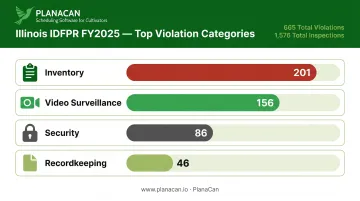
Illinois Department of Financial and Professional Regulation data from FY2025 illustrates the scale of what regulators examine: IDFPR conducted 1,020 cultivation center inspections and 556 craft grow inspections in a single fiscal year.
Of the 665 violations identified across the industry, inventory violations led with 201 findings, followed by video surveillance (156), security (86), and recordkeeping (46).
Multi-Room, Multi-Strain Complexity
A commercial cultivator may be managing plants at five different growth stages across multiple rooms simultaneously, each with different feeding schedules, IPM treatment protocols, and compliance timelines. Manual tracking breaks under that complexity. A spreadsheet doesn't distinguish between which batch received which pesticide application last Tuesday and which batch is scheduled for a different treatment this Thursday.
The Accountability Gap
Even when a cultivation team executes the right processes, undocumented work doesn't exist in the eyes of a regulator. Michigan Cannabis Regulatory Agency (CRA) consent orders make this concrete:
- GS Ashley LLC dba Holistic Industries (June 2024): Failed to accurately enter transactions and inventory into the statewide monitoring system; incorrect weight information on chain-of-custody documentation. Result: $5,000 fine.
- Alpine Grows LLC (December 2025): Failed to accurately enter current inventory into the statewide monitoring system; plant count exceeded the 1,500-plant license limit. Result: $2,000 fine.
"We did it, we just didn't log it" is not a defense regulators accept.
The Different Types of Cannabis Compliance and Regulatory Tools
State-Mandated Track-and-Trace Systems
METRC and BioTrack are government infrastructure, not optional software. Cultivators in METRC states must tag plants, report harvest batches, log all product transfers, and record destruction events — directly in the platform, in real time.
What these systems don't do is manage how or when cultivation teams execute the underlying work. They capture what happened. They don't schedule the work, assign tasks to team members, or create the operational documentation that demonstrates consistent, compliant execution. That gap is where operational tools come in.
Seed-to-Sale and Inventory Management Platforms
Platforms like Canix and Distru sit on top of or alongside state track-and-trace systems, helping cultivators manage internal inventory and generate METRC-ready batch records. Key capabilities in this category include:
- METRC sync: Bi-directional integration that pushes batch data directly to the state system
- RFID harvesting: Faster plant tagging and harvest logging at scale
- Discrepancy alerts: Real-time reconciliation flags before they become audit issues
- BioTrack integration: Deep connectivity for cultivators in BioTrack-mandated states
These tools handle the compliance reporting layer — translating operational activity into state-system-ready submissions.
Document Management and SOP Software
Document management tools store approved protocols, enforce version control, and create evidence that employees were trained on current compliant procedures. For audits, proving that an SOP existed and that staff used it is just as important as proving the work was done.
Cultivation Management and Scheduling Platforms
SOPs define what needs to happen — cultivation management platforms track that it did. This software manages grow schedules, treatment calendars, and task assignments at the room and batch level, generating an internally documented record of every cultivation action. That record is the operational evidence auditors increasingly want to see alongside state reporting submissions.
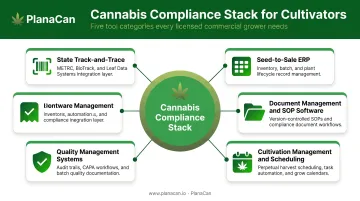
Quality Management Systems (QMS)
QMS tools designed for regulated industries handle document control, corrective and preventive actions (CAPA), and audit management. These are more common in large multi-state operators and vertically integrated companies that face pharmaceutical-grade compliance scrutiny across their entire operation.
Key Features That Matter for Cultivation Compliance Operations
METRC/BioTrack Integration
Cultivation management software should work alongside your state track-and-trace system — not in parallel with it. As the National Cannabis Industry Association notes, lack of coordination between business software and state-mandated systems creates duplicate data entry and reporting errors, one of the most common sources of compliance violations. A cultivation operations platform that complements METRC or BioTrack eliminates the manual dual-entry risk without replacing the state reporting layer.
Automatic Audit Trail and Task-Level Documentation
The software should log who completed which action, on which batch or room, at what time — without requiring manual report-writing after the fact. This timestamped compliance record is what inspectors look for when they want to verify that documented procedures were actually followed.
A system that requires managers to reconstruct records after an inspection creates exactly the kind of documentation gap that triggers violations. Auto-generated audit trails close that gap before it opens.
Customizable Workflow Templates
Different strains have different feeding schedules, IPM protocols, and harvest timelines. Software that lets cultivators build templates and deploy them consistently across every batch prevents the inconsistencies in how protocols are applied — the root cause of compliance gaps between rooms or harvest cycles.
Look for template functionality that covers:
- Strain-specific feeding and treatment schedules
- IPM and pest management protocols by treatment type
- Step-by-step workflows for each cultivation phase
Mobile Accessibility
Cultivation teams work on the floor, in the room — not at a desk. Software limited to desktop creates a documentation lag between when work happens and when it gets recorded. iOS and Android mobile access enables real-time task logging at the point of work, producing timestamped records that are accurate, verifiable, and audit-ready.
How Cultivation Management Software Fills the Compliance Gap
State track-and-trace systems record what products moved and when. They don't document the cultivation processes, treatment applications, scheduling decisions, or team accountability that inspectors increasingly want to see. That's the gap cultivation management software fills.
What the Operational Documentation Layer Looks Like
PlanaCan positions itself explicitly as the cultivation operations layer — the platform that runs the work underneath compliance reporting systems. It doesn't replace METRC or BioTrack; it generates the operational paper trail that those systems don't capture.
Specifically, PlanaCan produces:
- Version-controlled, timestamped SOPs embedded directly into task workflows, so cultivators see the current procedure at the moment of execution on their mobile device
- Automatic task completion records capturing who did what, when, and on which batch and room — at the point of work, not entered later
- Per-batch operations logs with structured data at each task: pH, EC, environmental readings, IPM applications, feed records, and photo evidence
- Harvest Detail views showing every task for an individual harvest with full user attribution, notes, and time KPIs
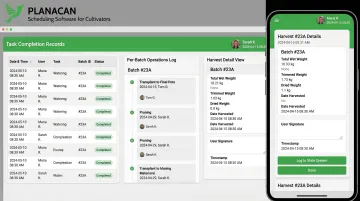
Every record is built through normal daily workflow execution — which means the audit trail exists whether an inspection is coming or not.
Practical Outcomes and Facility-Wide Visibility
Garden First Cannabis, a commercial cultivation operation managing 16 rotating harvests simultaneously, achieved a 36% increase in completed tasks and a 23% decrease in labor costs after implementing PlanaCan. Those results reflect what operational accountability looks like in practice: teams know what to do, when to do it, and every completion is documented.
PlanaCan's Gantt chart view displays every active harvest schedule across the entire facility on a single screen. For a cultivation director managing a perpetual harvest operation across multiple flower rooms (each at a different phase day), this eliminates the need to manually check each room. It also makes presenting a clear operational timeline to auditors or state officials straightforward.
The platform serves operations from single-room cultivations (3,000+ sqft canopy) to multi-state operators managing facilities across 11+ states, with the same template and scheduling infrastructure scaling to enterprise complexity.
Frequently Asked Questions
What is cannabis compliance software?
Cannabis compliance software covers digital tools that help licensed cannabis businesses meet regulatory obligations through tracking, documentation, and reporting. This includes government-mandated systems like METRC and BioTrack for plant-level tracking, and operator-facing platforms that manage internal workflows, SOPs, and compliance documentation.
Do cannabis cultivators need different compliance tools than dispensaries?
Yes. Cultivators face distinct obligations — plant-level RFID tagging, harvest batch records, pesticide and IPM application logs, and waste disposal documentation — that differ significantly from retail compliance requirements like purchase limits and POS transaction reporting. Tools built for dispensaries don't address cultivation-specific workflows.
How does METRC work for cannabis cultivation operations?
METRC requires cultivators to tag plants at defined growth stages, report harvest batches, log all product transfers, and record destruction events in real time. State rules vary — California requires individual tags on each flowering plant, while Michigan defines maturity at 8 inches — and failure to maintain current entries ranks among the most cited compliance violations.
What records should cannabis cultivators keep to stay compliant?
Core record categories to maintain include:
- Plant and batch UID tags
- Pesticide and treatment application logs with applicator information
- Harvest weights and task-level employee completion records
- Transfer manifests and waste disposal documentation with full tag numbers
Requirements vary by state — verify current standards with your state regulator.
What happens if a cannabis cultivator fails a compliance inspection?
Consequences range from fines and mandatory remediation plans to product holds, destruction orders, and license suspension. Notably, documentation gaps — not just operational failures — are among the most common inspection findings, as Michigan CRA consent orders for inventory entry failures illustrate.
How does cultivation management software help with cannabis compliance?
Cultivation management platforms log activity outside the state track-and-trace system — recording who completed each task, when, and on which batch. That creates the evidence-based paper trail inspectors expect during audits: proof that compliant procedures were consistently followed, not just theoretically in place.