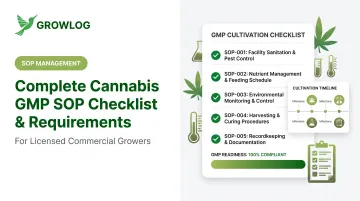
GMP SOPs are the foundation that keeps operations compliant, consistent, and scalable. This article covers what GMP means for cannabis cultivators, the complete SOP checklist regulators expect to see, and how to write procedures that actually get followed on the floor.
Key Takeaways
- GMP SOPs are a licensing requirement in most U.S. states, not optional paperwork
- Every SOP needs five components: Title/Purpose, Scope, Responsibilities, Procedure, and Recordkeeping
- Core SOP categories cover facility sanitation, cultivation process, personnel, and quality control
- Record retention requirements range from 5 to 7 years depending on state
- Written SOPs only work if your team has a clear system for assigning, tracking, and verifying daily task completion
What Is GMP for Cannabis?
Good Manufacturing Practices (GMP) are the quality standards licensed cannabis operations must meet to ensure products are produced and controlled consistently — minimizing contamination, batch failures, and compliance exposure.
Which Regulatory Frameworks Apply?
Your applicable framework depends on product type and state licensing:
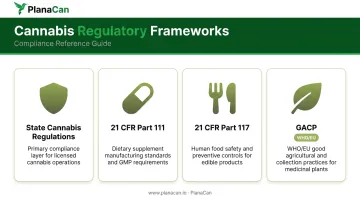
- State cannabis regulations — The primary compliance layer for licensed cultivators. Every legal state has its own cultivation rules covering sanitation, testing, tracking, and SOPs.
- 21 CFR Part 111 — Applies to dietary supplement manufacturing. Relevant if your operation produces hemp-derived products classified as dietary supplements.
- 21 CFR Part 117 — Covers human food manufacturing. Relevant for cannabis-infused food products depending on product classification.
- GACP (Good Agricultural and Collection Practices) — The WHO and EU framework for medicinal plant production. Michigan's CRA compliance guidance references GACP-GMP certification in relation to certain cannabis operations.
The FDA has stated that cannabis products fall under existing FDA authorities where applicable — but no FDA rule specifically mandates GMP for all licensed THC cultivators. Your state licensing requirements are the binding standard.
Understanding which framework applies narrows the compliance target. Once that's clear, the next question is how you actually prove you're meeting it.
GMP vs. SOPs: The Core Distinction
GMP defines the standard. SOPs are the documented procedures that prove — and enforce — compliance with that standard day to day. Without written, version-controlled SOPs your team actually follows, demonstrating GMP compliance during an inspection is nearly impossible.
Why Cannabis Cultivation Operations Need GMP SOPs
The compliance case is straightforward: most state cannabis licensing authorities require documented SOPs as a condition of licensure and audit them during inspections. Illinois issued $80,500 in cultivation center fines in FY2022. Michigan's CRA can impose fines, license suspensions, or revocations for non-compliance. California publishes every citation, denial, and disciplinary action publicly.
Beyond compliance, documented SOPs deliver real operational value:
- Maintain consistent product quality across every harvest cycle and grow room
- Onboard new cultivators faster by replacing verbal training with written, step-by-step procedures
- Reduce errors by assigning and tracking each step in writing
- Scale to additional facilities or multi-state operations without starting from scratch
- Pass inspections with documentation that shows exactly what was done, when, and by whom
The Complete Cannabis GMP SOP Checklist
The following categories represent the core SOPs that GMP-aligned cannabis cultivations must have documented. Exact requirements vary by state, but these areas appear consistently across California, Colorado, Michigan, New York, Illinois, and other regulated markets.
Facility, Equipment & Sanitation SOPs
Every SOP in this category must specify frequency, responsible staff, acceptable parameters, corrective actions, and recordkeeping — not just the task itself.
- Facility access control and security procedures
- Equipment cleaning and maintenance schedules (written procedures per 21 CFR 211.67 standards, covering methods, materials, schedules, and inspection before use)
- Pest and rodent control program (California DCC requires a documented pest management plan and DPR-compliant pesticide use; New York OCM requires trap maps and records of pest presence)
- Sanitation procedures for grow rooms, processing areas, and contact surfaces
- Environmental monitoring (temperature, humidity, CO₂, VPD) with defined acceptable ranges and corrective action triggers
Colorado Rule 3-330 specifically requires SOPs for cleaning and sanitizing contact surfaces, CO₂ accumulation controls, and cultivation and harvesting procedures. New York's compliance packet requires routine cleaning records for facilities, tools, and contact surfaces plus monitoring of temperature, ventilation, and humidity.
Cultivation Process SOPs
Facility SOPs establish the physical environment. The following process SOPs document what happens inside it — from the first cut to final harvest.
Propagation through harvest:
- Propagation and cloning protocols
- Transplanting procedures and substrate/media specifications
- Lighting schedules and distance settings
- Nutrient schedules with flush guidelines
- Defoliation and training techniques
- IPM program — both preventive and reactive, following EPA's four-step IPM framework: action thresholds, pest monitoring, prevention, and targeted control
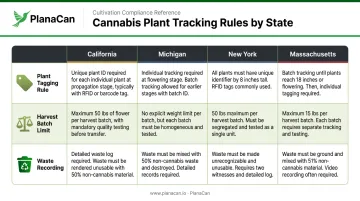
Tracking and traceability requirements by state:
| State | Plant Tagging Rule | Harvest Batch Limit | Waste Recording |
|---|---|---|---|
| California | Unique tags on main stem for canopy plants | Not specified | Within 24 hours |
| Michigan | RFID tags for plants over 8 inches | 50 lbs per batch | Within 90 days, under camera |
| New York | Unique tag on main stem; max 100 plants per lot | Not specified | 50%+ non-cannabis mixing required |
| Massachusetts | Immature batch max 100 clones | Not specified | Not specified |
Post-harvest SOPs required:
- Harvest readiness assessment criteria
- Plant weight recording and chain of custody
- Drying and curing protocols
- Waste management procedures (state-specific mixing and recording requirements)
- Seed-to-sale tracking compliance steps (METRC, BioTrack, or state equivalent)
Personnel, Hygiene & Training SOPs
These SOPs address the human element of GMP compliance — often where audits find gaps.
Personal hygiene and safety:
- Handwashing protocols and PPE requirements
- Clothing and contamination prevention standards
- Health and illness exclusion policies (employees with symptoms must not handle product)
- Visitor access protocols with sign-in logs
- OSHA-required safety procedures, first aid, and emergency response
Training documentation:
- New hire onboarding procedures
- Role-specific task training records
- Training completion verification
- Documentation that employees understand why each step matters, not just how to execute it
Quality Control, Compliance & Recordkeeping SOPs
Testing and batch documentation:
All major regulated states require pre-distribution testing for potency/cannabinoids, microbial impurities, heavy metals, and residual pesticides. A 2022 peer-reviewed analysis of cannabis contaminant data found California flower failure rates of 2.3%, with insecticides and fungicides as the leading cause — which is why pesticide SOPs and pre-harvest IPM documentation carry outsized weight in audits.
Required QC SOPs include:
- Product testing procedures and sampling protocols
- Batch recordkeeping and Certificate of Analysis (CoA) management
- Traceability and recall procedures
- CAPA (Corrective and Preventive Actions) for deviations and non-conformances
- Complaint handling and investigation procedures
Recordkeeping requirements:
Your recordkeeping SOP must specify retention periods, access controls, version control, and the review/approval process. These are among the most common audit failure points.
- California: 7-year record retention requirement
- New York: 5-year retention for transport manifests and visitor logs
- All states: Records must be accessible, organized, and retrievable during inspections
How to Write Effective GMP-Compliant Cannabis SOPs
Step 1 — Map Your Processes Before Writing
List every repeatable task from propagation through sale before drafting a single SOP. Organize by department or growth phase. Include the master grower and compliance team in this mapping exercise — they'll catch gaps that aren't visible from the office.
Step 2 — Choose the Right Format
| Format | Best Used For |
|---|---|
| Checklist | Daily room checks, sanitation routines, pre-harvest inspections |
| Visual/Photographic | Manual plant care techniques, pruning methods, PPE donning |
| Flowchart | Decision-based processes (pest identification, deviation response) |
| Hybrid | Complex multi-step procedures like full harvest sequences |
Step 3 — Write for the Person Doing the Task
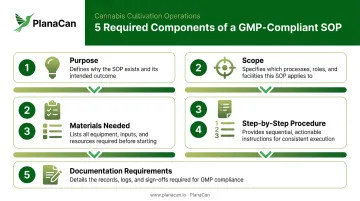
The FDA's plain-language guidance is clear: people follow instructions they understand. Every SOP should include:
- Purpose — why this procedure exists
- Scope — which rooms, roles, or products it covers
- Materials needed — specific products, equipment, PPE
- Step-by-step procedure — positive instructions, not prohibitions
- Documentation requirements — what to log, where, and by whom
Keep sentences short. Define any technical terms. Avoid jargon that someone new to cannabis cultivation wouldn't recognize.
Step 4 — Test It in the Field
Have the master grower and at least one frontline team member walk through the SOP in real conditions. Note any steps that require undocumented judgment calls, missing details, or outdated information. Any improvisation during the walkthrough is a signal to revise before publishing.
Step 5 — Build Version Control In
Every SOP needs: issue date, version number, author, and next review date. Establish a minimum semi-annual review cycle, with immediate updates triggered by any process change, new equipment, regulatory update, compliance finding, or post-harvest gap review.
Turning SOPs Into Daily Team Action
The most common GMP implementation gap isn't poor SOP writing — it's the chasm between the document and daily execution. The binder exists. The procedure is documented. But tasks get missed, accountability is murky, and managers can't tell what was actually completed on any given day.
This is where a cultivation management platform like PlanaCan addresses a real operational need. PlanaCan allows teams to build custom templates for every SOP-driven task — IPM treatments, room checks, harvest steps, drying and cure procedures — and embed the actual SOP directly into the task so cultivators see it on their mobile device at the moment of execution.
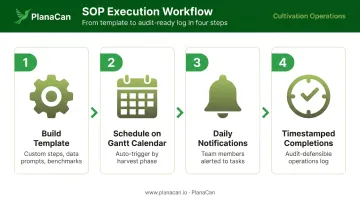
The execution workflow follows four steps:
- Build a custom template with step-by-step instructions, data-collection prompts (pH, EC, environmental readings, IPM applications), and time benchmarks
- Schedule templates onto a shared Gantt calendar — tasks trigger automatically on the correct phase day for each harvest
- Daily notifications alert each team member to their assigned tasks
- Completions are timestamped and user-attributed, building an audit-defensible operations log
Garden First Cannabis documented a 36% increase in completed tasks and a 23% decrease in labor costs after implementing PlanaCan. Their co-founder's summary: "Simple to use, and effective. Our team knows what they need to do, and when to do it."
Those results scale with operational complexity. For multi-room facilities and multi-state operators, the task-level audit trail shows inspectors exactly when each GMP procedure was completed and by whom — giving compliance reviewers a timestamped record tied to specific team members, not just a signed binder.
PlanaCan functions as the cultivation operations layer and complements state seed-to-sale platforms (METRC, BioTrack, Leaf Data Systems) rather than replacing them. The compliance reporting stays in your state system; the operational execution and documentation lives in PlanaCan.
Frequently Asked Questions
What is GMP for cannabis?
GMP (Good Manufacturing Practices) for cannabis refers to the quality standards and procedures that ensure products are produced consistently, safely, and in compliance with applicable regulations. Covered areas include grow room environmental controls, pest management, product testing, traceability, and recordkeeping.
What are the 5 components of an SOP?
The five core components are: (1) Title and Purpose, (2) Scope, (3) Responsibilities, (4) Step-by-Step Procedure, and (5) Documentation and Recordkeeping requirements. All five must be present for an SOP to be GMP-compliant and audit-ready.
Do cannabis cultivators have to follow GMP?
Most state cannabis licensing programs require documented SOPs and GMP-aligned practices as a condition of licensure. Operations producing tinctures, edibles, or extracts may also fall under FDA's 21 CFR Part 111 or Part 117 depending on how those products are classified under federal law.
How often should cannabis cultivation SOPs be reviewed?
At minimum, semi-annually. Immediate updates are required when any process changes, new equipment is added, a regulatory update occurs, a compliance finding is issued, or a post-harvest review reveals a procedure gap.
What is the difference between GMP and SOP in cannabis?
GMP is the overarching quality standard that defines what outcomes a cannabis operation must achieve. SOPs are the written procedures that document exactly how your team meets those standards day-to-day. Think of GMP as the regulatory requirement and each SOP as your operation's documented answer to it.