The good news is that sustainability and profitability aren't in conflict. They're the same goal approached from different angles.
This article covers the four core pillars of sustainable cannabis cultivation — water, energy, soil health, and waste — and explains why standardized operational practices are the often-overlooked foundation that makes every other sustainability effort actually stick.
Key Takeaways
- Indoor cannabis cultivation carries a massive energy and water footprint, but proven solutions exist at commercial scale
- LED lighting upgrades can cut vegetative room energy use by up to 50%, with downstream HVAC savings of 15–30%
- Precision irrigation and moisture-sensor scheduling cut water consumption by 20–40% without sacrificing yield
- State-level programs like California's OCal offer credible organic certification pathways — USDA Organic doesn't apply to cannabis
- Sustainable protocols only deliver results when teams execute them consistently; standardized SOPs and accountable workflows are what make the difference
Why Sustainability Matters in Commercial Cannabis Cultivation
The Environmental Footprint Is Hard to Ignore
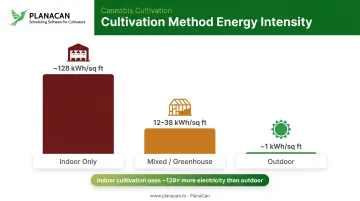
The numbers are stark. Indoor cannabis production accounts for an estimated 1% of total U.S. electricity consumption, and a 2025 update from the same research team estimates the U.S. cannabis industry now consumes roughly 595 PJ of energy annually — approximately $11 billion per year.
The production method matters enormously:
- Indoor-only: ~128 kWh per square foot annually
- Mixed/greenhouse: ~12–38 kWh per square foot
- Outdoor: ~1 kWh per square foot
That gap between indoor and outdoor represents a 128x difference in electricity intensity. For commercial operations running entirely indoors, the efficiency ceiling is high — and so is the opportunity.
Regulatory Momentum Is Real
Several states have already moved beyond voluntary guidance to hard requirements:
- Massachusetts limits Horticulture Lighting Power Density to 36 W/sq ft and requires energy reporting for licensed cultivators
- Boulder, CO mandates that marijuana cultivation facilities offset 100% of their electricity use through onsite renewables, verified solar gardens, or offset fund payments
- California regulates water rights, surface water diversion, and requires permitted handling of all irrigation tailwater and process wastewater
- Michigan restricts discharge of nutrient- or pesticide-containing wastewater without proper permits
Early adopters avoid costly retrofits later. Facilities that build sustainable infrastructure now — LED lighting, efficient HVAC, closed-loop water systems — won't scramble to comply when their state tightens standards.
The Business Case
Energy runs at roughly 33% of operating costs for most indoor cultivators. Every efficiency gain — better lighting, tighter HVAC controls, water recapture — translates directly into margin.
Consumer demand adds another angle. 57.1% of cannabis consumers report eco-friendly shopping preferences, giving sustainably positioned brands a real edge as state markets mature. Price still drives most purchase decisions, so the payoff shows up in brand loyalty and premium positioning rather than volume alone.
Water Conservation Strategies That Work at Commercial Scale
Precision Irrigation and Recirculation Systems
Recirculating hydroponic systems can use up to 90% less water than conventional soil-based farming by recovering and reusing nutrient solution rather than letting it drain to waste. At commercial scale, that difference translates directly into lower utility costs and reduced discharge management burden.
Substrate moisture sensors compound the savings further. EPA WaterSense data shows that soil moisture-based irrigation controllers save at least 20% of water compared to timer-only systems, and commercial nursery trials have demonstrated reductions exceeding 80% versus uncontrolled timer irrigation.
For cannabis, the practical gains are meaningful: sensors prevent both overwatering (a root health and waste problem) and underwatering, dialing in precise volumes tied to actual substrate conditions rather than a fixed schedule.
Key tools for precision water management:
- Drip irrigation systems with pressure-compensating emitters
- Recirculating nutrient solution reservoirs with EC/pH monitoring
- Capacitance or tensiometer-based substrate sensors
- Automated irrigation controllers tied to sensor thresholds, not timers
Rainwater Harvesting and Greywater Reuse
Commercial facilities can supplement municipal water supply by capturing:
- Rainwater from roof collection systems stored in cisterns
- HVAC condensate from dehumidification systems (a significant volume in humidity-controlled indoor grows)
- Reclaimed process water from irrigation runoff in recirculating systems
One critical note: California and Michigan both have explicit discharge and reuse regulations for cannabis cultivation wastewater. Before implementing a reuse system, verify state-specific requirements for water quality testing and permitted handling. Untreated reclaimed water introduced into the root zone can carry pathogens or elevated salt concentrations that damage crops.
Cultivar Selection and Scheduling Discipline
Lower-demand cultivars and tightly scheduled irrigation protocols — tied to growth stage rather than a fixed daily routine — reduce overall consumption across a harvest cycle. In multi-person grow teams, unscheduled watering is one of the most common sources of water waste. Common failures include:
- A cultivator watering a room "just to check" outside the protocol
- A mid-cycle top-off added without documentation
- Repeated small deviations that compound into significant overwatering across dozens of plants
Documented, distributed irrigation schedules enforced consistently across the team are what close that gap — not better equipment alone.
Energy Efficiency: From Lighting to Renewable Power
LED Lighting and Smart Light Management
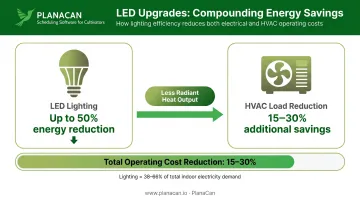
The shift from high-pressure sodium (HPS) and ceramic metal halide (CMH) fixtures to modern LEDs is the single highest-impact energy intervention available to most commercial cultivators. SWEEP's best-practices report found LEDs can cut vegetative room lighting energy by up to 50%.
The Resource Innovation Institute's Massachusetts guide puts LED transitions at 15–30% reduction in total operating costs. Because LEDs emit significantly less radiant heat than HPS, they also reduce HVAC load by that same 15–30%.
That compounding effect matters. Lighting accounts for 38–66% of total electricity demand in indoor cannabis facilities. Cut lighting energy by 50% and you're not just reducing your lighting bill: you're shrinking your cooling load, which drives HVAC energy consumption down further.
Additional lighting efficiency levers:
- Spectrum-specific light recipes adjusted by growth stage (different spectra for veg vs. flower)
- Automated photoperiod controls to eliminate accidental light-on periods
- Dimming capabilities during cooler nighttime hours or lower-demand growth phases
- DLC-listed fixtures verified for efficacy through independent testing
HVAC Optimization and Climate Control
Those lighting gains only go so far. HVAC systems represent 51% of indoor cannabis facility energy use in SWEEP's model — eclipsing lighting in many operations. The Northwest Power and Conservation Council found an efficiency potential of 826,814 kWh, or 18.3% savings, within surveyed facilities through HVAC optimization alone.
High-impact HVAC improvements:
- VPD-based climate management: controlling temperature and humidity together to the plant's actual vapor pressure deficit target, rather than managing them independently
- Smart environmental controllers: automated setpoint management that responds to real-time conditions rather than fixed schedules
- Chilled-water cooling systems: SWEEP found these save 30–40% on cooling and dehumidification energy versus direct expansion systems
- Regular maintenance: cleaning coils, sealing ducts, and calibrating sensors carries minimal labor cost but prevents compounding efficiency losses over time
Renewable Energy and LEED Certification
Practical renewable energy options for commercial cannabis facilities include on-site solar installation, Power Purchase Agreements (PPAs) with solar developers, renewable energy credits (RECs), and participation in verified solar gardens like those available through utility programs.
Boulder, CO effectively mandates this already, requiring 100% electricity offset for all licensed cultivation facilities. Massachusetts guidance requires facilities to identify renewable energy opportunities as part of licensing.
LEED certification is available to cannabis cultivation facilities and works on two levels. It provides a structured improvement roadmap across Energy and Atmosphere, Water Efficiency, Materials and Resources, and Indoor Environmental Quality — and it gives buyers, investors, and regulators an independent verification that your operation meets those standards. At least one commercial cannabis facility has achieved LEED certification, so the framework is proven in practice, not just theory.
Organic Practices, Soil Health, and Sustainable Growing Media
Organic and Regenerative Cultivation
Compost, living soil amendments, cover cropping in outdoor or mixed-use contexts, and reduced synthetic fertilizer use all build long-term soil fertility while reducing runoff and soil degradation from heavy chemical inputs. The regenerative approach treats soil as infrastructure, not a disposable input — and that thinking compounds across multiple cultivation cycles.
The certification nuance: USDA Organic certification is not available for cannabis. Federal law prohibits it, and the CDFA explicitly states that the term "organic" is reserved under federal law. However, several credible alternatives exist:
| Program | Certifying Body | Scope |
|---|---|---|
| OCal | California Dept. of Food & Agriculture | Comparable-to-organic certification for CA cannabis |
| Clean Green Certified | Clean Green Certified | Third-party, organic-style standards; active nationally |
| Sun+Earth Certified | Sun+Earth | Sun-grown, earth care, and community standards |
| DEM Pure | Dragonfly Earth Medicine | "Beyond regenerative" cultivation standards |
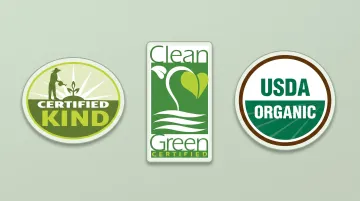
These certifications allow cultivators to communicate organic-aligned practices to consumers without misrepresenting compliance status.
Sustainable Growing Media
For indoor and soilless cultivation, media choice affects both environmental footprint and resource efficiency:
- Coco coir: Renewable, compostable, excellent water retention and aeration — a strong default for operators focused on environmental impact
- Rockwool (stone wool): Highly efficient for water and nutrient delivery, but poses end-of-life disposal challenges; less recyclable than coco
- Amended living soils: Build microbial communities that improve nutrient cycling and reduce synthetic fertilizer dependence, though they require more management knowledge and carry higher contamination risk at commercial scale
Coco coir's compostability and water efficiency give it a clear edge for operations where environmental footprint is a priority. Living soils suit cultivators willing to invest in the learning curve for long-term input reduction.
Waste Reduction and Integrated Pest Management
Reducing and Repurposing Cultivation Waste
Commercial cannabis operations generate several distinct waste streams:
- Plant biomass: stalks, roots, fan leaves — compostable or convertible to mulch
- Trim: can be repurposed for extraction or composted
- Grow media: coco coir compostable; rockwool requires supplier take-back programs or specialized disposal
- Packaging: recyclable glass jars and post-consumer resin containers reduce downstream footprint
State regulations govern disposal across all of these streams. Washington requires non-hazardous cannabis waste to be rendered unusable by mixing with at least 50% non-cannabis material before disposal. Minnesota guidance recommends composting for plant material and recycling for eligible packaging.
Cultivators should audit their full waste stream — from propagation through post-harvest — and establish disposal partnerships before volumes build up.
Integrated Pest Management (IPM)
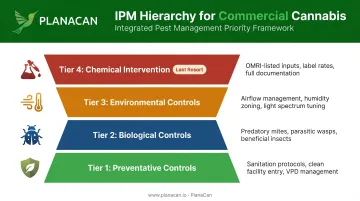
IPM layers controls in order of preference: preventative first, then biological, cultural, and chemical as a last resort. For commercial cannabis, a functional IPM program includes:
- Preventative controls: strict sanitation between harvest cycles, clean room entry protocols, VPD management to prevent powdery mildew
- Biological controls: predatory mites (Phytoseiulus persimilis, Neoseiulus californicus), parasitic wasps for aphid control, Stratiolaelaps scimitus for fungus gnats
- Environmental controls: airflow optimization, light spectrum management, and humidity zoning
- Chemical intervention (when required): OMRI-listed inputs only, applied at label rates with full documentation
Most commercial IPM failures come down to execution, not product selection. The gaps that let pest populations rebound between applications are predictable:
- Missed scouting windows that leave early infestations undetected
- Inconsistent spray coverage that creates untreated zones
- Undocumented treatment events that break the audit trail and obscure what worked
Standardizing scouting intervals and logging every application — even when nothing was found — keeps programs defensible and effective over multiple harvest cycles.
How Operational Standardization Supports Sustainable Cultivation
Every sustainable practice described in this article shares the same vulnerability: it only works when teams execute it consistently, on schedule, every cycle.
A well-designed irrigation protocol doesn't reduce water waste if cultivators supplement it informally. An IPM program with beneficials and OMRI-listed products doesn't prevent outbreaks if scouting tasks are missed. Spectrum-specific LED schedules don't save energy if photoperiod controls aren't adjusted at the right phase day.
Operational standardization is what closes the gap between a sustainability plan and actual sustainable outcomes.
Cultivation management platforms like PlanaCan are built for exactly this problem. Commercial grow teams can build custom workflow templates for every treatment, strain, and cultivation stage, encoding IPM schedules, irrigation protocols, and nutrient feeding programs once and deploying them automatically across every harvest cycle. Phase-day-driven task scheduling means an IPM scouting task set for flower day 14 fires automatically for every room running that template, without manual re-entry.
Key features that support sustainable execution include:
- Custom workflow templates that encode IPM, irrigation, and nutrient protocols for each strain and stage
- Phase-day task scheduling that triggers time-sensitive tasks automatically across all active rooms
- Gantt-style calendar providing a complete schedule overview of every active harvest simultaneously
- Automatic daily notifications alerting team members to upcoming tasks before they're missed
Together, these features reduce the reactive resource overuse that follows skipped applications and off-schedule irrigation events. When a task fires on time, teams avoid the compensatory inputs that drive up water, nutrient, and pesticide consumption.
The operational impact is documented: Garden First Cannabis, managing 16 rotating harvests on PlanaCan, achieved a 36% increase in completed tasks and a 23% decrease in labor costs. More consistent task execution directly reduces the ad-hoc decisions and undocumented actions that drive resource overuse.
Standardization also creates the data foundation for continuous improvement. When teams track completed tasks and outcomes consistently, managers can identify where sustainable protocols are breaking down and refine workflows with each harvest cycle, building a compounding operational advantage over time.
Frequently Asked Questions
What are the biggest environmental impacts of commercial cannabis cultivation?
The top three are high energy consumption from indoor lighting and HVAC (indoor facilities use ~128 kWh/sq ft annually), significant water usage across the growth cycle, and potential chemical runoff from synthetic fertilizer and pesticide inputs. Commercial operations have the scale to make meaningful improvements in all three areas.
How can indoor cannabis growers reduce their energy consumption?
LED lighting upgrades, smart environmental controls tied to VPD-based climate management, and renewable energy sourcing are the three highest-impact levers. LED transitions alone can cut total operating costs by 15–30% and reduce HVAC load by a similar margin.
What water conservation methods work best for cannabis cultivation?
Drip irrigation paired with recirculating systems, substrate moisture-sensor-driven scheduling, and HVAC condensate recapture for irrigation reuse are the most effective approaches for commercial grows. Moisture sensors alone can reduce water use by 20% or more versus timer-only systems.
Is organic cannabis cultivation possible at a commercial scale?
USDA Organic certification isn't available for cannabis due to federal law. Cultivators can still use organic-compliant inputs and pursue certifications like California's OCal, Clean Green Certified, or Sun+Earth to signal credibility to buyers.
How does sustainable cultivation affect cannabis yield and product quality?
Sustainable practices — particularly soil health management, precision irrigation, and reduced synthetic inputs — tend to strengthen root zone health, improve terpene expression, and produce more consistent yields across harvest cycles.
How does team accountability factor into sustainable cannabis operations?
Sustainable protocols only deliver results when teams execute them consistently. Missed IPM applications, off-schedule irrigation, and undocumented feeding events translate directly to higher input costs, off-spec harvests, and failed compliance audits — outcomes that proper accountability systems are specifically designed to prevent.