Maryland now joins a small group of states where cannabis ESOPs are not just tolerated but expressly enabled by statute. That distinction matters, because the legal landscape nationally remains murky — most cannabis operators pursuing this structure are navigating without a clear roadmap.
This guide covers what SB-215 actually changed, how cannabis ESOPs are structured, the legal and tax requirements operators must meet, and what it takes operationally to prepare for this kind of ownership transition.
Key Takeaways
- Maryland's SB-215 (effective July 1, 2025) created an explicit exception to the state's five-year cannabis license transfer ban for sales to an ESOP
- Cannabis ESOPs allow employees to become partial or full owners through a trust that holds company stock on their behalf — without buying shares out of pocket
- Federal complexities around cannabis's controlled substance status and ERISA governance make specialized legal counsel non-negotiable
- S-Corporation ESOPs can reduce federal income tax on the ESOP-owned portion of the business, providing direct tax relief under IRC 280E
- Audited financials, documented SOPs, METRC compliance, and consistent yield records must be in place before initiating any ESOP transaction
What Maryland's SB-215 Actually Changed for Cannabis Businesses
The Problem SB-215 Solved
Before SB-215, Maryland cannabis licensees faced a hard prohibition: no license transfers for five years after issuance, and only narrow exceptions after that window closed. This made ESOPs functionally impossible. An ESOP transaction requires transferring ownership interest to a trust — and that transfer triggered the exact restriction the law imposed.
Maryland's enacted Chapter 120, Section 36-503(c)(3)(ii) addresses this directly. The provision excepts "THE SALE OF A CANNABIS LICENSEE TO THE LICENSEE'S EMPLOYEES THROUGH AN EMPLOYEE STOCK OWNERSHIP PLAN AS DEFINED IN § 407(D)(6)(A) OF THE EMPLOYEE RETIREMENT INCOME SECURITY ACT OF 1974" from the transfer restriction. The law took effect July 1, 2025.
What Else SB-215 Covers
The ESOP provision was one piece of a broader cannabis reform package. Other key provisions in SB-215 include:
- Repealed MCA authority to issue on-site consumption licenses during the second licensing round
- Limited future on-site consumption applications to social equity applicants
- Extended certain medical cannabis delivery authority through July 1, 2026
- Created cannabis event registrations and vendor permit frameworks
What the Law Does Not Do
SB-215 creates the state-law transfer exception — it does not publish a complete ESOP transaction procedure. Until the Maryland Cannabis Administration provides dedicated guidance, operators should treat ESOP transactions as subject to:
- MCA's existing ownership transfer rules
- Standard disclosure and background check requirements
- No ESOP-specific form or notice process (none issued as of the law's passage)
Where Maryland Fits Nationally
Cannabis ESOPs remain rare. Two documented examples show where the model has gained traction:
- S1 Enterprises (parent company of Illicit and Space Coyote brands) launched a 100% S-corporation ESOP across its Missouri and New Jersey operations, citing IRC 280E tax burden as a primary driver
- Washington State's HB 1348 proposed authorizing ESOP ownership of up to 100% of licensed cannabis businesses — its final enactment status had not been confirmed as of this publication
How Cannabis ESOPs Work: Structure and Mechanics
The Basic Structure
An ESOP is a qualified retirement benefit plan in which a trust holds company stock on behalf of employees. Employees accumulate ownership shares over time based on tenure and compensation — they do not purchase shares out of pocket. The Department of Labor governs ESOPs under ERISA, and 26 U.S.C. 401(a)(28)(C) requires that valuations of employer securities not readily tradable on an established market be performed by an independent appraiser annually.
Two Common Transaction Structures
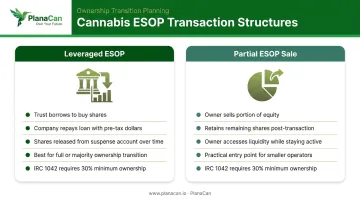
Leveraged ESOP: The ESOP trust borrows money to purchase owner shares. The company repays the loan over time using pre-tax dollars, and shares are released from a suspense account into employee accounts as the debt is retired. This is the most common structure for operators executing a full or majority ownership transition.
Partial ESOP sale: The owner sells a portion of company equity to the ESOP while retaining some shares. This allows an owner to access liquidity while remaining involved in operations. For C-corporation sellers, IRC Section 1042 requires the ESOP to own at least 30% after the sale to qualify for capital gains deferral — covered in detail under the tax considerations below.
For smaller cannabis operators, a partial ESOP sale is typically the more practical entry point. It requires less transaction financing and allows the business to build ESOP infrastructure before committing to full employee ownership.
How Employees Receive Their Ownership
- Shares vest according to schedule — ERISA requires either three-year cliff vesting or six-year graded vesting for individual account plans
- Share accounts are valued annually by an independent, ERISA-compliant appraiser
- Employees receive their account value upon retirement, departure, or company buyout
The Federal Legal Tension
No formal DOL or IRS guidance addresses cannabis ESOPs specifically. ESOPs are governed by federal ERISA law, while cannabis remains a controlled substance under federal law. Existing cannabis ESOP companies — like S1 Enterprises — have navigated this by structuring carefully, engaging independent trustees who understand the fiduciary risk, and maintaining defensible, independent valuations. The core trustee obligation under ERISA is clear: avoid paying more than fair market value, and conduct annual independent appraisals. Cannabis adds regulatory complexity to each of these obligations — which means legal counsel needs specific experience structuring ERISA plans around federally controlled substances, not just general ESOP transaction experience.
Feasibility Thresholds
Once the legal structure is workable, the next question is whether it pencils out economically. There is no statutory minimum size for an ESOP. However, the costs of establishing and administering the plan mean that smaller operators may not generate enough economic benefit to justify the structure. NCEO notes that feasibility depends on company-specific facts, while advisory sources commonly cite 20 full-time employees and $1 million in normalized EBITDA as practical screening benchmarks.
Legal Requirements and Eligibility for Maryland Cannabis ESOPs
Federal ERISA Requirements
Under federal law, every ESOP must meet these baseline requirements:
- Written plan document with one or more named fiduciaries
- Trust holding plan assets, managed by a named trustee
- Vesting schedule: three-year cliff or six-year graded for individual account plans
- Annual report filing: Form 5500 filed with the DOL each year
- Independent annual valuation: required by 26 U.S.C. 401(a)(28)(C) for non-publicly traded employer securities
- IRS plan review: ESOP determination letter applications are reviewed by IRS ESOP specialists
No additional Maryland-specific ESOP plan design requirements beyond federal ERISA were identified. Maryland's additional compliance layer comes through cannabis license ownership and control rules, specifically COMAR's definitions of ownership and control — not a separate state ESOP code.
Maryland Cannabis Ownership Compliance
COMAR defines "ownership interest" as any direct or indirect equity interest, including shares or stock. Transfers of less than 5% ownership generally receive different treatment than larger transfers, which require MCA review or approval.
No official MCA guidance on ESOP trustee treatment has been published. Treat the ESOP trustee's ownership position conservatively: assume MCA review is required and engage cannabis counsel before executing the transaction.
The Professional Team Required
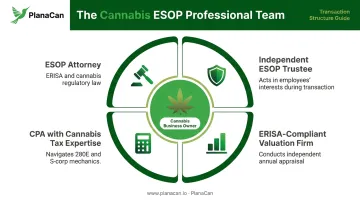
Attempting a cannabis ESOP without all four of these professionals creates significant legal and regulatory exposure:
- ESOP attorney: experienced in both ERISA and cannabis regulatory law
- Independent ESOP trustee: fiduciary acting in employees' interests during the transaction
- ERISA-compliant valuation firm: conducts the independent appraisal required by federal law
- CPA with cannabis tax expertise: navigates 280E and S-corp ESOP mechanics
Ongoing Compliance Obligations After Forming an ESOP
Forming the ESOP is not a one-time event. Ongoing obligations include:
- Annual Form 5500 filing with the DOL
- Annual independent business valuation
- Employee account statement distribution
- Repurchase obligation fund management: the company must buy back shares from departing employees, which requires a funded reserve policy
Budget for these obligations during feasibility analysis — annual valuation fees alone typically run $10,000–$30,000 depending on company size and complexity.
Tax Advantages for Cannabis Businesses with ESOPs
The 280E Problem
IRC 280E disallows deductions or credits for any business trafficking in Schedule I or II controlled substances. For cannabis operators, this means ordinary business expenses — rent, payroll, marketing — cannot be deducted, driving effective federal tax rates far higher than comparable non-cannabis businesses. The IRS has confirmed this applies to cannabis businesses regardless of state licensing status.
As of mid-2025, cannabis remains Schedule I. DEA proposed rescheduling to Schedule III in 2024, but no final rule had taken effect — meaning 280E's full weight still applies.
How an S-Corp ESOP Changes the Math
Under IRC 1361, qualified retirement plans including ESOPs can be S-corporation shareholders. Under IRC 512's special rules for S-corp ESOP employer securities, the ESOP trust — as a tax-exempt entity — pays no income tax on its allocable share of S-corp income.
For cannabis companies, this creates a meaningful opening: the portion of business income attributed to ESOP ownership can escape the 280E burden entirely.
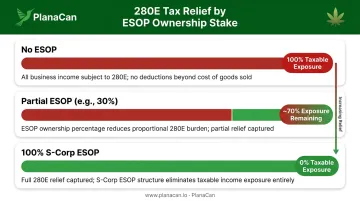
The 280E relief this structure delivers scales directly with ownership stake:
- 100% S-corp ESOP — captures the full tax benefit on all business income
- Partial ESOP (e.g., 30%) — captures a proportional share of the benefit
- No ESOP — full 280E exposure on all deductible expenses
S1 Enterprises structured its 100% S-corp ESOP specifically to reduce its 280E cash-tax burden — the most documented real-world example of this approach in the cannabis industry.
The IRC 1042 Distinction
The S-corp structure that unlocks 280E relief is not the same structure that maximizes seller tax benefits — which is where IRC 1042 becomes relevant.
IRC Section 1042 allows sellers of C-corporation stock to an ESOP to defer capital gains tax, provided the ESOP owns at least 30% after the sale and the seller reinvests proceeds in qualifying replacement securities. This benefit does not apply to S-corporation sellers. Cannabis business owners evaluating corporate structure for an ESOP transaction should discuss the trade-offs with their CPA and ESOP attorney before committing to either path.
How to Set Up a Cannabis ESOP in Maryland: Step-by-Step
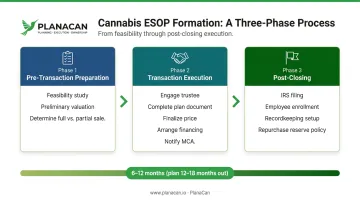
Phase 1: Pre-Transaction Preparation
- Conduct an ESOP feasibility study — assess profitability, normalized EBITDA, employee census and demographics, debt service capacity, repurchase obligation modeling, and owner objectives
- Get a preliminary business valuation — establishes a realistic transaction price range before incurring full transaction costs
- Determine full vs. partial sale — owners seeking full exit pursue a leveraged buyout structure; owners seeking liquidity while remaining active typically start with a partial sale
Phase 2: Transaction Execution
- Select and engage an independent ESOP trustee — the trustee acts as the fiduciary buyer on behalf of employees
- Complete the formal ESOP plan document meeting all ERISA requirements
- Finalize purchase price through an ERISA-compliant independent appraisal
- Arrange financing if executing a leveraged ESOP
- Notify or seek approval from the MCA per SB-215 and existing ownership transfer requirements — no ESOP-specific MCA form exists yet, so work with cannabis counsel to determine the correct filing
Phase 3: Post-Closing
- File the ESOP plan with the IRS and obtain a determination letter
- Issue participant enrollment materials to all eligible employees
- Establish recordkeeping systems for employee accounts
- Create a repurchase obligation reserve policy
The full ESOP formation process typically takes 6–12 months from feasibility through closing. Cannabis-specific regulatory review adds timing uncertainty on top of that. Plan to start the feasibility process 12–18 months before your target transaction date — state licensing review alone can introduce weeks of unpredictable delay.
Operational Readiness: Preparing Your Cultivation Business for an ESOP
Why Due Diligence Is More Intensive Than a Standard Sale
When employees become owners, the ESOP trustee has a fiduciary obligation to act in their interest. That means their advisors will audit your financial records, compliance history, MCA regulatory standing, and operational documentation in detail. A cultivation business with poorly documented workflows, inconsistent yield records, or compliance gaps will not just struggle to close the transaction — it will likely receive a lower valuation.
The scrutiny is different from a typical M&A sale. The trustee is legally required to confirm they are not paying more than fair market value. Operational inconsistency directly reduces that value.
What Trustees and Their Advisors Look For
In a cannabis cultivation business, ESOP due diligence focuses on:
- Standardized cultivation workflows — repeatable SOPs across every phase, documented and version-controlled
- Treatment protocols and feeding schedules recorded at the point of execution, not reconstructed afterward
- Consistent yield records — multi-cycle data showing reproducible outcomes across strains and rooms
- METRC compliance: clean track-and-trace records with no material gaps
- Team accountability documentation — tasks assigned, completed, and tracked by named individuals
Cultivation businesses that have systematized their operations are better positioned for this process. Platforms like PlanaCan are built specifically for this kind of operational documentation — standardizing grow schedules through version-controlled SOP templates, tracking task completion with per-user records across every room, and surfacing harvest analytics that demonstrate consistent yield and profitability across multiple cycles.
That audit-ready operational record supports both due diligence and a higher valuation.
12–24 Month Preparation Checklist
Start these steps well before initiating an ESOP transaction:
- Get financials audited — ESOP valuations require audited or reviewed financial statements; accrual-basis accounting is standard
- Resolve any open MCA compliance issues — outstanding violations will surface in due diligence and reduce your valuation
- Document all standard operating procedures with version control, embedded into daily workflows, and completion records by employee
- Demonstrate consistent yield and profitability trends — multi-cycle harvest data showing reproducible outcomes is among the strongest valuation inputs you can present
Frequently Asked Questions
What are SOPs for cannabis businesses in Maryland?
SOPs (Standard Operating Procedures) are written operational guidelines required by the Maryland Cannabis Administration for licensing compliance. They cover areas like inventory control, security, and employee procedures. These are distinct from ESOPs, which are an employee ownership structure. Visit the MCA's official site for current SOP requirements.
What is the new cannabis law in Maryland?
SB-215, signed by Governor Wes Moore and effective July 1, 2025, is a cannabis reform bill that created an exception to Maryland's five-year cannabis license transfer ban for sales to Employee Stock Ownership Plans. It also expanded rules covering on-site consumption licensing, social equity applicants, and cannabis event permits.
What are the regulations for cannabis dispensaries in Maryland?
Maryland cannabis dispensaries are regulated by the Maryland Cannabis Administration, which oversees licensing, compliance, security, inventory tracking through METRC, and operational standards. Visit the MCA's website for current regulations and licensing requirements.
What is the Maryland cannabis grant?
Maryland's Cannabis Business Assistance Fund provides direct capital assistance to social equity cannabis licensees. A prior round distributed $40 million; Maryland Commerce has since opened additional application rounds for licensees awarded through the MCA's lottery. See the Cannabis Business Assistance Fund page for current program details.
Can a cannabis business set up an ESOP if cannabis is still federally illegal?
Yes — a small number of cannabis companies, including S1 Enterprises in Missouri and New Jersey, have established ESOPs despite cannabis's Schedule I federal status. Maryland's SB-215 addresses the state-level barrier, but federal ERISA complexity remains. Specialized legal counsel is required.
How large does a Maryland cannabis business need to be to consider an ESOP?
There is no fixed legal minimum. NCEO notes feasibility depends on company-specific facts. Common advisory benchmarks are 20 full-time employees and $1 million in normalized EBITDA — these are screening thresholds, not eligibility rules. ESOP administration costs mean smaller operators may not generate sufficient tax or liquidity benefit to justify the structure.