Get the timing wrong and you're looking at slower recovery after pruning, wetter buds at harvest, and weaker root establishment after transplanting. Get it right, and you're working with your plants' natural rhythms instead of against them.
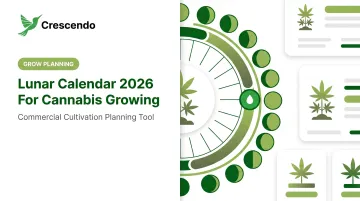
This guide breaks down the 2026 lunar calendar for cannabis, explains how moon phases and cycles affect each cultivation task, and gives commercial growers a practical scheduling framework they can use across the full year.
Key Takeaways
- Waxing and full moon phases drive sap upward — best for germination, transplanting, and foliar feeding
- Waning and new moon phases pull sap toward roots — ideal for harvesting, pruning, and substrate fertilization
- Ascending moon favors above-ground work; descending moon favors root-zone tasks — a second scheduling layer separate from phase
- Avoid all major interventions on rest days: moon nodes, perigee, and apogee
2026 phase dates sourced from the U.S. Naval Observatory.
Why the Lunar Calendar Matters for Cannabis Growing
The moon's gravitational pull doesn't stop at ocean surfaces. Research published in peer-reviewed journals found that tree species including Picea abies show 24.8-hour stem-diameter rhythms synchronized with lunisolar tidal acceleration — diameter peaks following gravitational peaks by as little as two hours. Sap flow in Citrus deliciosa similarly shifted from 24-hour to 25-hour cycles under constant conditions, aligning with lunar tidal rhythms.
No cannabis-specific gravitational study has confirmed the same response — but cannabis inflorescences contain 78–80% moisture at harvest, making it one of the highest-moisture crops in commercial agriculture. That moisture load makes cannabis a plausible candidate for the same gravitational water-movement effects documented in other species.
Biodynamic agriculture has operated on this premise for generations. Hartmut Spiess documented measurable effects tied to new/full moon phases and ascending/descending cycles in biodynamic crop research. Commercial cannabis cultivators report similar patterns in practice:
- Harvest timing: growers like Eli Buffalo at Moon Valley Cannabis schedule cuts on full moon windows for reduced dry time
- Terpene retention: biodynamic craft operations report stronger aroma profiles from moon-timed harvests
- Transplant success: ascending moon phases are consistently preferred for root establishment across biodynamic cultivation guides
What's not in dispute: lunar timing costs nothing and requires only planning effort. For commercial operations where harvest moisture, terpene retention, and dry time directly affect revenue, it's a low-risk variable worth controlling.
Moon Phases and Cycles: The Two Layers of Lunar Influence
Most growers conflate moon phases with moon cycles — they're related but operate on different timelines and affect the plant in different ways.
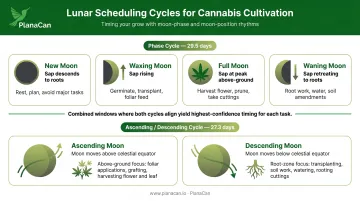
The Phase Cycle (29.5 Days)
The synodic cycle — the familiar waxing-to-full-to-waning sequence — runs 29.5 days. It governs how much light the moon reflects and, by extension, how sap distributes within the plant:
| Phase | Sap Direction | Best Cannabis Tasks |
|---|---|---|
| New Moon | Root-concentrated | Pruning, defoliation, planning |
| Waxing Moon | Rising upward | Germination, transplanting, foliar feeding |
| Full Moon | Maximum in foliage | Germination, transplanting — avoid pruning |
| Waning Moon | Descending to roots | Harvesting, root fertilization, cuttings |
The Ascending/Descending Cycle (27.3 Days)
The sidereal cycle runs 27.3 days and tracks whether the moon is rising higher in the sky on successive nights (ascending) or moving lower (descending). This is independent of whether it's waxing or waning.
- Ascending moon: Liquids move toward the upper plant — best for cloning, foliar feeding, and any above-ground intervention
- Descending moon: Liquids concentrate at the roots — prioritize soil amendments, transplanting into final containers, and harvest timing here
Combining both layers gives you the highest-confidence task windows. A waning moon during a descending period, for example, is one of the highest-confidence windows for harvest.
Zodiac Days and Rest Days
Biodynamic calendars add a third refinement layer using zodiac constellations:
- Flower days (air signs: Gemini, Libra, Aquarius) — timed for flowering-stage work like defoliation, canopy management, and nutrient adjustments targeting bud development
- Root days (earth signs: Taurus, Virgo, Capricorn) — suited for transplanting, soil amendments, and anything targeting the root zone
- Fruit/Seed days (fire signs: Aries, Leo, Sagittarius) — favored for germination and seed-related tasks; treated as high-energy days in biodynamic practice
- Leaf days (water signs: Cancer, Scorpio, Pisces) — generally the weakest days for cannabis; avoid major interventions and use these for observation instead
Four rest days occur each month — when the moon is at its nodes, perigee, or apogee. Skip major cultivation tasks on these days. Use them for scouting, data review, and updating your grow records.
2026 Cannabis Lunar Calendar: What to Do During Each Phase
New Moon — Rest and Prune
During the new moon, sap concentrates in the root zone and the plant enters a natural low-energy state. This is the right window for:
- Pruning and defoliation
- Removing wilted or diseased leaf material
- Reviewing upcoming grow schedules
- Preparing for the next active cycle
Avoid heavy watering during this phase. The plant's uptake is reduced, and waterlogging the medium during a rest period adds stress without benefit.
Waxing Moon — Germinate, Transplant, Feed
As the moon gains brightness, sap rises and plant metabolism accelerates. The waxing phase is your most productive window for:
- Seed germination (moisture in growing medium is elevated)
- Transplanting seedlings into new containers
- Applying foliar fertilizers and growth-stage nutrients
- Introducing beneficial organisms or preventive pest treatments
Pest and disease resistance tends to run higher during this phase — a favorable condition for introducing biologicals or beginning an IPM protocol.
Full Moon — Germinate and Transplant Only
The full moon represents peak sap concentration in upper plant tissue. Two tasks work well here: germination and transplanting. Almost everything else should wait.
Avoid pruning or harvesting during the full moon. Excess moisture in tissue slows wound healing after cuts and produces wetter buds at harvest. University of Illinois Extension notes that a review of 120 scientific papers found no consistent relationship supporting lunar influence — but the postharvest moisture risk is well-documented independent of that debate.
Pest pressure often spikes near the full moon due to heightened plant moisture and leaf activity. Step up monitoring during this window.
Waning Moon — Harvest, Root Care, Fertilize Substrate
The waning phase — especially when combined with a descending moon — is the single best harvest window. Sap retreats from flowers toward the root zone, and cannabis buds dry faster and cure more cleanly when harvested with lower moisture content from the start.
This phase also suits:
- Root-zone fertilization and soil enrichment
- Transplanting into larger containers — particularly to support root establishment before the next growth push
- Taking cuttings for propagation
2026 Key Lunar Dates for Cannabis Task Planning
All phase dates below are from the U.S. Naval Observatory in Universal Time (UT). Convert to your facility's operating time zone before scheduling.
2026 Primary Moon Phase Reference Table
| Month | New Moon | First Quarter | Full Moon | Last Quarter |
|---|---|---|---|---|
| January | Jan 18 | Jan 26 | Jan 3 | Jan 10 |
| February | Feb 17 | Feb 24 | Feb 1 | Feb 9 |
| March | Mar 19 | Mar 25 | Mar 3 | Mar 11 |
| April | Apr 17 | Apr 24 | Apr 2 | Apr 10 |
| May | May 16 | May 23 | May 1 / May 31 | May 9 |
| June | Jun 15 | Jun 21 | Jun 29 | Jun 8 |
| July | Jul 14 | Jul 21 | Jul 29 | Jul 7 |
| August | Aug 12 | Aug 20 | Aug 28 | Aug 6 |
| September | Sep 11 | Sep 18 | Sep 26 | Sep 4 |
| October | Oct 10 | Oct 18 | Oct 26 | Oct 3 |
| November | Nov 9 | Nov 17 | Nov 24 | Nov 1 |
| December | Dec 9 | Dec 17 | Dec 24 | Dec 1 / Dec 30 |
Task Windows by Quarter
Germination windows fall between the new moon and full moon (waxing phase). For highest-confidence germination, cross-reference waxing dates with fire sign constellation days (Aries, Leo, Sagittarius) from a current biodynamic calendar such as the Maria Thun Biodynamic Calendar.
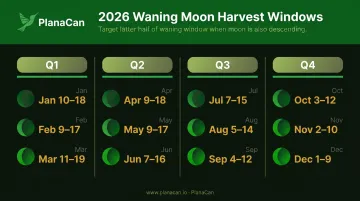
Harvest windows fall between the full moon and next new moon (waning phase). Target the latter half of that window when the moon is also descending. Strong waning harvest windows by quarter:
- Q1: Jan 10–18, Feb 9–17, Mar 11–19
- Q2: Apr 10–17, May 9–16, Jun 8–15
- Q3: Jul 7–14, Aug 6–12, Sep 4–11
- Q4: Oct 3–10, Nov 1–9, Dec 1–9
Pruning and defoliation windows align with new moon dates. For maximum effect, schedule pruning when the moon is also descending. New moon dates are listed in the table above — verify descending periods against your biodynamic calendar source.
2026 Rest Days to Mark Off
Flag these dates as no-intervention days across your 2026 schedule. Perigee (closest approach) and apogee (farthest distance) dates from AstroPixels:
- Perigee dates: Jan 1, Jan 29, Feb 24, Mar 22, Apr 19, May 17, Jun 14, Jul 13, Aug 10, Sep 6, Oct 1, Oct 28, Nov 25, Dec 24
- Apogee dates: Jan 13, Feb 10, Mar 10, Apr 7, May 4, May 31, Jun 28, Jul 25, Aug 22, Sep 18, Oct 16, Nov 13, Dec 11
Node dates also qualify as rest days — verify the complete list directly from AstroPixels before publishing your final facility calendar.
Putting It Into a Scheduling System
Commercial operations managing multiple flower rooms across staggered harvest cycles face a real coordination problem: lunar windows open for days, not weeks, and tasks spread across 8–12 rooms can't all wait for a manager to manually check the calendar.
That's where a centralized scheduling platform closes the gap. PlanaCan's Gantt chart gives cultivation directors a full view of every active harvest across the entire facility at once. Once lunar task windows are mapped onto the schedule, PlanaCan sends automatic daily notifications via push or email to iOS and Android devices, alerting the grow team the moment those windows open. Garden First Cannabis used this kind of workflow standardization to manage 16 rotating harvests simultaneously while cutting labor costs by 23% and increasing completed tasks by 36%.
The platform's template library lets teams build pruning, transplanting, and harvest workflows once, then deploy them across rooms on different lunar-aligned start dates — without rebuilding the schedule from scratch each cycle.
Timing Mistakes to Avoid on the Lunar Calendar
Harvesting During the Full Moon
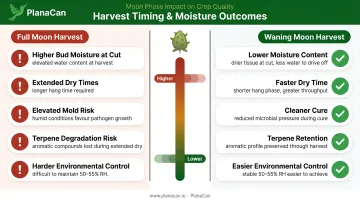
This is the most damaging error in lunar-timed cannabis cultivation. When sap is maximally concentrated in flower tissue, buds carry more moisture at the cut. That moisture doesn't disappear — it extends dry times, increases mold risk during drying, and can degrade terpene profiles if drying temperature rises to compensate.
Proper cannabis drying targets 18–21°C at 50–55% RH. Harvesting wetter material makes those conditions harder to maintain. Drying above 40°C has been shown to significantly reduce terpene concentrations — a direct revenue hit in any quality-focused operation.
Pruning During the Waxing or Full Moon
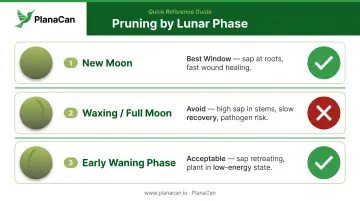
The plant is actively pushing energy into above-ground tissue during this window. Cuts made when sap is at its highest in stems and leaves heal more slowly and leave open tissue more vulnerable to pathogen entry.
Biodynamic practitioners recommend scheduling all cutting work at the new moon or early waning phase — when sap has retreated and the plant is already in a lower-energy state. Key guidelines:
- Schedule pruning at the new moon or early waning phase
- Avoid cuts during peak sap periods (waxing through full moon)
- Treat the waning phase as your primary maintenance window
Ignoring Rest Days
Perigee, apogee, and node days are not minor calendar footnotes. Biodynamic practice treats these as windows when plant vitality and responsiveness are at their lowest. Transplanting, heavy feeding, or pruning on these days tends to produce poor recovery and reduced effectiveness — though cannabis-specific peer-reviewed evidence on this point remains limited.
Skipping these windows costs nothing. Use rest days for facility walk-throughs, data review, and planning the next active window — that way you lose no productivity while reducing the risk of sluggish plant response.
Frequently Asked Questions
What is the cannabis grow calendar?
A cannabis grow calendar maps key cultivation tasks — germination, transplanting, feeding, pruning, and harvesting — to optimal timing windows across the year. Lunar-based grow calendars specifically align these tasks to moon phases and ascending/descending cycles for improved plant performance and timing precision.
Does planting using a moon calendar work?
Scientific research is ongoing, and a review of 120 studies found no consistent proof of lunar influence on plant life. That said, biodynamic traditions have applied lunar timing for centuries, and many commercial cannabis cultivators report improved transplant recovery and harvest quality. For cultivators already optimizing environment and nutrition, lunar timing adds another variable worth tracking.
What fertilizer makes buds bigger?
Bud development responds to phosphorus and potassium-rich bloom fertilizers during the flowering stage. A 2022 study found that elevated root-zone phosphorus (25–75 mg/L) did not significantly improve flower yield or cannabinoid quality, so application rate matters more than volume. Timing applications during the waning moon phase, when sap moves toward roots and substrate, may improve nutrient uptake efficiency.
When is the best time to harvest cannabis according to the lunar calendar?
The optimal harvest window is during the waning moon phase combined with a descending moon cycle. Sap retreats from flowers during this period, resulting in lower bud moisture at harvest, more concentrated terpene and cannabinoid profiles, and faster curing times overall.
Does the lunar calendar apply to indoor cannabis grows?
Lunar gravitational effects on plant sap and moisture movement occur regardless of indoor or outdoor environment. Tree and sap-flow research confirmed lunar-synchronized rhythms under constant light and dark conditions, suggesting the mechanism isn't driven by moonlight exposure alone. Indoor growers can apply the same timing principles with the same potential benefits.