This guide covers what RI regulations specifically require in each document, when SOPs are reviewed throughout the licensing lifecycle, and how cultivators can build systems that hold up under inspection — including at annual renewal.
Key Takeaways
- SOPs must be submitted with your application, not developed after buildout
- The CCC reviews your Operations Manual and Security & Safety Plan at application, pre-operational inspection, and renewal
- Rhode Island's final cannabis regulations took effect May 1, 2025 under the CCC
- Cultivators face additional SOP obligations tied to canopy size, facility class, and batch-level documentation
- Variance requests for material operational changes must be filed at least 60 days in advance
Rhode Island's Cannabis Compliance Landscape
Rhode Island legalized medical cannabis in 2006 under the Edward O. Hawkins and Thomas C. Slater Medical Marijuana Act (R.I. Gen. Laws Chapter 21-28.6). Adult use followed in 2022 via The Rhode Island Cannabis Act (R.I. Gen. Laws Chapter 21-28.11). The Cannabis Control Commission (CCC) now serves as the primary regulator for all licensing, enforcement, and compliance.
Active License Types
SOP requirements apply across all establishment types, though the specific documents vary:
- Cannabis cultivators (micro, Class A, Class B)
- Cannabis retailers and social equity retailers
- Workers' cooperative cannabis retail sales
- Compassion centers and hybrid cannabis retailers
- Cannabis product manufacturers
- Independent testing laboratories
A Shifting Regulatory Environment
The CCC unanimously approved final cannabis regulations on April 11, 2025, effective May 1, 2025 — marking the full transition of regulatory authority to the CCC. Operators still referencing older DBR or OCR guidance should cross-check those materials against current CCC rules before using them.
When Rhode Island Cannabis Businesses Must Have SOPs
Many operators treat SOPs as a post-buildout task. That assumption has derailed more than a few license applications.
Under 560-RICR-10-10-1, both the Operations Manual (§1.3.1(A)(4)) and Security & Safety Plan (§1.3.1(A)(3)) are required application exhibits. They must exist before you file, not after you receive conditional approval.
Three Compliance Checkpoints
SOPs face scrutiny at three distinct points in the licensing lifecycle:
- Initial application: Submit both documents as separate exhibits with your application package
- Pre-operational inspection: CCC staff verify the built premises, floor plan, and security map match your submitted materials before issuing a final license
- Annual renewal: The CCC reviews updated application information and may inspect or evaluate compliance as part of its oversight process
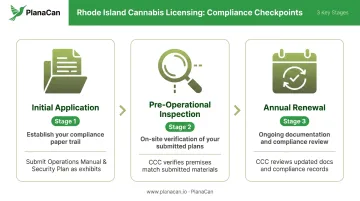
The pre-operational inspection is a gate, not a formality. If your physical premises don't match your submitted SOPs — wrong camera placements, undocumented limited-access areas, missing security coverage — the final license won't issue until the discrepancies are resolved.
Knowing when SOPs are required is only half the equation. Understanding exactly what each document must contain determines whether yours will hold up at each of these checkpoints.
What Rhode Island Requires in Your Cannabis Operations Manual
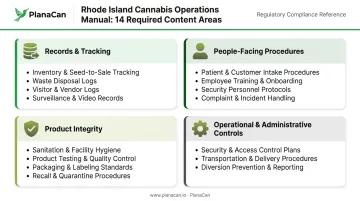
Per 560-RICR-10-10-1.3.1(A)(4), the Operations Manual must cover at least 14 distinct areas. Inspectors use it to verify that your facility operates exactly as documented — so gaps between your written procedures and actual practice will surface during review.
Required Content Areas
| Category | Required Content |
|---|---|
| Records & Tracking | Recordkeeping protocols, inventory tracking plan, seed-to-sale tracking system compliance |
| People-Facing Procedures | ID/age verification, staffing and employee training, drug-free workplace policy |
| Product Integrity | Labeling and packaging, product storage, voluntary and mandatory recall procedures, quarantine and destruction of outdated/contaminated/adulterated cannabis |
| Operational Environment | Odor control, community safety, emergency management |
| Administrative Controls | Data security plan, marketing and advertising plan |
Seed-to-Sale Tracking
Rhode Island requires licensed establishments to use the state-approved seed-to-sale tracking system under 560-RICR-10-10-2. Your Operations Manual must detail how your establishment will comply with this requirement — missing or vague language here is one of the most common reasons applications stall before final licensure.
Advertising Compliance
Your marketing plan must comply with 560-RICR-10-10-2.8. Rhode Island's advertising rules carry three concrete requirements your SOP must address:
- Prohibits any advertising that reasonably appears to target individuals under 21
- Requires the universal cannabis symbol in color on all advertising materials
- Mandates your cannabis establishment license number on every ad
Document each of these controls explicitly in your advertising SOP — inspectors will check for them.
Security and Safety Plan: The SOP Component Regulators Inspect
The Security and Safety Plan is a separate document from the Operations Manual, with its own exhibit in the application package and its own inspection criteria.
What the Plan Must Cover
Per the CCC's application requirements, your Security and Safety Plan must address:
- Security equipment — hardware capabilities, software applications, and compliance with Commission standards
- Third-party vendor relationships — any contractors providing security services or technology
- Maintenance and operations SOPs — documented procedures for security system upkeep
- Cash management or electronic payment processing policies
- Secured deposit banking account — either confirmation that one exists or a documented plan to open one before you begin licensed operations
The banking account requirement surprises many applicants. It's a required plan component — not an afterthought you can address after approval.
Floor Plan and Security Mapping
During the pre-operational inspection, CCC staff verify that your physical premises match your security documentation. Your floor plan must precisely identify:
- Security alarm locations
- Camera placement and coverage areas
- Surveillance recording and storage equipment
- All limited-access areas
- Areas accessible to patients, customers, or visitors
For cultivators specifically, your floor plan must map:
- Canopy and cultivation areas
- Vault and storage areas
- All entrances and exits
- Visitor access points
Complete this mapping before requesting your final inspection.
SOP Requirements Specific to Cannabis Cultivators in Rhode Island
Cultivators carry the heaviest SOP burden of any license type in Rhode Island. The requirements extend well beyond the standard Operations Manual into canopy-specific, batch-level documentation that must be updated continuously.
Cultivator License Classes and Canopy Thresholds
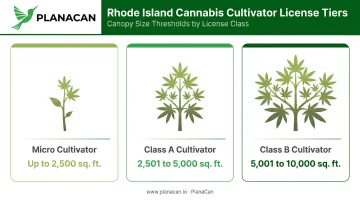
The CCC classifies cultivator licenses by canopy size — not facility size — under its current transition framework:
| License Class | Canopy Threshold |
|---|---|
| Micro cultivator | Up to 2,500 sq. ft. |
| Class A cultivator | 2,501 to 5,000 sq. ft. |
| Class B cultivator | 5,001 to 10,000 sq. ft. |
Hybrid cultivators transitioning from medical must submit updated floor plans showing canopy boundaries and measurements before commencing adult-use activities.
Cultivation-Specific SOP Content
In addition to the standard Operations Manual requirements, the CCC evaluates cultivators on:
- Canopy boundary documentation with precise measurements
- Updated floor plans reflecting current cultivation layout
- Protocols preventing cannabis from being visible from the street
- Batch and harvest-level traceability through the seed-to-sale system
- Inventory controls, product storage, quarantine, and destruction procedures
- Strain-level production documentation
None of these are static documents. Every time canopy allocation changes — whether you adjust veg/flower room ratios, change racking systems, or add grow coverage — you may be looking at a variance, a floor plan update, and a security plan revision. Internal SOP edits alone won't satisfy the CCC if the physical premises have materially changed.
Keeping Cultivation SOPs as Living Documents
Cultivation SOPs that sit in a binder and never change are a red flag during renewal. The CCC expects documentation that reflects actual current operations, not the operations you described when you first applied.
This is where PlanaCan gives Rhode Island cultivators a practical compliance advantage. PlanaCan maintains version-controlled, time-stamped SOP templates embedded directly into daily task workflows. When you update a treatment protocol or adjust a production procedure, the revised SOP deploys automatically to upcoming harvest cycles.
Task completion records then capture who executed each step, when, and on which batch. That two-layer structure — the SOP template ("this is how we do it") alongside the execution record ("this is who did it on this batch") — gives CCC inspectors exactly what they look for during pre-operational and renewal reviews. PlanaCan functions as the cultivation operations layer; it complements Rhode Island's METRC-based seed-to-sale system rather than replacing it.
Keeping Your Rhode Island Cannabis SOPs Current
Submitting SOPs at application is the beginning, not the end. Rhode Island's compliance framework treats SOPs as ongoing obligations with three recurring pressure points.
Variance Requirements for Material Changes
CCC variance guidance requires that material changes to approved application components — including your Operations Manual, Security and Safety Plan, premises layout, or floor plan — be submitted at least 60 days before the proposed effective date.
Making the change first and filing the variance afterward can void your license. Maintain a change-control log for all SOP documents and treat any material operational change as a CCC approval trigger.
Annual Renewal Obligations
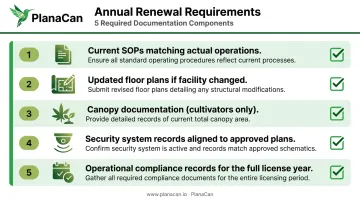
Renewal under 560-RICR-10-10-1 is not a rubber stamp. Licensees must update application information and demonstrate that current operations still match what was approved. At renewal, expect to produce:
- Current SOPs matching actual operational procedures
- Updated floor plans if any facility changes occurred
- Canopy documentation and evidence (cultivators only)
- Security system records aligned to approved plans
- Operational records showing consistent compliance throughout the license year
Employee Identification Card Tracking
All on-site employees, managers, and key persons must maintain current commercial cannabis establishment identification cards under the CCC licensing rule. Tracking renewals is the licensee's responsibility. Maintain an employee ID-card expiration log — lapsed cards are a direct compliance violation that inspectors routinely flag.
Frequently Asked Questions
What license do I need to open a dispensary in Rhode Island?
The primary retail license types are Cannabis Retail Sales, Social Equity Retail, Workers' Cooperative Cannabis Retail Sales, Compassion Center (medical), and Hybrid Cannabis Retailer. Application periods are opened and announced by the CCC — verify the current open period directly on the CCC website before applying.
What are the cannabis laws in Rhode Island?
Rhode Island legalized medical cannabis in 2006 and adult use in 2022 via the Cannabis Act (R.I. Gen. Laws Chapter 21-28.11). Adult-use retail sales are subject to a 7% state, 10% state excise, and 3% local cannabis excise tax. The CCC oversees licensing, enforcement, and advertising compliance.
What is the Cannabis Advisory Board in Rhode Island?
The Cannabis Advisory Board is an advisory body established under R.I. Gen. Laws § 21-28.11-6. Board members may not hold a direct or indirect financial interest in a cannabis establishment while serving, and all members must comply with Rhode Island's Code of Ethics.
What must be included in a Rhode Island cannabis Operations Manual?
Per 560-RICR-10-10-1.3.1(A)(4), the Operations Manual must cover key areas including recordkeeping, ID verification, employee training, inventory tracking, seed-to-sale compliance, data security, labeling, storage, recall procedures, odor control, emergency management, and a marketing plan, among others.
When does the CCC review SOPs during the Rhode Island licensing process?
The Operations Manual and Security & Safety Plan must be submitted with the license application, reviewed again during the pre-operational inspection before the final license issues, and assessed again at each annual renewal inspection.
Do Rhode Island cannabis cultivators need different SOPs than retailers?
Yes. Beyond the core requirements, cultivators must also address canopy and facility documentation, batch-level production records, strain-level traceability, updated floor plans, and quarantine and destruction procedures in their Operations Manual.