Cannabis process standardization fixes that. It means documenting every repeatable cultivation workflow — from propagation through harvest — and deploying those workflows consistently so that quality and compliance don't depend on who happens to be working that day.
This guide covers what standardization means at the cultivation level, why regulators and operations directors both demand it, how to implement it in practice, and where commercial grows most commonly go wrong.
Key Takeaways
- Process standardization means documented, repeatable workflows for every grow stage — not a binder no one opens.
- Without it, commercial cultivators face batch inconsistency, compliance failures, missed tasks, and scaling walls.
- State regulators require cultivation records, treatment logs, and audit-ready documentation — none of which you can produce consistently without standardized processes.
- Implementation follows a three-step cycle: map existing workflows, build strain-specific templates, then deploy, track, and refine after each harvest.
- Digital cultivation management tools like PlanaCan turn SOPs into daily operations your team can schedule, execute, and be held accountable for.
What Is Cannabis Process Standardization?
Cannabis process standardization is the development and consistent application of documented procedures — SOPs, feeding schedules, treatment protocols, environmental targets — that govern every repeatable action in a commercial cultivation facility.
The goal is producing the same quality product harvest after harvest — giving your team clear instructions and giving regulators the paper trail they require. Documentation is the means, not the end.
One important distinction: cannabis process standardization refers specifically to internal cultivation operations — how your team executes work. It's not the same as cannabis testing standardization (lab methods, cannabinoid analysis) or dose standardization in medical research contexts. Those are separate disciplines.
Process standardization also differs from seed-to-sale compliance reporting. Platforms like METRC and BioTrack handle plant-tag tracking and state inventory reporting. Process standardization governs the actual cultivation work underneath that compliance layer — what tasks get done, when, by whom, and how. PlanaCan, for example, operates as a cultivation operations layer that complements state track-and-trace systems rather than replacing them.
Why Commercial Cannabis Operations Need Process Standardization
The Regulatory Burden Is Real and State-Specific
Most US cannabis states impose substantial documentation requirements on licensed cultivators. The specifics vary — and that variation matters:
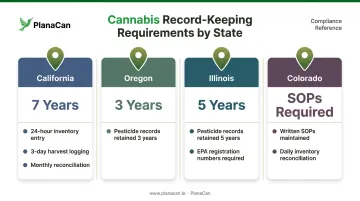
- California requires cultivation records retained for 7 years, inventory entries within 24 hours for receipts and disposals, harvest events logged within 3 calendar days, and monthly inventory reconciliation per the DCC's self-inspection checklist.
- Oregon requires pesticide application records retained for at least 3 years.
- Illinois cultivation centers must keep pesticide records for 5 years, with records including EPA registration numbers, quantities, dates, and applicators.
- Colorado requires written SOPs for cultivation activities including pesticide and nutrient application, plus daily inventory reconciliation.
These requirements can't be met retroactively. Standardized processes are what make this documentation possible in real time — before an inspector walks in.
The enforcement stakes are tangible. Michigan's Cannabis Regulatory Agency fined Cherry Industries $20,000 for record-retention failures and ultimately accepted a voluntary license surrender as part of the resolution. Nevada's CCB discovered nearly 8,000 pounds of cannabis treated with unapproved pesticide — a documentation and approval control failure with direct public health implications.
Quality Consistency Is a Revenue Issue
Without standardized inputs, the same strain produces different results across rooms and cycles. Research on genetically identical commercial cannabis plants found that cultivation environment alone caused meaningful differences in cannabinoid and terpene profiles — meaning two rooms running the same cultivar can produce chemically different products if environmental controls aren't standardized.
Post-harvest handling compounds the problem. The research is specific:
- Raw cannabis inflorescence contains roughly 78–80% moisture at harvest
- Standard drying targets of 18–21°C at 50–55% RH are narrow — deviations directly affect final cannabinoid content
- High relative humidity (78–98%) reduced flower size, biomass, and cannabinoid concentrations in PMC-published research
That's not theoretical yield loss — it's product that fails testing or sells at a discount.
Team Accountability Breaks Down Without Documentation
In a 5–20 person cultivation team, undocumented processes rely on individual knowledge. When that person leaves — and turnover in cannabis cultivation is consistently reported among the highest in the industry — that knowledge walks out the door.
The problem scales exponentially in multi-room operations. Garden First Cannabis, a PlanaCan customer managing 16 rotating harvests, achieved a 36% increase in completed tasks after implementing structured cultivation management. Structured task assignments and automated daily notifications gave the existing team what they needed to execute consistently — no new hires required.
How Cannabis Process Standardization Works
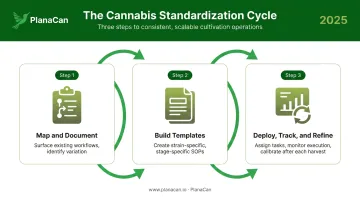
Standardization isn't a one-time project. It's a cycle: map what exists, codify it into templates, deploy and track execution, then refine based on outcomes.
Step 1: Map and Document Current Workflows
Before building any template, surface what your team actually does. Walk every stage of the grow and document what you find:
- Every repeatable task (feeding, IPM treatments, transplanting, pruning, environmental checks, harvest triggers)
- Who does it, how often, and what inputs are required
- Where decisions are made informally vs. explicitly
The goal is to convert tribal knowledge into written process. Most operations discover significant variation in this step — two cultivators executing the "same" feeding protocol with different ratios, timings, or documentation habits. That variation is what standardization eliminates.
Step 2: Build Standardized Templates for Each Process
Once workflows are mapped, convert them into structured templates. Each template should specify:
- Task sequence and timing — what happens in what order, relative to cultivation phase day (not just calendar date)
- Responsible roles — team-level or individual assignment
- Inputs — specific products, doses, and application methods
- Expected outcomes and data collection points — pH, EC, temperature, humidity, notes
Templates should be strain-specific and stage-specific. A single universal feeding schedule applied across all cultivars creates false confidence in consistency. Different strains have different nutrient tolerances and environmental requirements.
PlanaCan's template builder allows cultivators to create custom workflow templates for every treatment, strain, and cultivation step — then schedule them onto a shared calendar in a few clicks. The "create once, deploy anywhere" architecture means the same Blue Dream flower phase template can be deployed to Room 1 on one start date and Room 3 two weeks later, with tasks automatically staggered based on each room's phase-day calendar.
Step 3: Deploy, Track, and Refine
Deployment is where most standardization efforts either succeed or stall. A template sitting in a shared folder is just a document until someone executes it consistently. That requires:
- Clear task assignment — every cultivator knows what they're responsible for each day
- Automated notifications — tasks are surfaced to the right person at the right time without manager intervention
- Completion tracking — visibility into what was done, skipped, or delayed at the task level
After each harvest, use execution data to refine templates. Which tasks consistently ran over time? Which were frequently skipped? How did completion rates correlate with yield outcomes? That data turns each harvest into a calibration opportunity — not just a production event.
PlanaCan's Harvest Analytics dashboard connects task execution data to yield outcomes, enabling cultivation directors to identify which process changes actually drove yield improvements and which adjustments to carry into the next cycle.
Key Areas That Require Standardization
Standardization applies across distinct operational zones, each with its own compliance risk and quality impact.
Environmental and VPD Management
Document target ranges by growth stage — and document what to do when you drift outside them:
| Growth Stage | VPD Target Range |
|---|---|
| Vegetative | 0.8–1.0 kPa |
| Early Flower | 0.9–1.1 kPa |
| Late Flower | 1.1–1.3 kPa |
Without documented environmental standards, humidity drift goes undetected until it causes mold pressure, cannabinoid loss, or uneven development. VPD protocols need to specify not just targets but adjustment triggers — when and how to respond when sensors go out of range.
Nutrient and Treatment Schedules
Feeding regimens and IPM calendars serve two purposes simultaneously: operational consistency and compliance evidence. Most state regulators require pesticide records that include:
- Product name and EPA registration number
- Quantity applied and application date
- Location treated and applicator identity
Strain-specific feeding templates prevent one-size-fits-all protocols from masking cultivar-specific deficiencies or toxicities. The research is clear: nitrogen, phosphorus, and potassium requirements vary meaningfully by cultivar and growth stage.
Harvest and Post-Harvest Workflows
Batch-to-batch quality variance is often most preventable here. Standardize:
- Harvest trigger criteria (trichome development, days-from-flip benchmarks by strain)
- Drying room parameters (temperature, humidity, airflow, duration)
- Curing intervals and monitoring schedule
- Trim and processing sequence
Drying responses vary by cultivar, so post-harvest SOPs need the same strain-level differentiation as feeding templates — not a single universal protocol.
Team Task Management and Accountability
How tasks are assigned, communicated, and confirmed complete is itself a process that needs standardization. Paper task lists, group texts, and verbal handoffs all create gaps — tasks that were "definitely communicated" but never confirmed received or completed.
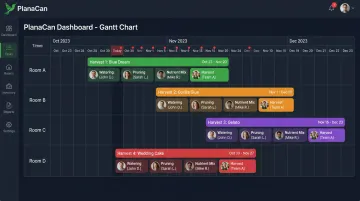
Closing that gap requires a system that connects scheduling to execution. PlanaCan's Gantt chart gives managers full visibility across all active harvest cycles, while automatic daily notifications push tasks directly to each cultivator's mobile device. Managers can see which tasks were completed, when, and by whom — the same documentation trail state inspectors want to see.
Common Mistakes in Cannabis Process Standardization
Three mistakes show up repeatedly across licensed cultivations — and each one is preventable with the right systems in place.
SOPs that exist but aren't executed. A document in a binder or shared drive isn't an operational standard — it's a filing artifact. Cannabis Business Times notes that SOPs only transform operations when used daily as part of the management structure. The gap between "we have SOPs" and "our team executes SOPs" is where most compliance failures actually originate.
One universal template applied to every strain. A single feeding or IPM schedule creates false confidence rather than real control. When a strain underperforms, you can't isolate whether the process failed — or whether the process was simply never appropriate for that strain to begin with.
Treating standardization as a one-time project. Standards should evolve with each harvest cycle, informed by completion data and yield outcomes. Templates built once and left untouched become outdated baselines — and outdated baselines quietly produce worse results with every crop that follows.
Frequently Asked Questions
What is process standardization in cannabis cultivation?
It's the development and consistent application of documented workflows, SOPs, and schedules — covering every repeatable cultivation task from propagation through harvest. The goal is quality consistency and compliance readiness, achieved through repeatable execution rather than individual judgment calls.
Why is process standardization required for cannabis compliance?
Most state regulators require cultivators to maintain operational records, document pesticide use, and demonstrate consistent practices during inspections. Standardized processes are what make that documentation possible and auditable. Without them, records either don't exist or aren't defensible under scrutiny.
What should a cannabis cultivation SOP include?
At minimum: the task or procedure, who is responsible, when it occurs, what inputs are used, expected outcomes, and how completion is recorded. It needs enough specificity that any trained team member can execute it consistently — not just the person who wrote it.
How do you standardize processes across multiple grow rooms or facilities?
Multi-room standardization requires strain- and room-specific templates deployed independently on a shared scheduling system, with cross-harvest visibility so discrepancies between rooms or sites are easy to identify. Templates need enough room-level differentiation to account for variation while remaining consistent enough to produce comparable outcomes across harvests.
What happens when cultivation processes aren't standardized?
Batch inconsistency, unpredictable yields, failed regulatory audits, and missed tasks are the predictable results. Scaling becomes nearly impossible because there's no operational baseline to replicate — new rooms or facilities inherit the same informal, individual-dependent patterns.
How does cultivation management software help with process standardization?
Platforms like PlanaCan let teams build workflow templates digitally, schedule them across a shared calendar, assign tasks to individual cultivators or teams with automatic notifications, and track completion at the task level. The result is documented SOPs that translate directly into executable, accountable daily operations.