Introduction
Running a perpetual cannabis harvest sounds straightforward on paper: stagger multiple batches through veg and flower so you're always pulling product on a consistent schedule. In practice, most commercial operations underestimate how quickly a single scheduling error cascades through every subsequent batch.
The financial pressure is real. According to Oregon's OLCC 2025 supply and demand report, demand represented only 57% of supply in 2024 — operators competing on thin margins can't afford inconsistent output or preventable delays. When wholesale prices are falling, production efficiency becomes a competitive advantage, not just an operational nicety.
This guide covers how to build a perpetual harvest schedule that holds up under real conditions:
- Room count math and capacity planning
- Strain selection tradeoffs for staggered timing
- Common failure modes and how to prevent them
- What a functional day-to-day schedule actually looks like
Key Takeaways
- Two rooms is the minimum; a dedicated propagation space enables tighter, more consistent cadences.
- Strain selection is a scheduling decision — cultivars with variable finish times make perpetual harvests unpredictable.
- Schedule drift from small, compounding delays is the most common reason perpetual systems break down.
- Standardized workflows and automated task notifications separate a schedule that works once from one that scales.
- Garden First Cannabis achieved a 23% decrease in labor costs and 36% increase in completed tasks after standardizing their perpetual harvest operations with PlanaCan.
Why Scheduling Is the Foundation of a Perpetual Cannabis Harvest
A single-batch grow has one timeline. A perpetual harvest runs three to seven overlapping timelines simultaneously — and a scheduling error in one doesn't stay contained.
The Cascade Problem
Miss your veg-to-flower flip date by a week because the flower room wasn't cleaned in time. That week doesn't disappear — it pushes your next harvest back, which backs up the following batch's propagation window, which creates a backlog in your clone room. By the time you've run two cycles with unresolved drift, the whole schedule has shifted.
This is fundamentally different from a single-batch delay, which is inconvenient but bounded.
Labor Distribution
A well-structured perpetual schedule spreads workload evenly across the week. Instead of 15 people descending on one room for a harvest event and then having downtime while the next batch matures, your team has consistent daily tasks distributed across multiple active batches — watering, feeding, IPM applications, and training.
That labor consistency has measurable value. Garden First Cannabis, running 16 rotating harvests through PlanaCan's scheduling platform, achieved a 23% reduction in labor costs alongside a 36% increase in completed tasks. Clear task ownership and a reliable daily schedule eliminate the coordination overhead that burns labor hours in unstructured operations.
Risk Distribution
Multiple concurrent batches provide a natural operational buffer. If a pest event hits your Room 3 batch, the rest of your operation keeps moving:
- Rooms 1, 2, and 4 continue through their timelines uninterrupted
- Harvest commitments tied to other rooms stay on schedule
- IPM response stays contained rather than facility-wide
For operations under wholesale supply commitments or with downstream processing tied to consistent delivery windows, that containment is the difference between a manageable setback and a missed contract.
How to Build Your Perpetual Harvest Schedule
There's no universal calendar. Your schedule is a function of three inputs: available rooms, strain flowering times, and target harvest frequency. Get those three variables wrong and the schedule won't hold regardless of how carefully you manage execution.
Based on Room Count and Operational Scale
The Cannabis Business Times perpetual harvest framework describes four distinct areas as the operational baseline: clones, veg, and two rotating flower rooms. Empty space in any of those areas represents wasted revenue potential.
Minimum viable setup: Two rooms (one veg, one flower) supports a harvest every 8–12 weeks depending on strain. Workable, but with limited flexibility for delays.
Adding a clone/propagation room: Tightens the cadence to 4–6 weeks and creates a buffer at the earliest stage — where holds cause the least disruption.
Enterprise and MSO operations: Stagger each room's flip date by a fixed interval (typically 2–4 weeks), enabling multiple harvests per month.
A concrete commercial example: Clarity Gardens operates seven tiered flower rooms on a precise 54-day cycle, harvesting one room every Tuesday with a six-person team, then repopulating within 36 hours. Their monthly output runs 500–700 pounds. That output depends entirely on a schedule that's locked, documented, and followed without exception.
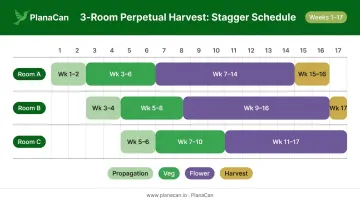
Sample 3-Room Staggered Schedule:
| Room | Propagation Start | Veg Flip | Flower Flip | Harvest Window |
|---|---|---|---|---|
| Room A | Week 1 | Week 3 | Week 5 | Week 13 |
| Room B | Week 3 | Week 5 | Week 7 | Week 15 |
| Room C | Week 5 | Week 7 | Week 9 | Week 17 |
Work backwards from your target harvest date to calculate each milestone. The stagger interval (two weeks in this example) becomes the heartbeat of the whole operation.
Based on Strain Selection and Flowering Time
Room count sets the framework — strain selection determines whether that framework holds. Cannabis Business Times advises cultivation startups to limit initial genetics to five to ten varieties — beyond that, production scheduling becomes difficult to manage reliably. The guidance includes standardizing planting densities, nutrition, pruning, and harvest times so all varieties fit within the same production cycle.
The science backs this up. A 2024 peer-reviewed study tracking two high-THC cultivars found that Gorilla Glue required approximately 25% longer than Incredible Milk to reach commercial maturity — 72 days versus 58 days after photoperiod initiation. Running both strains in the same room on the same flip schedule creates a structural mismatch.
Key strain selection criteria for scheduling:
- Consistent finishing time within ±3–5 days of target (not an 8–12 week "range")
- Predictable rooting success rate (Cannabis Business Times benchmarks 80% as an expected rate)
- Compatibility with your room's lighting, canopy, and environmental setup
Many commercial perpetual growers standardize around 2–4 core cultivars. Running 6–8 different strains with different flowering times is manageable — but it requires tracking each batch on its own timeline, which increases scheduling complexity.
Based on Target Harvest Cadence
The relationship between batch size and harvest frequency is a tradeoff worth making deliberately:
- Smaller batches, higher frequency (every 4 weeks): More consistent cash flow, more labor touchpoints, requires more rooms and tighter coordination
- Larger batches, lower frequency (every 8 weeks): Operationally simpler, but creates bigger labor spikes at harvest and longer gaps between revenue events
Match your cadence to your team size and post-harvest processing capacity. A six-person team can handle weekly harvests if rooms are sized appropriately. The same team attempting weekly harvests in oversized rooms will create a quality and consistency problem.
Common Scheduling Mistakes That Break the Cycle
Schedule Drift
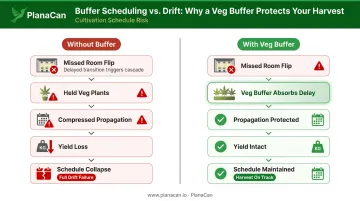
Drift is the perpetual harvest killer. A batch takes an extra week to root — manageable on its own. But now your veg room is holding plants that are ready to flip while the flower room is still being cleaned. The flower room clears, but the veg plants have outgrown their planned canopy footprint. You flip them anyway and lose yield. The next propagation window is now compressed.
Cannabis Business Times identifies this pattern explicitly: propagation rooms filling up when veg space is unavailable, flower rooms being cleaned before veg plants are ready — small mismatches that compound into chronic bottlenecks.
The fix is building deliberate buffer time into the veg stage, where vegetative plants can be held (with training to manage canopy size) without the same consequences as extending flower. Don't build the buffer at the back of the schedule.
Running Too Many Strains Without Independent Tracking
Running five or more cultivars with different flowering windows on a single shared schedule is manageable if each batch is tracked independently. It becomes chaotic when the team is trying to hold all those timelines in their heads or on a shared whiteboard.
The failure mode: teams lose visibility into which batch is on which timeline and start making decisions based on which room looks ready rather than which room is scheduled to flip next.
Team Communication Failures
In operations with 5–20 cultivators, verbal task assignments or static spreadsheets produce predictable problems: missed IPM applications, skipped feedings, duplicated work, and confusion about which batch a task applies to. Any one of those misses can push a flip date back.
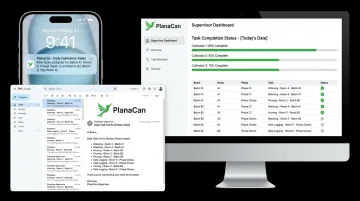
This is where PlanaCan's automated daily task notifications address a specific operational gap. Rather than relying on a head grower to verbally assign work each morning, the platform delivers push notifications and emails to each cultivator listing their tasks for the day — tied to specific batches, phases, and rooms. Supervisors see real-time task completion status without having to check in manually.
No Buffer in the Schedule
Many operations plan to the day with zero contingency. Equipment fails, regulatory inspections arrive unannounced, a pest response takes three days instead of one. Any of those events immediately breaks a schedule with no slack.
Best-practice perpetual schedules build defined buffer windows at the veg stage. Build that slack in deliberately — it's what separates a schedule that absorbs disruption from one that collapses under it.
Best Practices for Maintaining a Perpetual Harvest Long-Term
Standardize Every Phase as a Repeatable Workflow
SOPs drive profitability in cannabis operations — this is as true for scheduling as it is for cultivation practices. Each stage of the perpetual cycle (propagation, transplant, veg, flip, early flower, late flower, harvest, dry/cure) should have a standardized task checklist executed the same way, every batch, every cycle.
PlanaCan's custom workflow templates are built for exactly this workflow: create a template for each cultivation stage, schedule it against a batch's calendar, and deploy it to every subsequent batch in a few clicks. The "create once, deploy anywhere" approach means your team executes the same proven process each time — and any deviation shows up immediately rather than going unnoticed until damage is done.
Maintain a Bird's-Eye View of All Active Batches
At three rooms, you can probably manage batch timelines on a whiteboard. At five rooms, the whiteboard starts failing. At seven or more rooms, it's not a viable system.
Managers need to see all active batches and their stage timelines simultaneously — specifically to catch conflicts before they happen. Two batches converging on the same flower room is a conflict that should be visible weeks in advance, not discovered on flip day.
PlanaCan's interactive Gantt-style calendar displays every harvest schedule in a single view — phase timelines, key dates, and task status across all active batches at once. Monthly, weekly, and daily views let a cultivation director zoom from the full operational picture down to individual task execution.
Conduct Post-Harvest Reviews
After each cycle, compare actual milestone dates against planned dates for every batch:
- When did propagation actually start vs. when was it scheduled?
- Did the flower flip happen on the planned date?
- What caused any delays, and at which stage?
- Did the veg buffer get used? How much?
Operations that run this review systematically compound efficiency gains over time. Those that skip it repeat the same scheduling errors, adjust timing reactively, and never build the strain-specific data that makes future schedules more accurate.
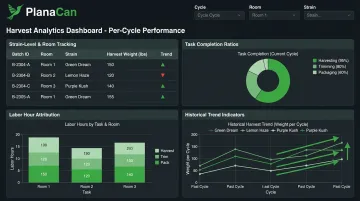
PlanaCan's harvest analytics track per-cycle data by strain, room, batch, and grower — including task completion ratios, labor hour attribution, and historical performance trends. That data supports the kind of review that actually improves the next cycle rather than just documenting what happened.
Frequently Asked Questions
How many grow rooms do you need for a perpetual cannabis harvest?
The minimum is two: one veg room and one flower room. That supports a harvest every 8–12 weeks depending on strain. Adding a dedicated propagation/clone room enables a tighter 4–6 week cadence and is strongly recommended for commercial operations targeting monthly or more frequent harvests.
How do you handle a batch that finishes late without disrupting the whole schedule?
The veg stage is the right place to absorb delays. Vegetative plants can be held longer using training techniques to manage canopy size without the yield consequences of extending flower. Building deliberate buffer time into the veg phase, rather than treating the schedule as rigid from day one, is the most effective mitigation.
What strain characteristics matter most for perpetual harvest scheduling?
Predictable, consistent finishing times within a narrow window (±3–5 days of target) are the most important trait. Strains with wide flowering-time ranges make scheduling unreliable. Most commercial perpetual operations standardize around 2–4 well-understood cultivars to keep the schedule manageable.
How far apart should harvest cycles be staggered in a commercial grow?
The stagger interval depends on your target harvest frequency and team processing capacity. Common commercial cadences run 2–4 week offsets between rooms, with each room's flip date staggered to distribute labor evenly and maintain a consistent product supply.
How do you keep a large cultivation team aligned on a perpetual harvest schedule?
Verbal communication and static spreadsheets break down once you're managing 5+ cultivators across multiple concurrent batches. Standardized daily task assignments tied to specific batches, delivered through automated notifications, ensure every team member knows exactly what to do and when — no morning verbal rundown required.
What is the biggest single reason perpetual harvest schedules fail?
Schedule drift. Small, compounding delays that are never corrected accumulate into a schedule that's weeks off its original targets. The fix is building deliberate buffer windows into the veg stage and using a centralized scheduling system that makes any deviation from the plan immediately visible to the whole team.