Introduction
Delaware's adult-use cannabis market is newer than most operators realize. HB 1 and HB 2 were enacted without signature in April 2023, with the Delaware Marijuana Control Act taking effect on July 5, 2023. The Office of the Marijuana Commissioner (OMC) began accepting adult-use license applications on August 19, 2024 — opening a capped, competitive pool of just 125 licenses across four categories.
That cap matters. When applications are screened before a lottery, incomplete or weak documentation disqualifies candidates before a single plant is ever grown. Standard Operating Procedures are among the first documents screeners evaluate.
This guide covers exactly what Delaware requires: which license types must establish SOPs, what each SOP set must address, and how operators can build documentation that satisfies the OMC across applications, pre-operational inspections, and renewal reviews.
Key Takeaways
- Cultivation and manufacturing applicants must establish written SOPs as an explicit condition of licensure under OMC Rule 5001
- All four license types — cultivation, manufacturing, retail, and testing — require an operational plan, safety/security plan, and training plan at application
- Testing facilities must comply with ISO/IEC 17025 standards, the strictest documentation standard among all four license types
- Keep SOPs on-site and inspection-ready throughout the full two-year license term — not just at application
- Embedding SOPs into task-level workflows — not binders — builds both operational consistency and audit-ready compliance records
Delaware's Cannabis Regulatory Framework at a Glance
Delaware's adult-use cannabis program built toward its current structure over more than a decade:
- 2011 — Delaware Medical Marijuana Act established the state's first regulated cannabis program
- April 2023 — HB 1 (removing possession penalties) and HB 2 (the Delaware Marijuana Control Act) were enacted without signature, with the Act taking effect July 5, 2023
- August 2024 — OMC began accepting adult-use license applications on August 19, 2024, with selections made via lottery after initial application review
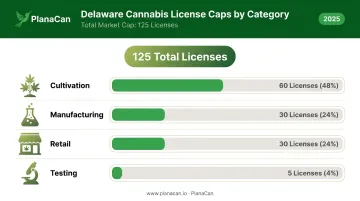
That August 2024 window opened access to 125 available licenses distributed across four categories:
| License Type | Cap |
|---|---|
| Cultivation | 60 |
| Manufacturing | 30 |
| Retail | 30 |
| Testing | 5 |
Social equity and microbusiness tiers carry reduced fees and specific eligibility criteria. Microbusiness applicants must meet all three of the following:
- Delaware-resident ownership
- 10-employee maximum
- Facility size capped at 2,500 sq ft
Delaware's adult-use framework is codified in Title 4, Chapter 13 of the Delaware Code, with OMC Rule 5001 serving as the primary operational regulation across all four license types.
All applicants must submit a comprehensive application package covering business, operational, security, training, social responsibility, and worker safety plans — as outlined in the OMC's application matrix.
SOP Requirements by Delaware Cannabis License Type
The OMC's documentation requirements differ by license type. Here's what each category demands.
Cultivation Facility
OMC Rule 5001 requires cultivation facilities to maintain written procedures for planting, harvesting, tracking, and destroying marijuana plants with those SOPs available on-site for Commissioner inspection. Failing an inspection due to missing or incomplete documentation carries the same operational risk as a formulation error — treat SOP readiness as an ongoing requirement, not a one-time application task.
The application matrix also requires submission of:
- An operating plan covering management structure and safe handling
- A quality assurance (QA) plan with written policies for product safety and consistency
- An environmental and sustainability plan addressing energy, water use, and waste management
What cultivation SOPs must address:
- Plant lifecycle management from propagation through post-harvest processing
- Pest and disease management protocols
- Nutrient and irrigation procedures
- Waste disposal : cannabis waste must be rendered unusable by mixing with at least 50% non-consumable solid waste per Rule 5001
- Plant batch tracking within Delaware's Commissioner-approved seed-to-sale tracking system, documenting canopy areas, plant counts, and harvest weights
Manufacturing Facility
Rule 5001 requires manufacturing facilities to maintain SOPs for receipt, processing, storage, and tracking of products, with those SOPs available for Commissioner inspection. Security arrangements are also an explicit application condition — plan for both documentation and physical security review.
Manufacturing SOPs must cover the full production chain:
- Cannabis intake and chain of custody from source cultivator
- Extraction or infusion processes with contamination prevention controls
- Sanitation and product-contact surface procedures
- Packaging, labeling, and finished goods transfer protocols
- Batch consistency documentation and product testing requirements before distribution
The application matrix adds a QA plan, environmental/sustainability plan, social responsibility plan, and employee health/safety/welfare plan to the manufacturing application requirements.
Retail Store
Retail applicants do not submit individual SOPs upfront. Instead, they submit an operating plan at application, with operational procedures required to be inspection-ready on-site.
The application matrix applies the same cross-license plan requirements: safety/security, social responsibility, training/staffing, and employee welfare.
Retail SOPs must address:
- Customer identity and age verification procedures
- Inventory management and daily reconciliation
- Point-of-sale transaction procedures
- Employee training documentation and onboarding records
Two hard restrictions must be reflected in retail SOPs: adult-use delivery is prohibited, and on-site consumption is not permitted under Delaware's current framework. Any SOP that implies or accommodates either practice creates direct exposure to violations.
Testing Facility
Testing carries the most rigorous documentation requirements of any license type. OMC Rule 5001 requires testing facilities to operate according to ISO/IEC 17025:2017 , the international standard for laboratory competence, impartiality, and consistent operation.
Testing-specific requirements include:
- Designation of a quality assurance management officer
- Maintenance of a comprehensive QA management plan
- Chain-of-custody records for all samples
- Certificate of Analysis (COA) issuance to producing licensees
- Sample destruction and disposal procedures that comply with Rule 5001
ISO/IEC 17025 compliance means your SOPs must document not just what your lab does, but how you validate that it's done correctly — including measurement uncertainty, method validation, and internal audit trails.
Core SOP Content Areas Every Delaware Cannabis Business Needs
Beyond license-specific requirements, four documentation areas apply across all or most license types.
Safety and Security Plan
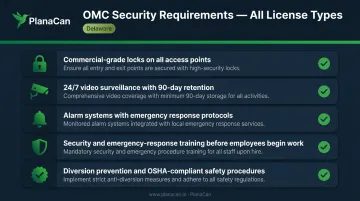
Every license type requires a security plan under the OMC application matrix. Rule 5001 specifies:
- Commercial-grade locks on all access points
- 24/7 video surveillance with 90-day footage retention
- Alarm systems with emergency response protocols
- Security and emergency-response training before employees begin work
- Diversion prevention controls and OSHA-compliant safety procedures
This document functions as both a standalone application requirement and an SOP component: it needs to be specific enough that employees can actually follow it, not merely descriptive enough to pass initial review.
Operational Plan and Training SOPs
Delaware's application matrix requires an operational plan that includes:
- A social responsibility plan covering diversity in hiring, community engagement, and equity commitments
- A training and staffing plan documenting role-specific onboarding, ongoing competency verification, and employee development
- An employee health, safety, and economic welfare plan
These aren't just application exhibits. The underlying SOPs must describe what employees actually do: how they're trained, what they're trained on, and how competency is verified over time.
Quality Assurance and Environmental SOPs
Cultivation and manufacturing applicants must submit both a QA plan and an environmental/sustainability plan. The QA plan should address:
- Batch testing requirements and documentation standards
- Rejection criteria for out-of-spec product
- Rework or destruction procedures
- Consistency controls across production runs
The environmental plan must cover energy efficiency strategies, water conservation practices, and waste reduction. This includes the Rule 5001 requirement that cannabis waste be rendered unusable before disposal.
Unlike some application exhibits, these plans carry ongoing weight. The OMC may review them during inspections, and deficiencies can affect license renewal.
From Documentation to Daily Operations: Making Your SOPs Work
The most common failure point in cannabis compliance audits isn't missing documentation — it's documentation that no one uses. A binder of well-formatted SOPs sitting in a back office provides almost no protection during an inspection if your team can't demonstrate consistent execution.
Effective SOPs need to be written at the task level: specific enough that any trained employee can complete the work accurately without checking with a supervisor. They also need to be reviewed and updated after each harvest cycle or production run to reflect actual operational changes.
The Gap Between Paper and Practice
Static documents create accountability blind spots, especially across multi-room grows where different team members handle the same tasks on different days. Without a system that connects written procedures to scheduled work, it's difficult to prove that work was completed according to documented standards — which is exactly what an OMC inspector is evaluating.
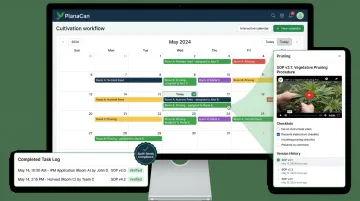
For cultivation operations, platforms like PlanaCan address this directly. Cultivators can build custom workflow templates for every treatment, strain, and cultivation phase — then schedule them on an interactive calendar and assign tasks to specific team members.
SOPs are version-controlled, time-stamped, and embedded directly into daily tasks, so cultivators see the current procedure on their iOS or Android device when they need it. Automatic daily notifications keep the grow team aligned without relying on verbal briefings or paper logs.
The result is an audit trail that answers both compliance questions: this is how we do it (the documented SOP) and this is who actually did it on this batch (task completion records with user attribution, timestamps, and logged data).
Ongoing Compliance and License Renewal
That audit trail matters beyond individual inspections — it shapes how prepared you are when your license comes up for renewal.
Delaware licenses are valid for two years.
Renewal applications must be submitted on or before the first day of the third month before biennial expiration — roughly 90 days out. The Commissioner holds inspection authority throughout the license term, and cultivation and manufacturing SOPs must be available on-site for those reviews.
Operators who treat SOPs as living documents — updated after inspections, staff changes, or process improvements — are better positioned at renewal. Those who let documentation drift from actual practice face a harder conversation when an inspector asks to see both the written procedure and proof it was followed.
Frequently Asked Questions
How much is a dispensary license in Delaware?
The open retail application fee is $5,000 (non-refundable), with a $10,000 license fee for a two-year term. Social equity applicants pay a $1,000 application fee and 40% of the open license rate. Microbusiness applicants pay a $3,000 application fee.
What is an SOP in cannabis?
A cannabis SOP (Standard Operating Procedure) is a written document that defines, step by step, how employees must perform specific tasks (plant feeding, product labeling, inventory reconciliation) to ensure consistency and regulatory compliance. It creates a repeatable standard every team member follows across every harvest cycle.
What are Delaware cannabis laws?
Adult-use cannabis was legalized through HB 1 and HB 2, enacted without signature in April 2023. The OMC began regulating recreational licenses in 2024, with a 15% marijuana enforcement tax on retail sales. Municipalities may prohibit cannabis establishments by ordinance; county-level bans apply only in areas where Delaware law grants county jurisdiction (such as unincorporated areas).
Does Delaware require SOPs for all cannabis license types?
Cultivation and manufacturing applicants must establish written SOPs as an explicit application and operational requirement under Rule 5001. Retail applicants must submit an operational plan at application and keep operating procedures inspection-ready on-site. Testing facilities must submit and maintain a comprehensive QA management plan meeting ISO/IEC 17025 standards, with SOPs available for Commissioner review.
What should a Delaware cultivation SOP include?
A Delaware cultivation SOP should cover the full plant lifecycle (propagation through post-harvest), pest and nutrient management protocols, batch tracking within the Commissioner-approved seed-to-sale system, waste disposal procedures (including the 50% non-consumable mixing rule), and QA checkpoints. Each procedure should be documented at the task level so any team member can execute it consistently.