A mistimed plant date pushes back your flip. An early flip leaves you with underdeveloped canopy that can't support heavy buds. A missed harvest window costs you cannabinoid potency across an entire room. Multiply those errors across multiple strains and rooms, and you're looking at meaningful revenue left on the floor every cycle.
This guide covers the full cannabis cultivation calendar — stage-by-stage timing windows, outdoor planting anchors by US region, pruning decisions by growth phase, biological harvest signals, and how to build a scalable system that keeps commercial teams aligned across every room.
Key Takeaways
- The cannabis lifecycle has five stages — germination, seedling, vegetative, flowering, and harvest — each with its own timing window.
- Outdoor planting is anchored to regional last-frost dates; indoor commercial grows can run year-round on any schedule.
- Pruning belongs in the vegetative stage; heavy pruning after week 3 of flowering risks stressing plants during active bud development.
- Harvest readiness is determined by biology — trichome color, pistil darkening, and leaf fade — not by a calendar date.
- Commercial operations managing multiple rooms and strains need a standardized scheduling system to stay consistent across every harvest cycle.
Why Timing Determines Yield, Quality, and Profitability in Commercial Grows
Every cannabis growth stage is physiologically dependent on the one before it. A plant that was under-vegged won't support a heavy flowering canopy. One harvested too early won't reach peak cannabinoid concentration. These aren't isolated mistakes — they cascade.
MJBizDaily's cultivation revenue model estimates flower canopy can generate $500–$1,000 gross revenue per square foot per year, based on five harvests annually at current wholesale pricing. That math only holds when rooms turn on schedule.
Propagation timing is one of the first places this breaks down. The same source notes that 50% rooting success can leave flower rooms operating at half capacity — and failed cuttings can delay production by several weeks before the problem even reaches the veg room.
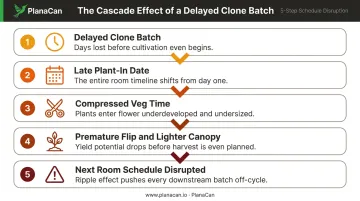
For operations running perpetual harvests across multiple rooms, the cascade effect is the real risk:
- A delayed clone batch pushes back the plant-in date
- A late plant-in compresses veg time
- Compressed veg leads to premature flipping
- Premature flipping produces lighter canopy and lower grams per light
- Meanwhile, the next room's schedule is already waiting
Informal scheduling based on memory or rough estimates is manageable when one person oversees one room. With 5–20 cultivators, multiple strains, and staggered harvest cycles, it becomes unreliable fast. The operations that consistently hit yield targets run on documented, repeatable timing systems — and the sections below break down exactly what that looks like, stage by stage.
The Cannabis Cultivation Calendar: Stage-by-Stage Breakdown
The five-stage cannabis lifecycle is the structural foundation of any grow calendar. Duration varies by strain type (photoperiod vs. autoflowering), environment (indoor vs. outdoor), and growing method — but the sequence never changes.
Germination and Seedling Stage (Weeks 1–3)
Germination typically takes 1–7 days, with cotyledons emerging around days 3–6 under appropriate conditions. The seedling stage follows and lasts roughly 2–3 weeks.
Peer-reviewed germination studies show optimal cannabis germination occurs between 66–86°F (19–30°C), with seedling biochemical profiles varying by thermal conditions. For commercial propagation, target these environmental parameters:
- Temperature: 66–86°F during germination
- Humidity: 60–70% RH throughout the seedling stage
- Light intensity: Moderate — avoid high-intensity exposure until roots stabilize
The goal in this stage is establishing root structure — not pushing growth rate. Rushing seedlings into veg before they've stabilized creates fragile plants that underperform across every subsequent stage.
Vegetative Stage (Weeks 3–19 for Photoperiod)
The vegetative phase is the most variable in duration. Photoperiod plants can be vegged anywhere from 3 to 16+ weeks depending on desired plant size and canopy goals. This is also the primary window for all plant training, topping, and pruning.
Autoflowering strains begin flowering around 3–4 weeks after germination, regardless of light schedule — which requires a fundamentally different scheduling approach than photoperiod cultivation.
Veg duration directly shapes what's possible in flower:
- 4 weeks of veg: Smaller canopy, lower yield ceiling, faster room turnover
- 8+ weeks of veg: Fuller canopy, greater productivity, higher labor investment upfront
- Minimum veg targets: Define per strain and hold to them — inconsistency here cascades through every downstream stage
Flowering Stage (Weeks 6–14 Depending on Strain)
Flowering begins when the photoperiod plant is switched to a 12/12 light cycle indoors, or when days shorten past the summer solstice outdoors. A cannabis morphology study documented discernible inflorescences appearing after just 10 days under short-day conditions, with full flowering established by day 15.
General flowering duration ranges by strain type:
- Indica-dominant / fast-finishing strains: 7–10 weeks
- Most photoperiod hybrids: 8–10 weeks
- Sativa-dominant genetics: 10–14 weeks or longer
Commercial operations should document expected flowering time per strain and build that directly into room turnover scheduling. Running a 10-week sativa in a room scheduled for 8-week turnovers creates structural problems that ripple forward.
Harvest, Drying, and Cure (Weeks 1–8 Post-Chop)
Harvest is not the end of the calendar. The post-chop phases are where product quality is either preserved or lost.
| Phase | Typical Duration | Notes |
|---|---|---|
| Drying | 7–14 days | Surveyed cultivators averaged ~10 days; some optimal ranges exceed 2 weeks |
| Curing | 2–8 weeks | Studies show curing increases cannabinoid content by 3.3–13.6% |
| Storage risk | Ongoing | Accelerated storage studies found 18–34% total THC loss after 127 days without proper terpene preservation |
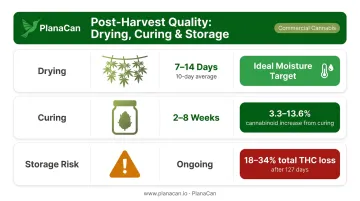
Source: Postharvest Drying and Curing research, MDPI Plants; Vapor Phase Terpenes study, Sage Journals
Commercial operations must account for dry and cure time in room cycle planning. Compressing these phases to free up storage space or rush product to market is one of the most common quality mistakes in commercial cultivation.
When to Plant: Timing by Environment and Operation Type
There's no single universal answer to "when should I plant." The right timing depends on whether you're running indoor or outdoor, your target market window, strain genetics, and regional climate.
Indoor Commercial Grows: Plant on Your Schedule
Indoor operations can initiate a grow cycle year-round — that's the core advantage of controlled-environment cultivation. Commercial cultivators run perpetual harvest models where rooms are always offset by phase, creating a continuous production pipeline.
For multi-room facilities, the planting calendar should be staggered based on:
- Room capacity and square footage
- Clone or seedling readiness
- Flowering duration per strain
- Harvest targets and downstream processing capacity
The perpetual harvest model requires deliberate scheduling. Rooms need to be planned against each other so no two rooms hit harvest at the same time, unless your processing capacity can genuinely handle the volume.
Outdoor Grows: Anchoring to Seasonal Windows
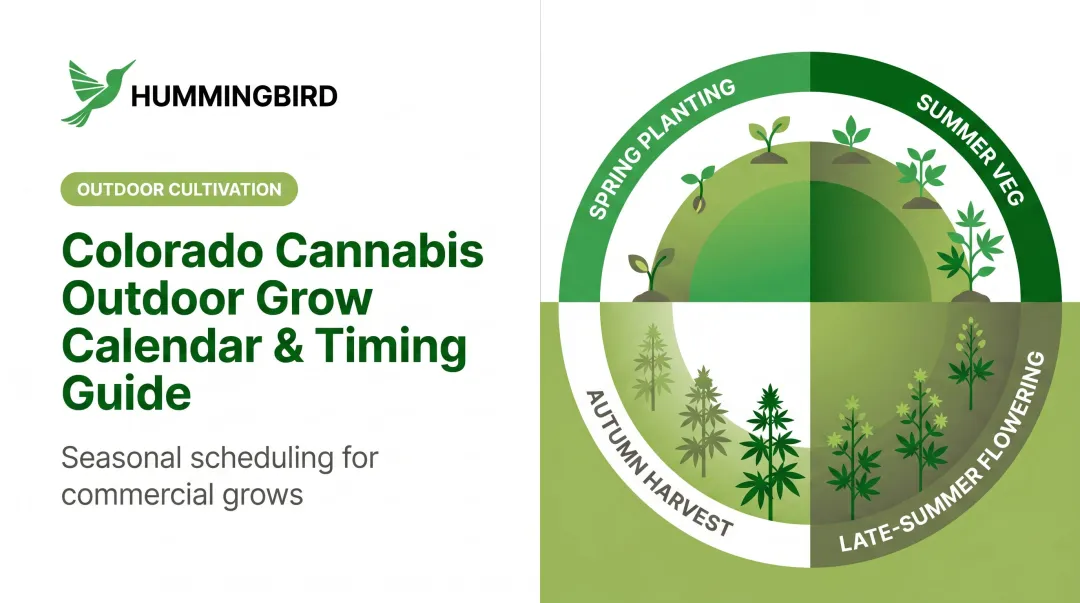
Outdoor cultivation is constrained by regional climate and the natural photoperiod. The general Northern US timeline:
- March–April: Start seeds or clones indoors
- Mid-May: Transplant outdoors after last frost risk clears
- Late June: Summer solstice — days begin shortening, which will eventually trigger flowering
- Late September–October: Harvest window for most photoperiod strains
Regional Timing Adjustments for US Outdoor Grows
| Region | Transplant Window | Flowering Onset | Harvest Target |
|---|---|---|---|
| Northern states (NY, OR, WA) | Mid-May to early June | Mid-August | Late September–early October |
| Mid-Atlantic / Midwest | Early to mid-May | Early-to-mid August | Late September–October |
| Southern states (CA, AZ) | April–early May | August | October–November |
NWS climate data confirms the range: Northern New York sees first freeze risk as early as the third week of September, while Southern Arizona's first fall freeze typically doesn't arrive until around December — giving Southern operations significantly more finishing time. Before locking in a transplant schedule, verify your local last and first freeze dates against your nearest NOAA/NWS station.
When to Prune: Stage-Specific Timing for Commercial Canopy Management
Pruning timing in commercial cannabis is driven by plant stage, not calendar date. The wrong pruning at the wrong time doesn't just stress the plant — it can directly reduce yield and cannabinoid uniformity.
Research on large medical cannabis plants found that lower plant sections had cannabinoid concentrations up to 40% lower than upper sections. This makes canopy management a chemistry issue, not just a labor task.
Pruning During the Vegetative Stage
Veg is the primary window for all major pruning and training work. The three techniques most used in commercial operations:
- Topping: Removing the main apical stem to encourage lateral branching and a wider, more even canopy. A 2022 study found topping at the 10th node produced 18.5g dry inflorescence per plant with strong side-shoot development.
- Lollipopping: Removing lower growth that won't receive adequate light — reduces wasted plant energy and improves airflow through the lower canopy.
- Defoliation: Strategic leaf removal to improve light penetration and airflow to developing bud sites, typically done in rounds rather than all at once.
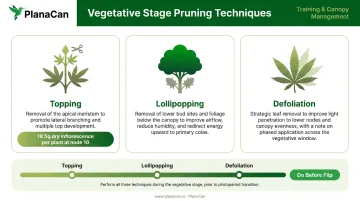
Complete the bulk of this work before flipping to flower. Indica-dominant strains close canopy faster than sativas, so front-load your pruning earlier in the veg cycle — once you flip to flower, the window for major work closes quickly.
Pruning at the Flowering Transition and Early Flower
Light defoliation remains acceptable in the first 2–3 weeks of flowering to improve airflow and light exposure to developing bud sites. After that, stop.
Heavy pruning past week 3 removes productive leaf area during active bud development. In commercial operations where consistency matters, avoiding major interventions after the early-flower window is the standard. The same applies to spraying — no pesticides, fungicides, or foliar feeds during late flower.
When to Harvest: The Biological Signals That Tell You It's Time
Harvest timing should be determined by plant biology, not by the calendar. Even the most accurate grow schedule is a planning tool. The final harvest decision requires direct plant observation.
Trichome Color: The Primary Indicator
Use a jeweler's loupe (30–60x) or digital microscope to examine trichome heads. The progression:
- Clear: Immature — THC still developing
- Cloudy/milky white: Peak THC concentration
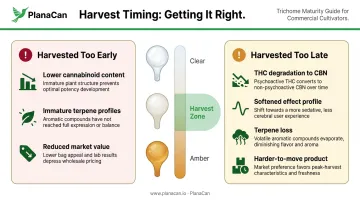
- Amber: THC degrading into CBN, effect profile shifting
Most commercial operations targeting peak potency harvest when the majority of trichomes are milky with some amber beginning to appear. 2025 research across 25 genotypes found that 22 of 25 strains peaked in total cannabinoid concentration between the mostly amber and fully amber stigma stages — confirming that stigma/trichome color is a reliable maturity marker, though the exact window is cultivar-dependent.
Pistil Color: A Secondary Indicator
As plants approach peak maturity, pistils shift from white to orange/brown and curl inward. When approximately 70–90% of pistils have darkened and curled, the plant is at or approaching its harvest window.
Pistil observation is useful but less precise than trichome examination. Use both indicators together for a more complete read on maturity.
Bud Swelling and Final Weeks
Bud fattening and calyx stacking typically accelerate in the final 2–3 weeks before harvest — often weeks 6–8 of flowering for most photoperiod strains. This is also when growers should:
- Reduce or eliminate nitrogen inputs
- Begin flushing if that's part of your protocol
- Increase observation frequency (check trichomes every few days)
The Cost of Mistimed Harvest
Mistimed harvest cuts directly into yield quality and revenue:
- Harvesting too early means lower cannabinoid content, immature terpene profiles, and reduced market value
- Harvesting too late means THC degradation to CBN, a softened effect profile, terpene loss, and product that's harder to move
At room-scale canopies, these errors multiply across thousands of plants. A single mistimed cycle can measurably reduce revenue per run — which is why systematic observation, not guesswork, is the standard for commercial operations.
Timing Mistakes That Cost Commercial Cannabis Operations
Even experienced teams make timing errors at scale. These are the most common — and the most expensive:
Starting clones before the previous room is cleared and cleaned
This compresses the grow calendar, forces rushed transplants, and creates cross-contamination risk between cycles. Build a sanitation buffer between harvest/room turnover and the next plant-in date. This isn't extra time — it's risk management.
Flipping to flower before the plant is structurally ready
Plants that haven't built sufficient vegetative structure can't support heavy bud development. The result: underdeveloped colas, airy flowers, and lower grams per square foot. Saving a week in veg often costs far more at the scale.
Using one strain's harvest schedule as a proxy for all strains
In multi-strain operations, this is a persistent source of quality problems. Each genetic has its own maturation timeline. Peak THC timing varies by cultivar — a 2025 study documented peak timing on day 63 for Cherry Wine and day 75 for BaOx.
Separate harvest schedules per strain aren't optional at commercial scale.
Letting flowering stretch past peak maturity
Overbaked trichomes, increased CBN, degraded terpenes — the signs are visible under magnification before they become a market problem. But that only works if someone is checking consistently and the harvest date is tracked against actual plant readiness, not just a fixed calendar slot.
Managing Your Cultivation Calendar at Scale
For commercial operations managing multiple rooms, multiple strains, and teams of 5–20+ cultivators, a cultivation calendar cannot live on a whiteboard or in a basic spreadsheet. The operational complexity demands a system.
Three practices make the difference at this scale:
- Build strain-specific templates. Document timing windows for each genetic — germination, veg target, flip date, flowering duration, harvest window, dry/cure timeline. Deploy to any new room with consistent results and a clear reference point for your team.
- Put everything on a shared visual calendar. Every grow milestone — plant dates, flip dates, pruning windows, harvest targets — needs to be visible across the facility. When one person carries the schedule in their head, it becomes a single point of failure.
- Log performance after every cycle. Record actual days per stage, yield per room, environmental readings, and any deviations from plan. This is what separates reactive growers from operations that improve with every harvest.
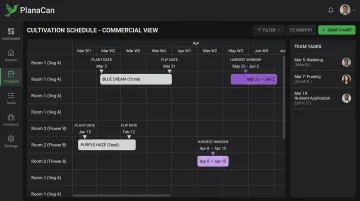
PlanaCan is built for exactly this — commercial operations that can't afford a schedule living in one person's head. It lets cultivators build custom strain templates, schedule them on an interactive Gantt chart, and send automatic daily notifications to the grow team, so every person on the floor knows what to complete and when.
Garden First Cannabis used PlanaCan to manage 16 rotating harvests and saw a 36% increase in completed tasks alongside a 23% decrease in labor costs.
PlanaCan's harvest analytics and labor dashboards handle the logging side automatically — tracking who completed what, when, and how actual execution compared to the planned schedule. The data builds without requiring manual entry after the fact.
When timing decisions are documented, visible to the whole team, and refined after each cycle, the calendar stops being a reference document and starts driving consistent, repeatable results across every room you run.
Frequently Asked Questions
What week do buds fatten the most?
Bud fattening typically accelerates in the final 2–3 weeks before harvest — generally weeks 6–8 of flowering for most photoperiod strains — when calyx stacking peaks and trichome density surges. This is also the window to reduce nitrogen inputs and begin flushing if that's part of your protocol.
What is the best month to grow cannabis?
For outdoor grows in the Northern US, start seeds indoors in March–April and transplant after the last frost (typically mid-May) to maximize the vegetative window before the solstice triggers flowering. Indoor commercial grows have no single best month — cycle timing is fully controlled and set by your production schedule.
How long is the vegetative stage for cannabis?
Autoflowering strains veg for roughly 3–4 weeks before flowering by maturity regardless of light cycle. Photoperiod plants range from 3 to 16+ weeks depending on desired canopy size, growing method, and your commercial production schedule.
When should I start pruning cannabis plants?
Complete topping, lollipopping, and defoliation during veg or within the first 2–3 weeks of flower. Beyond week 3, pruning stress disrupts active bud development — a risk commercial operations should avoid.
How do I know when cannabis is ready to harvest?
Look for three converging signals: trichomes shifting from milky white to amber under magnification, pistils approximately 70–90% darkened and curled inward, and natural fan leaf yellowing. All three together give you the most reliable harvest window — no single indicator is definitive on its own.
What's the difference in cultivation calendar timing for indoor vs. outdoor cannabis grows?
Indoor commercial grows allow year-round planting on any schedule, giving cultivators complete control over cycle timing and the ability to run perpetual harvests. Outdoor grows are constrained by regional climate, last-frost dates, and the natural photoperiod shift after the summer solstice that triggers flowering — making timing largely non-negotiable.