Cannabis Business Times modeled the revenue difference between a 7.5-week and 10-week flower schedule at the same facility: $3.25 million per year in annual bulk revenue. That gap isn't just about genetics — it's about how precisely a team manages stage transitions, flip timing, and harvest windows across concurrent rooms.
This guide is written for commercial cultivation teams. It breaks down each growth stage biologically, covers the environmental parameters and operational decisions that matter at each phase, and addresses the common mistakes that reduce yield and consistency at scale.
Key Takeaways
- Cannabis progresses through four stages: germination, seedling, vegetative, and flowering — each with distinct lighting, nutrition, and environmental requirements.
- Photoperiod strains require a 12/12 light change to trigger flowering; autoflowering strains transition by age regardless of light schedule.
- Mistimed flips, missed male removal, and premature harvests directly cut yield and potency — timing each transition correctly is non-negotiable.
- Commercial PPFD targets shift significantly across stages: 150–200 µmol/m²/s for propagation, 350–550 for veg, and 900–1,000 for flower.
- Running multiple rooms at different stages simultaneously demands proactive scheduling — operations that rely on memory and whiteboards miss tasks and lose harvests.
What Is the Cannabis Plant Life Cycle?
Cannabis sativa L. is classified as an annual herbaceous plant — it completes its full reproductive cycle within a single growing season. Outdoors, it germinates in spring, grows through summer, and flowers as day length shortens in fall. Indoors, cultivators replicate and compress that cycle under controlled conditions.
The Four-Stage Framework
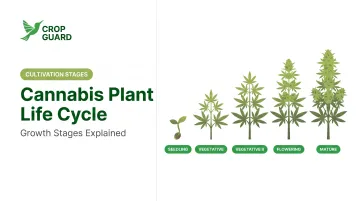
Commercial operations typically divide the life cycle into four operational stages:
- Germination — seed activation and taproot emergence
- Seedling — early leaf development and root establishment
- Vegetative growth — canopy and root mass expansion
- Flowering — bud development, resin production, and harvest
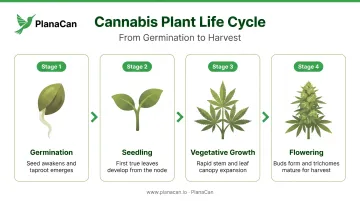
Post-harvest processing (drying and curing) follows the flowering stage and is a critical determinant of final product quality.
Photoperiod vs. Autoflowering: Why It Matters for Scheduling
The most consequential biological distinction in cannabis cultivation is how a strain triggers flowering:
- Photoperiod strains flower in response to a reduction in daily light hours — typically when the light schedule shifts to 12 hours on, 12 hours off. This gives commercial growers direct control over when flowering begins and how long plants stay in veg.
- Autoflowering strains are photoperiod-insensitive, transitioning based on age and genetics regardless of light schedule. They move faster but offer less scheduling flexibility.
For multi-room facilities, this distinction shapes room design, light cycle management, and the entire harvest scheduling cadence.
The Four Growth Stages of a Cannabis Plant
| Stage | Typical Duration | Key Trigger |
|---|---|---|
| Germination | 2–10 days | Moisture + warmth + darkness |
| Seedling | 1–3 weeks | First true leaves appear |
| Vegetative | 2–8 weeks | 18/6 light schedule (indoor) |
| Flowering | 7–14 weeks | 12/12 light change (photoperiod) |
Timing varies by strain, environment, and grower decisions. These are operational ranges, not universal constants.
Stage 1: Germination (2–10 Days)
When a cannabis seed encounters moisture, warmth, and darkness, the embryo activates. The taproot (radicle) emerges first, anchoring downward, followed by the stem pushing upward toward the surface. The first two leaves that break the soil are cotyledons — embryonic leaves that were already inside the seed, not true cannabis fan leaves.
Peer-reviewed germination research confirms radicle emergence as the measurable germination endpoint, with water and darkness at approximately 24°C as baseline conditions. The plant does not require nutrients at this stage — only moisture, moderate warmth, and undisturbed darkness.
Two common commercial germination methods:
- Direct sow into media — seeds are planted directly into starter cubes, rockwool, or propagation media. Less handling, lower risk of root damage.
- Pre-soak or paper towel method — seeds are soaked or placed between moist paper towels until the taproot emerges, then transferred to media.
The most avoidable cause of germination failure is physical disturbance. A taproot that breaks during transfer rarely recovers. Whatever method a team uses, consistency and minimal handling matter more than the method itself.
Stage 2: Seedling (1–3 Weeks)
The seedling stage begins when the first true serrated leaves emerge — distinct from the round cotyledons — and ends when the plant has developed leaves with 5 to 7 full blades and is ready for transplant into its next container.
During this phase, the root system is minimal and fragile. The plant is building the foundation for veg growth, but it can't yet handle the environmental demands of a mature canopy.
Commercial PPFD target for propagation: 150–200 µmol/m²/s, per Cannabis Business Times. This is significantly lower than veg or flower intensity — pushing light too hard at this stage stresses leaf tissue that isn't yet equipped to process it.
Key risks during the seedling stage:
- Overwatering — the root zone can't drain excess moisture efficiently yet
- Nutrient burn — seedlings need minimal feeding; early-stage nutrient errors are difficult to reverse
- Mold — high humidity combined with dense trays creates ideal conditions for damping off
Stage 3: Vegetative Growth (2–8 Weeks)
Vegetative growth is where the plant builds its physical infrastructure. Root mass expands, stems thicken, branches develop, and the canopy takes shape. The framework built here sets the hard limit on flower yield — bud sites can only develop where structure already exists.
Standard indoor veg light schedule: 18 hours on, 6 hours off. Commercial PPFD targets during veg run 350–550 µmol/m²/s. Research in Industrial Crops and Products offers useful context for canopy management:
- ~900 µmol/m²/s produced compact, robust plants with tighter internodes
- ~600 µmol/m²/s resulted in taller plants with longer internodes — relevant for operations dialing in stretch by strain
Veg duration is a strategic decision, not a fixed timeline. Longer veg produces larger plants with more potential bud sites, but delays the flip and pushes back harvest scheduling. Cannabis Business Times models commercial operations using either a 2-week or 4-week veg duration depending on target cycle length — the right choice depends on canopy targets, room turnover goals, and strain-specific growth rates.
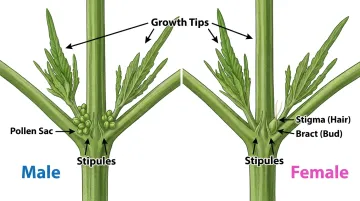
Pre-flower sexing happens at the end of veg. As plants approach flip readiness, pre-flowers appear at nodes. Female plants show two white hair-like pistils. Male plants produce pollen sacs. Utah State University extension research reports that male plants shed pollen for 2–4 weeks, and pollination reduced essential oil yield by 56% in one documented case. Identifying and removing males before the flip isn't optional — it's crop protection.
Stage 4: Flowering and Harvest (7–14 Weeks)
Flowering is initiated when photoperiod plants receive a shift to 12 hours of light and 12 hours of uninterrupted darkness. This change signals the plant to shift from vegetative growth to reproductive mode. Autoflowers transition independently of this trigger.
Early flower (weeks 1–3): the stretch. Plants can double or triple in height in the first few weeks after the flip. Sativa-dominant strains stretch more aggressively than indica-dominant cultivars. Managing canopy height relative to light distance is critical here — plants that outgrow their room are difficult to light efficiently.
Mid-to-late flower is where bud development accelerates and resin production peaks. This is the phase where environmental precision has the most direct impact on final potency and terpene expression.
Determining Harvest Readiness
Harvest readiness requires trichome examination under magnification. The progression to understand:
- Clear trichomes — immature; cannabinoids not yet fully developed
- Cloudy/milky white — peak THC accumulation; USU cites milky trichomes as the primary harvest indicator
- Amber trichomes — THC degrading to CBN; some amber is common in commercial targets
Industry guidance (Ed Rosenthal and others) commonly references an 80–90% cloudy with 5–15% amber window as a practical harvest target, though trichome maturation varies by genotype. Pistil color — white turning orange — is a useful secondary visual cue but less reliable than trichome examination.
Post-Harvest: Drying and Curing
A well-grown crop can lose significant quality in the dry room. Parameter targets vary across sources:
- USU recommends: 60–70°F, 45–55% RH
- Greenhouse Grower recommends: 60–65°F, 60–65% RH
- Typical duration: 7–14 days drying; minimum 2–4 weeks curing in sealed containers
A 2025 study on postharvest drying and curing found total cannabinoid content wasn't significantly altered, but decarboxylation and terpene reductions occurred with improper conditions. The real exposure is terpene loss and terpene profile shift — degraded aromatics show up directly in lab results and consumer experience.
Key Factors That Influence Stage Progression
Light: PPFD, Spectrum, and Schedule
Light is the primary control variable in indoor cultivation. Three dimensions matter:
PPFD by stage:
| Stage | Commercial PPFD Target |
|---|---|
| Propagation/Seedling | 150–200 µmol/m²/s |
| Vegetative | 350–550 µmol/m²/s |
| Flowering | 900–1,000 µmol/m²/s |
Beyond 1,000 µmol/m²/s, yields increased approximately 1% per 1% light increase up to around 1,800 µmol/m²/s, after which returns plateau.
Spectrum matters too. Peer-reviewed research confirms that blue and red wavelength ratios affect plant morphology, cannabinoid production, and inflorescence yield. Blue-heavy spectrums favor compact vegetative growth; red-heavy spectrums support flowering. Most commercial LED fixtures offer controllable spectrum profiles to manage this across stages.
Nutrients Across the Cycle
Feeding requirements shift significantly as the plant moves through stages:
- Veg: Nitrogen-dominant to support foliar and root mass development
- Early-mid flower: Shift toward phosphorus and potassium as bud sites develop
- Late flower / flush: Reduced or eliminated feeding to clear residual salts before harvest
A 2021 N-P-K study found that drug-type cannabis in flower responded meaningfully to nitrogen and phosphorus inputs. One nitrogen-rate study put maximum inflorescence yield around 160 mg/L N, above which plants showed toxicity responses — though optimal N levels vary by cultivar and system.
Overfeeding is the harder mistake to fix. Excess nutrients at any stage can lock out uptake, trigger toxicity, and set back weeks of growth — and that connects directly to the next variable: how well your environment supports the plant's ability to use what you're feeding it.
VPD: Managing Vapor Pressure Deficit by Stage
VPD (vapor pressure deficit) governs transpiration efficiency and directly affects nutrient uptake and disease pressure. General targets by stage:
- Propagation / Seedling: 0.4–0.8 kPa (low VPD to protect fragile root systems)
- Vegetative: 0.8–1.2 kPa (moderate VPD supports vigorous transpiration)
- Flowering: 1.2–1.6 kPa (higher VPD reduces mold risk as canopy density increases)
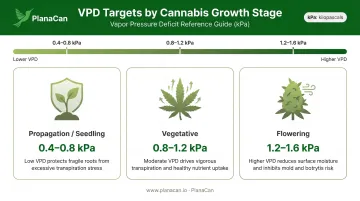
These ranges are starting points. Optimal kPa shifts with cultivar, canopy density, and HVAC capacity — dial them in against your specific setup rather than applying them as fixed rules.
Common Mistakes in Cannabis Growth Stage Management
Applying One Timeline to Every Strain
Strain genetics create real variation in veg duration, flowering time, and stretch behavior. A facility running five strains on a single flip schedule will consistently see some harvested too early and others running past their peak window. Strain-specific timelines aren't optional at commercial scale: they're the foundation of accurate harvest scheduling.
Flipping Too Early or Too Late
Flipping before the plant's canopy frame is established means fewer and smaller bud sites — the plant simply doesn't have enough structural support for heavy flower development. Flipping too late wastes canopy space and delays the next harvest cycle without proportional yield gain.
Cannabis Business Times' scheduling models show that even a 2.5-week difference in flower duration changes annual output materially. The right flip point is determined by canopy coverage, plant height relative to the room, and strain-specific growth rates — not a fixed calendar day.
Dark Period Disruption During Flower
Light interruptions during the dark period can interfere with the photoperiod signaling that keeps plants in flower. Light below 20–30 lumens generally doesn't disrupt dark-period perception, but significant leaks or extended interruptions cross that threshold and can trigger a flowering response reversal.
Hermaphroditism risk is real but depends on duration, intensity, and strain sensitivity. Dark period integrity matters: room light-sealing should be verified before and during flowering, not assumed.
Harvesting Before Trichome Maturity
Cutting early to accelerate throughput trades cannabinoid and terpene development for speed. Trichome maturation varies by genotype, and research published in the Journal of Cannabis Research confirms that development depends on both genetics and plant age.
No single universal harvest window applies to all strains. The only reliable approach is trichome examination on each strain, each cycle.
Common indicators to assess before harvest:
- Trichome color: Clear → cloudy → amber progression signals cannabinoid peak
- Pistil coloration: 70–90% darkened pistils align with most strains' peak windows
- Calyx swelling: Full, tight calyxes indicate mature flower structure
- Strain baseline: Each cultivar has a documented finish range — track it each run
Managing Growth Stage Transitions at Commercial Scale
In a multi-room commercial facility, germination, seedling care, veg management, flower room work, and drying are happening simultaneously across different spaces. That's not a planning challenge — it's an execution challenge. And execution without structure produces inconsistent results.
Why Stage Transitions Compound
Missing a single stage-specific task rarely stays isolated. A delayed nutrient transition in week 3 of flower affects bud development in week 6. A missed male removal before the flip can pollinate an entire room. A harvest that runs three days long because the dry room wasn't ready pushes back the next room's flip. Each delay has downstream consequences in a perpetual harvest model.
Stage-specific, time-sensitive tasks that require coordination across teams:
- Transplanting from propagation into veg containers
- Light cycle changes at the flip
- Nutrient program transitions between veg and flower
- Topping, training, and defoliation on schedule
- Pest and disease scouting at defined intervals
- Flush initiation in late flower
- Harvest day coordination and dry room handoff
Scheduling as Operational Infrastructure
Cannabis Business Times notes that a weekly perpetual harvest model standardizes tasks, improves labor consistency, and increases predictability of product quality and volume. That structure requires deliberate scheduling infrastructure — not whiteboards and group texts.
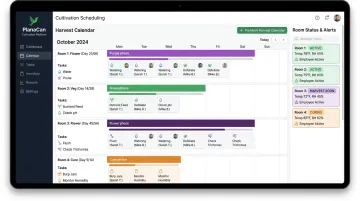
This is the problem PlanaCan addresses directly. The platform gives commercial cultivation teams three core capabilities:
- Build custom workflow templates for each strain and cultivation phase
- Schedule stage-specific tasks across multiple harvest rooms on a shared interactive calendar
- Automatically notify team members of daily priorities based on phase-day progression
When a grower deploys a strain template to a new room, the entire phase sequence — veg tasks, the flip, weekly checks, flush timing, harvest day — populates automatically. Supervisors receive alerts when tasks are overdue. Cultivators execute from iOS and Android mobile apps as they move through the facility.
Garden First Cannabis, running 16 rotating harvests through PlanaCan, reported a 36% increase in completed tasks and a 23% decrease in labor costs after implementing the platform. Those results reflect what structured stage-transition management produces in practice: higher output at a lower cost per unit.
Frequently Asked Questions
How long is a cannabis plant cycle?
The full cycle from seed to harvest typically runs 4 to 10 months. Autoflowering varieties move faster due to age-triggered flowering, while photoperiod strains with extended veg periods run longer. Indoor grows with controlled environments tend toward the shorter end of the range.
How many weeks is the cannabis seedling phase?
The seedling stage lasts 1 to 3 weeks, beginning when the first true serrated leaves emerge and ending once the plant has developed leaves with 5 to 7 full blades — at which point it's ready for transplant and vegetative growth.
What triggers the cannabis plant to start flowering?
Photoperiod strains flower in response to a shift to 12 hours of light and 12 hours of uninterrupted darkness per day. Autoflowering strains transition based on age and genetics alone, regardless of what light schedule they're on.
What is the difference between photoperiod and autoflowering cannabis?
Photoperiod strains require a deliberate light cycle change to trigger flowering, giving growers control over veg duration and plant size before the flip. Autoflowers transition automatically based on age, producing faster cycles that trade flexibility for speed — making them less suited for yield optimization in larger commercial operations.
How do you know when cannabis is ready to harvest?
Trichome color is the primary indicator: clear means immature, cloudy/milky white signals peak THC, and amber indicates degradation has begun. Pistil color shift from white to orange is a useful secondary cue, but trichome examination under magnification is more reliable.
What are the most critical environmental conditions to manage during flowering?
The three priorities are humidity reduction to prevent bud rot, uninterrupted dark periods to avoid photoperiod disruption, and a nutrient shift to phosphorus and potassium-dominant feeding. For most commercial operations, light intensity should sit in the 900–1,000 µmol/m²/s range.