For commercial cultivators managing 3,000+ sqft of canopy or multi-room operations, this isn't optional optimization — it's operational survival. Labor consumes a disproportionate share of production margins, and manual processes introduce batch-to-batch inconsistency that directly degrades product quality, compliance standing, and profitability. According to MJBizDaily, one person hand-trims roughly one pound per eight-hour shift. A trained machine operator handles 10–15 pounds per hour.
This guide covers the full automation process end to end — from trichome-ready plants to shelf-ready product — including how each stage works, what factors determine success, and where operations commonly go wrong.
Key Takeaways
- Cannabis harvest automation spans five sequential stages: timing and cut, bucking, trimming, drying and curing, and sorting with quality control.
- Primary drivers are labor cost reduction, batch-to-batch consistency, trichome preservation, and traceability for regulatory compliance.
- Physical equipment handles the mechanical work; scheduling and workflow tools handle the operational layer. Both are required at scale — neither works well without the other.
- Automating one stage in isolation without coordinating the full workflow creates new bottlenecks — sometimes worse than a manual process that's already running smoothly.
Why Commercial Cannabis Operations Automate the Harvest Process
The math is straightforward. Hand-trimming labor runs $150–$200 per pound at some operations, according to trade reporting by MG Magazine. At that rate, trimming alone becomes one of the highest-cost, most variable inputs in a commercial grow — and one of the hardest to control across multiple rooms and harvest cycles.
What manual harvesting cannot reliably deliver, at commercial throughput, is:
- Lot-to-lot trim consistency — hand crews vary by person, by shift, by fatigue level
- Moisture content uniformity — without controlled drying environments, each batch drifts
- Throughput speed that matches perpetual harvest schedules across multiple flowering rooms
- Documented traceability — manual workflows leave gaps that compliance audits expose
What Goes Wrong Without It
Unautomated commercial operations encounter the same failure patterns:
- Uneven trim quality between batches as crew composition changes
- Trichome degradation from extended handling time between stages
- Harvest windows missed because scheduling relies on memory or spreadsheets
- Labor retention issues from repetitive, physically demanding trim work
State-level seed-to-sale tracking requirements in California, Michigan, Massachusetts, Illinois, and other markets now demand documented process consistency that informal manual workflows cannot sustain. Closing that gap requires more than trimming equipment — it requires documented scheduling, standardized SOPs, and workflow systems that create a verifiable record at every harvest stage.
How the Cannabis Harvest Automation Process Works, Step by Step
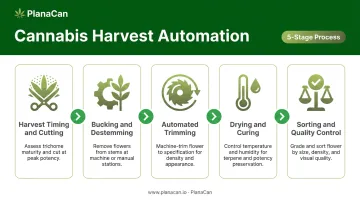
A harvested plant moves through five stages. Each can be automated to varying degrees, and each must be coordinated so bottlenecks in one stage don't back up or damage product in the next.
The equipment is only half the story. The scheduling and workflow coordination layer behind it — task assignments, stage-transition timing, team visibility — determines whether physical automation equipment actually runs at capacity or sits idle waiting for human follow-through.
Step 1: Harvest Timing and Cutting
Harvest timing is driven by trichome maturity. Milky or cloudy trichomes signal peak cannabinoid concentration; amber trichomes indicate degradation has begun. Automating this step means standardizing the inspection protocol — defined visual criteria, logged observations, consistent cut windows — so teams harvest at the right moment every cycle, not based on calendar convenience or crew availability.
Cultivation management platforms can schedule trichome checks as recurring tasks with documented results, ensuring the decision to cut is traceable and consistent across rooms.
Step 2: Bucking (Destemming)
Bucking is the mechanical removal of buds from stems and stalks. It's the most labor-intensive manual stripping step, and automated bucking machines process material at speeds that would require many hands to match.
Commercial bucking equipment spans a wide throughput range:
- Entry-level machines (Mobius MBX, Triminator BuckMaster Pro): 80–150 lb/hour
- High-capacity systems (CenturionPro XL MegaBucker): up to 480 lb/hour dry
Tunable speed settings matter here. Different bud densities require different machine configurations to avoid flower damage, and those settings should be documented per strain in your workflow templates.
Step 3: Automated Trimming
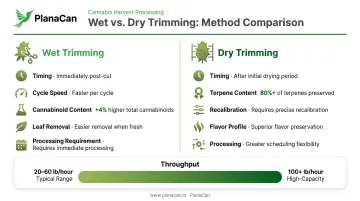
The choice between wet and dry trimming affects equipment setup, timing, and output quality:
- Wet trimming — immediately post-cut, when leaves are turgid and easy to remove; faster per cycle
- Dry trimming — after initial drying; a 2024 peer-reviewed study found dry trimming produced the highest terpene content for over 80% of analyzed mono- and sesquiterpenes, though mild wet trimming produced 4% higher total cannabinoid content
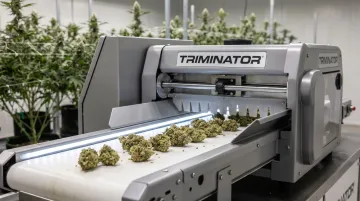
Automated trimmers use blade or tumbling mechanisms to remove fan and sugar leaves consistently. The critical machine variables are blade speed and batch time — both must be calibrated per strain.
Under-processing leaves visual quality failures. Over-processing risks roughly 7–10% flower loss per pound, per MJBizDaily reporting. Commercial dry trimmers typically process 20–60 lb/hour depending on system and configuration; high-capacity systems can exceed 100 lb/hour with a small crew.
Step 4: Drying and Curing
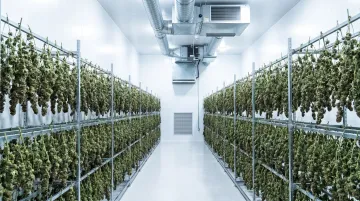
Fresh-cut cannabis flower contains 75–78% moisture by wet weight, according to a peer-reviewed post-harvest operations review. The target after drying: 9–13% moisture content, with a water activity range of 0.55–0.65 per ASTM D8197-22.
Peer-reviewed drying research cites optimal drying conditions of 18–21°C (64–70°F) at 50–55% relative humidity, with most commercial drying and curing cycles running 10–14 days total. Removing roughly 50% of moisture in the first 24–48 hours is typically ideal.
HVAC systems maintaining those temperature and humidity parameters — with consistent airflow management — prevent mold proliferation and protect terpene integrity.
Curing follows in airtight storage with periodic burping to release CO₂, stabilizing the terpene profile over several additional weeks.
Step 5: Sorting, Quality Control, and Post-Harvest Processing
Automated sorters separate trimmed flower by bud size using conveyor and band systems. Belt-based sorting (food-grade polyurethane belts) is gentler than vibration methods, reducing trichome damage during size separation. Industrial sorting systems can process 90–360 lb/hour, depending on configuration.
This stage serves two purposes:
- Larger buds command premium pricing; smaller "popcorn" buds route to pre-rolls or extraction
- Trim and biomass that would otherwise be discarded becomes feedstock for pre-roll production or concentrate extraction
- Intentional routing through an automated post-processing workflow captures that value at scale
Pre-rolls have shifted from a trim byproduct into a primary revenue line at many operations — making intentional biomass routing a direct contributor to per-harvest profitability.
Key Factors That Affect Cannabis Harvest Automation Outcomes
Equipment selection matters, but these operational factors determine whether that equipment actually delivers consistent results across harvests.
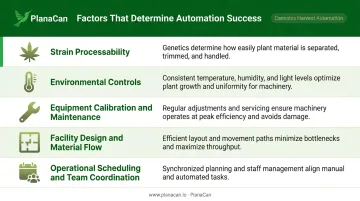
Strain processability — Dense, uniformly shaped flowers handle mechanical trimming and sorting far better than airy or irregular varieties. Evaluate new strains in smaller runs before committing them to fully automated workflows.
Environmental controls during drying and curing — Temperature and humidity deviations are the primary cause of mold loss and terpene degradation in automated facilities. Without consistent HVAC control, the precision gains from mechanical trimming are undone in the drying room.
Equipment calibration and maintenance — Blade dullness, incorrect speed settings, and residue buildup in trimming machines are the most common causes of inconsistent output and compliance risk. Calibration should be documented per strain and verified between batches.
Facility design and material flow — Inadequate space or poor flow between stages creates bottlenecks where product sits in suboptimal conditions, accelerating degradation. Each stage needs enough throughput capacity to keep pace with the one before it.
Operational scheduling and team coordination — Often the most overlooked efficiency loss in commercial operations. When harvest stages aren't sequenced and assigned in advance, physical automation equipment sits idle waiting on human follow-through — erasing the gains it was bought to deliver. Platforms like PlanaCan close this gap by scheduling each stage, assigning tasks, and sending automatic daily notifications to the team.
Garden First Cannabis saw a 23% decrease in labor costs and a 36% increase in completed tasks after implementing PlanaCan's scheduling and workflow coordination across 16 rotating harvests.
Common Misconceptions About Cannabis Harvest Automation
Misconception: Buying trimming equipment = harvest automation
Automating one stage without coordinating the full workflow — scheduling, team roles, stage-transition timing — creates new bottlenecks. Product sits between stages in unfavorable conditions, and the downstream problems (mold, quality inconsistency, compliance gaps) often exceed what a well-organized manual process would have produced. True automation requires both the equipment and the operational layer that governs when and how each step executes.
Misconception: Automated trimming always damages trichomes more than hand-trimming
This is equipment-dependent, not categorically true. Trade-publication testing showed modern machine-trimmed flower with only a 0.6% THC discrepancy versus hand-trimmed flower — improved from 3.8% in earlier tests.
Trichome damage typically results from incorrect speed settings, over-processing time, or dirty equipment. Properly calibrated automated trimmers with gentle handling mechanisms perform comparably to hand-trimming at a fraction of the labor cost.
Misconception: Automation only makes sense for very large operations
The break-even threshold is lower than most operators assume. Single-room operations at 3,000 sqft can reduce labor overhead and improve consistency through a combination of equipment and scheduling software. The ROI case holds at modest throughput because the gains stack across multiple dimensions:
- Labor savings per pound compound across every harvest cycle
- Scheduling software standardizes workflows without requiring large teams
- Consistency benefits — reduced rework, fewer quality rejects — apply at any scale
Frequently Asked Questions
What is the difference between wet trimming and dry trimming in cannabis harvest automation?
Wet trimming happens immediately after cutting when leaves are still hydrated and easy to remove, making it faster to process. Dry trimming occurs after initial drying and better preserves terpene profiles, though it requires more precise machine settings. Automated trimmers can handle both methods, but blade speed and batch time need to be recalibrated for each approach.
How much can automation reduce labor costs in a cannabis harvest operation?
Documented results vary by operation. One commercial producer working with Twister Technologies reduced labor costs by 49%, cut staff from 12 to 7, and increased yield by 7%. PlanaCan customer Garden First Cannabis achieved a 23% labor cost reduction through scheduling and workflow coordination alone. Actual savings depend on how many stages are automated and whether cultivation management software is paired with physical equipment.
Does automated trimming damage trichomes compared to hand-trimming?
Properly calibrated automated trimmers using gentle handling mechanisms perform comparably to hand-trimming in preserving trichome integrity. Incorrect settings, over-processing time, or dirty equipment cause damage — not automation itself. Machine trimming can cause roughly 7% flower loss per pound, rising to 8–10% if overprocessed, making calibration and batch time control critical.
At what canopy size does investing in cannabis harvest automation typically become cost-effective?
Most industry guidance points to operations above 3,000–5,000 sqft as the range where automation ROI becomes clear within one to two harvest cycles. Vendor ROI models typically assume 400–500 lb/week minimum dry-flower processing, with payback modeled around 5–6 months at 1,000 lb/week.
How does scheduling software support the cannabis harvest automation process?
Cultivation management platforms like PlanaCan coordinate when each harvest stage executes, assign tasks to specific team members, and send automatic push or email notifications to prevent product from sitting unprocessed between stages. This keeps physical automation equipment running at capacity rather than waiting on human coordination — one of the most common efficiency losses in multi-room operations.
Can cannabis harvest automation help with regulatory compliance?
Yes, in two ways. Equipment with hygienic designs and documented calibration supports GMP-adjacent standards. Workflow platforms like PlanaCan create timestamped records — who completed each harvest step, on which batch, and when — that regulators in states like California, Massachusetts, and Michigan expect during inspections. This complements but does not replace seed-to-sale reporting through METRC or BioTrack.