Introduction
The cannabis market is contracting fast. MJBizDaily reported a 24% drop in active U.S. cultivation permits since Q3 2023, leaving roughly 5,380 active licenses in 2025. In California, wholesale prices fell from $1,377/lb in 2020 to $721/lb in 2024 — a collapse that's wiped out single-variable operations that couldn't adapt.
Single-strain, single-room grows were viable when demand outpaced supply. That window is gone. Survival now favors operations that serve multiple market segments, maintain consistent harvest revenue, and absorb crop failures without losing the whole year.
Building a diversified cultivation platform means more than growing more plants. It means layering strain portfolios, dedicated room functions, staggered harvest cycles, and standardized workflows into one coherent operating model.
This article covers the core components of that model — how to design rooms for flexibility, how to standardize workflows across multiple strains and spaces, and the common pitfalls that derail operations that scale too fast.
Key Takeaways
- Diversification means designing rooms, selecting strains, and building workflow systems — canopy size alone won't get you there
- Staggered harvests across multiple flower rooms are the foundation of consistent, predictable revenue
- Standardized scheduling tools prevent the operational chaos that compounds when rooms and strains multiply
- Scaling canopy before systems, unchecked strain creep, and communication breakdowns are the most common pitfalls — and all are preventable
- PlanaCan's Gantt chart and automated notifications keep multi-room teams aligned as operations scale
What a "Diversified" Cannabis Cultivation Platform Actually Means
Diversification in cannabis cultivation is not simply running more plants or more strains. It means managing a multi-variable platform — coordinating all of the following as one operating model:
- Strain mix and strain-specific protocols
- Room functions (mother, veg, flower, dry/cure)
- Growing systems and environmental targets
- Harvest timing and staggered cycle management
- Post-harvest capacity and throughput
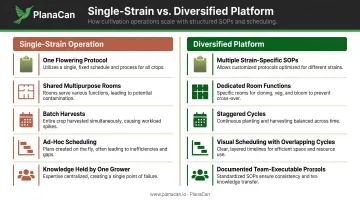
The gap between a siloed single-strain grow and a true multi-variable platform is significant:
| Single-Strain Operation | Diversified Platform |
|---|---|
| One flowering protocol | Multiple strain-specific SOPs |
| Shared or multipurpose rooms | Dedicated room functions (mother, veg, flower, dry/cure) |
| Batch harvests | Staggered cycles across rooms |
| Ad-hoc scheduling | Visual scheduling with overlapping cycle management |
| Knowledge held by one grower | Documented, team-executable protocols |
"Platform" in this context means the full operational system: physical infrastructure, growing protocols, team structure, and management tools. A grow with five rooms but no documented workflows is not a platform. It's five independent variables with no coordination layer — and without that layer, complexity compounds faster than yield.
Core Components of a Diversified Cannabis Cultivation Platform
Strain Portfolio Diversity
According to Cannabis Business Times, 60% of commercial operators flower 1–10 cultivars at once, with only 6% flowering more than 50. That range reflects a real tension: enough variety to serve different market segments, but not so many protocols that quality control breaks down.
When building a strain portfolio, prioritize:
- Varied flowering windows — mixing 8-week and 10-week strains supports harvest staggering without idle rooms
- Cannabinoid and terpene diversity — terpene improvement was cited by 37% of cultivators as a top priority, potency by 36%
- Market demand alignment — 32% of operators cited changing consumer preferences as a leading challenge, so strains need to match current retail demand, not just grower preference
- Disease and yield resilience — pest resistance and yield consistency were each cited as challenges by 20% of operators
Only add a new strain when it has a documented protocol, an assigned room, and confirmed post-harvest capacity.
Room Type Segmentation
A diversified platform requires dedicated spaces, not multipurpose rooms. Each room type has different timing, sanitation, and environmental requirements that make sharing impractical at scale:
- Mother room — maintains genetics, requires stable lighting and feeding schedules
- Veg room — shorter cycle times, higher density, different light spectrum than flower
- Multiple flower rooms — the revenue engine; independent environmental controls per room
- Drying and cure room — often the bottleneck; must be sized proportionally to total canopy
Multipurpose spaces force compromises on environment and scheduling that erode quality. As operations grow, those compromises become costly.
Growing Method Diversification
Commercial cultivators use a range of substrates — coco, mineral wool, peat, and clay aggregate are all documented by the Resource Innovation Institute as active systems in cannabis controlled environment agriculture (CEA) operations.
Running parallel systems (coco in one room, rockwool in another) makes sense when testing yield or quality differences at scale, but carries real operational costs:
- Separate nutrient programs and feeding schedules per substrate
- Different irrigation and drainage infrastructure
- Added SOP complexity for staff working across rooms
For most operations, standardizing on one substrate per room type reduces training time and error rate. Reserve method experimentation for dedicated test rooms with documented protocols.
Harvest Staggering
Staggered harvest cycles across multiple flower rooms are the financial foundation of a diversified operation. A single harvest batch means a single revenue event — followed by a gap. Overlapping cycles mean consistent cash flow.
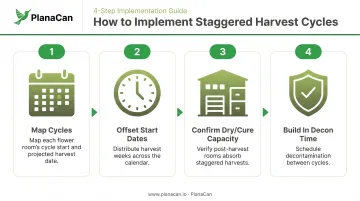
Making staggering work requires precision scheduling from day one:
- Map each flower room's cycle start and projected harvest date
- Offset room start dates to distribute harvest weeks across the calendar
- Confirm dry/cure room capacity can absorb staggered harvests without bottlenecks
- Build in decontamination time between cycles before refilling rooms
This level of coordination is impossible to manage reliably on a whiteboard when you're running four or more rooms simultaneously.
Post-Harvest Infrastructure
Under-built post-harvest capacity is one of the most common bottlenecks in diversified operations. Cannabis Business Times found that 74% of cultivators identified hand-trimming as a major post-harvest bottleneck. Drying and curing infrastructure must be planned in proportion to canopy size — not added reactively when harvests start stacking up.
Build post-harvest capacity before expanding canopy — facilities that skip this step consistently find themselves harvesting into a bottleneck they can't quickly fix.
Designing Your Grow Rooms for Operational Flexibility
Room Sizing Within Regulatory Limits
Room design starts with license limits, not desired output. Canopy regulations vary significantly by state:
- California: Specialty Indoor caps at 5,000 sq ft; Small Indoor up to 10,000 sq ft; Medium Indoor up to 22,000 sq ft
- Massachusetts: 11 licensing tiers from under 5,000 sq ft up
- Illinois: Craft growers can expand in 3,000, 6,000, and 9,000 sq ft increments up to 14,000 sq ft
- Michigan: Adult-use Class C grows are capped at 2,000 plants
Design room count and size against your licensed canopy ceiling first, then optimize layout for workflow efficiency.
Modular room design — where walls, utilities, and environmental systems can be added without disrupting active cycles — makes expansion far less disruptive.
Environmental Control: One System Per Room
In a diversified setup, flower rooms cannot share HVAC, dehumidification, or CO2 systems. A peer-reviewed humidity study found that high relative humidity (60–73% RH) delayed flowering and reduced cannabinoid concentrations compared to 37–58% RH treatments. Different strains require different VPD targets; shared systems force compromises that cost yield.
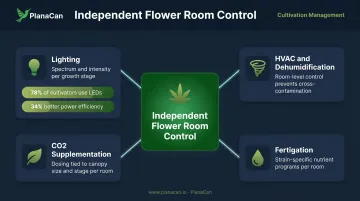
Each flower room needs independent control of:
- Lighting — spectrum and intensity matched to growth stage; 78% of commercial cultivators now use LEDs, and LED flowering operations show 34% better average electric power-use efficiency than non-LED operations
- HVAC and dehumidification — room-level control prevents cross-contamination of humidity conditions
- CO2 supplementation — dosing tied to canopy size and growth stage per room
- Fertigation — strain-specific nutrient programs require independent delivery systems
Designing for Workflow Efficiency
Aisle width, bench placement, and traffic flow directly affect how long tasks take and how many staff are needed per room per day. Practical design considerations:
- Minimum 4-foot aisle widths for cart access during harvest
- Bench or rack heights that allow canopy inspection without equipment
- Clear traffic flow paths that don't cross during concurrent tasks (feeding, scouting, training)
- Two-tier vertical configurations can dramatically increase canopy per square foot, but they require integrated lighting, drainage, and airflow built into the rack system from the start. Retrofitting these systems after installation costs significantly more than building them in during initial construction.
Plan utility rough-ins (electrical, plumbing, HVAC ducting) for future rooms during initial buildout, even if those rooms aren't active yet. The cost of adding capacity during construction is a fraction of retrofitting an active facility.
Standardizing Workflows Across Multi-Room and Multi-Strain Operations
Why Ad-Hoc Management Fails Past Two Rooms
Operational complexity increases faster than room count. Each additional strain adds propagation timing, IPM requirements, nutrition programs, harvest windows, and drying parameters. Each additional room adds a new daily task set. Two rooms with two strains is manageable in your head. Four rooms with six strains is not.
The failure mode is predictable: tasks get missed, feeding schedules get mixed up, scouting falls behind, and by the time the harvest comes in, the quality problems are already baked in.
Strain-Specific and Room-Specific Workflow Templates
The solution is documented, repeatable protocols for every cultivation step — by strain and by room. A complete template covers:
- Transplant timing and container specifications
- Training schedule (topping, LST, defoliation weeks)
- Nutrient program by week
- Environmental targets (temp, RH, VPD) by phase
- Scouting frequency and escalation criteria
- Harvest trigger indicators
- Post-harvest processing steps
When every protocol is written down and assigned to a room, any team member can execute the work correctly. The knowledge lives in the system, not in one grower's head.
Visual Scheduling for Multi-Room Operations
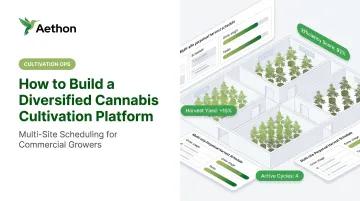
Managing four or more flower rooms with overlapping harvest cycles requires a full-facility overview — which rooms are in which phase, what's due this week, and what's coming in the next 30 days. Spreadsheets and whiteboards fail when cycles drift, staff turns over, or a harvest gets pushed.
PlanaCan's interactive Gantt chart is built for exactly this. The Harvests Tab shows every active harvest schedule on a single timeline, with key dates, phase breaks, and upcoming tasks visible at a glance. Head growers can drill down into individual harvests to see task completion status, who executed each step, and labor time per task — without walking every room. Automated daily notifications push task assignments to cultivators via push notification or email, so team alignment doesn't depend on morning meetings or manual check-ins.
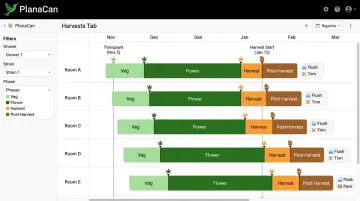
Garden First Cannabis, an active PlanaCan customer, achieved a 36% increase in completed tasks and a 23% decrease in labor costs while managing 16 rotating harvests — the kind of result that reflects what systematic scheduling and accountability can produce at scale.
Using Historical Data to Improve Protocols
That scheduling accountability also generates something valuable: a record. Each completed harvest cycle produces yield per room, task completion rates, labor hours per phase, and a log of any crop issues. The question is whether that data feeds back into the next cycle — or sits unused.
The process is straightforward:
- Review yield and task completion data after each harvest
- Identify phases where completion rates were low or labor ran over budget
- Update the workflow template to address the gap
- Deploy the revised template for the next cycle in that room
Run this loop consistently and protocols sharpen with each cycle. The operation builds on what worked — and stops repeating what didn't.
Building a Scalable Cultivation Team for a Diversified Operation
Role Specialization by Room Count
Small operations (one to two flower rooms) can function with generalist cultivators who handle everything from veg through harvest. As room count grows, role specialization becomes necessary:
- Head grower — owns protocols, approves environmental changes, reviews yield data
- Assistant growers — room-level execution, daily task ownership
- IPM specialist — scouting, prevention, and treatment programs across all rooms
- Harvest crew — dedicated to harvest, processing intake, and dry room management
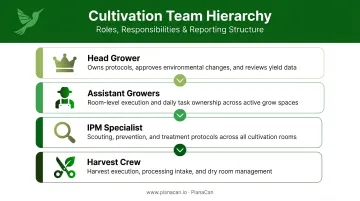
Knowing when to add headcount is a function of task completion data, not intuition. If certain rooms consistently show overdue tasks or labor overruns, that's the signal.
Cross-Training as Risk Management
Every team member should understand the protocols for at least two room types or two strain families. One absence or resignation shouldn't be able to stall an entire room's cycle — but it will if only one person knows how to run it.
Cross-training requires documented protocols to actually work. Specifically:
- Protocols written down at the task level, not just described verbally
- SOPs stored where any team member can access them
- New cross-trainees completing at least one supervised cycle in the room before flying solo
You can't cross-train someone on knowledge that only exists in a senior grower's head. Once protocols are documented, accountability systems are what keep teams executing them consistently.
Accountability Systems
Task tracking closes the loop between scheduling and execution. Head growers need visibility into:
- Which tasks were completed on time vs. overdue, by room and by cultivator
- Completion rates per harvest cycle to identify protocol gaps
- Labor hours per task type to inform staffing planning for upcoming cycles
Supervisor alerts that trigger automatically when tasks are overdue per room remove the need for manual room checks and give head growers a clear picture of where execution is slipping before it affects the harvest.
Avoiding Common Pitfalls When Diversifying Your Cannabis Cultivation Platform
Scaling Canopy Faster Than Systems
The most common mistake: adding rooms before adding the workflow documentation, scheduling infrastructure, and team capacity to run them. California's 2024 market data illustrates the consequence at an industry level — 36% canopy utilization with active licenses down 42% from their 2022 peak. Operations that expanded aggressively without operational discipline are the ones exiting.
The rule is straightforward: before adding a room, confirm you have a documented protocol for every strain it will run, a scheduling system that incorporates it, and a team with the capacity to execute.
Strain Creep
Strain creep — running too many unique strain protocols without adequate documentation — causes quality inconsistency that's hard to trace back to its source. Different strains require different feeding programs, environmental targets, and harvest timings. Without strain-specific templates and differentiated room assignments, procedures bleed into each other, and errors become chronic.
The 6% of operations running 50+ cultivars simultaneously represent the extreme end of complexity. For most operations, keeping active flower to 10 or fewer cultivars with fully documented protocols produces more consistent results than chasing variety without the systems to support it.
Communication and Coordination Breakdown
As teams grow and rooms multiply, coordination failures get expensive fast. Without centralized scheduling and task visibility, facilities typically see:
- Tasks dropped between shifts or rooms
- Duplicated work when assignments aren't clearly owned
- Head growers pulled into people management instead of plant management
- Constant manual follow-up as the only coordination mechanism
The structural fix is a communication system built into the cultivation workflow itself: task assignments tied to the schedule, automatic notifications when tasks are due, and real-time visibility into what's completed and what's outstanding. When that infrastructure exists, coordination happens through the system — not through daily stand-ups and hallway check-ins.
Each of these pitfalls shares the same root cause: growth that outpaced the operational systems supporting it. Getting the systems right first is what separates facilities that scale from those that stall.
Frequently Asked Questions
What is the best platform for managing cannabis retail?
Retail and cultivation management are distinct needs. Cultivation platforms like PlanaCan handle grow scheduling, team task management, and harvest tracking across flower rooms. Retail operations require point-of-sale and inventory systems built for the dispensary counter — evaluate tools based on which floor they actually serve.
How many strains should a commercial cannabis cultivation operation run at once?
The right number depends on canopy size, room count, and team capacity. Most commercial operators keep active flower to 10 or fewer cultivars — the limit of what documented protocols can reliably cover. Over-diversifying without a workflow template for each strain creates quality and consistency problems that compound harvest over harvest.
What's the difference between a single-room and multi-room cannabis cultivation setup?
Single-room operations run all growth stages in one space, which limits harvest staggering and makes consistent yields difficult. Multi-room setups allow dedicated veg, flower, and drying spaces, enabling overlapping harvest cycles and independent environmental control per growth stage — both of which improve consistency and revenue predictability.
How do you manage different harvest schedules across multiple grow rooms?
Overlapping harvest schedules require a visual scheduling tool — like a Gantt chart — that shows all active cycles, key phase dates, and upcoming tasks in a single view. Automated team notifications are equally critical; without them, task execution depends on manual follow-up, which fails as room count and team size grow.
What tools do commercial cannabis growers use to track tasks and team performance?
Commercial cultivators now use dedicated cultivation management platforms — like PlanaCan — that combine scheduling calendars, strain-specific workflow templates, and task completion tracking. These replace spreadsheets and whiteboards that don't scale past two or three rooms, adding per-room task visibility, labor analytics, and real-time team accountability.
How long does it take to scale a cannabis cultivation operation from one to multiple rooms?
The timeline depends on regulatory approvals, buildout complexity, and operational readiness. Operations with standardized workflow templates and a scheduling system already running can typically onboard new rooms significantly faster than those building protocols from scratch. The documentation infrastructure transfers directly rather than being rebuilt for each new space.