Key Takeaways
- A cannabis transportation SOP must document personnel authorization, vehicle security, manifest requirements, and chain of custody.
- Only specific license types may move cannabis legally — for example, California Type 11 distributors or Minnesota cannabis transporter licensees.
- Shipping manifests must be generated in the state track-and-trace system before departure and cannot be changed once the vehicle is en route.
- Transporting cannabis across state lines is a federal crime under the Controlled Substances Act, even if both states have legalized cannabis.
- A complete SOP includes incident response protocols, not just routine operating procedures.
What Is a Cannabis Transportation SOP?
A cannabis transportation SOP is a written, step-by-step document outlining every procedure a licensed cannabis business must follow when moving cannabis goods between licensed locations. That includes vehicle preparation, personnel authorization, manifest generation, and delivery confirmation.
Minnesota's Rule 9810.2300 puts it plainly: a cannabis business with a valid transporter license must establish an SOP to ensure compliance with cannabis and commercial vehicle requirements. That regulatory framing is the clearest definition available across states.
The SOP creates a consistent, verifiable process that keeps cannabis goods traceable within the regulated supply chain from origin to destination. Without it, any break in the chain — a missing manifest, an unauthorized driver, an undocumented stop — becomes a compliance event with real consequences.
Transportation vs. Delivery: Not the Same Thing
These two terms get conflated, and the confusion causes problems:
- Transportation SOP — governs movement between licensed business premises (cultivator to distributor, distributor to retailer); operated under distributor or transporter license types
- Delivery SOP — governs consumer-facing, last-mile fulfillment to customers; governed by separate license categories in most states
Different license types, different rules. A transportation SOP covers business-to-business movement only — consumer delivery falls under an entirely separate regulatory framework.
Why Cannabis Businesses Need a Transportation SOP
Most operators understand that transportation is regulated. Fewer understand just how directly regulators inspect it — and what happens when the paperwork doesn't hold up.
The Regulatory Mandate
Minnesota and Michigan are the clearest examples of explicit SOP requirements:
- Minnesota Rule 9810.2300 directly requires transporter licensees to establish a written SOP covering cannabis and commercial vehicle compliance
- Michigan CRA Rule R 420.206a requires all marijuana businesses to maintain up-to-date written SOPs on site at all times
California and Colorado don't frame their requirements as "you must have an SOP" — but their operational requirements for manifests, vehicles, personnel, and documentation are specific enough that a written SOP is the only defensible way to comply consistently.
What Happens Without One
California's enforcement record shows the stakes clearly. In the Social Market Inc. final decision (December 2025), California DCC revoked a Type 11 distribution license and imposed a $10,000 administrative fine plus $8,742 in enforcement costs. The violations cited: undocumented transfers, missing CCTT tracking information, and paperwork indicating interstate transport. The paper controls weren't there. The license didn't survive it.
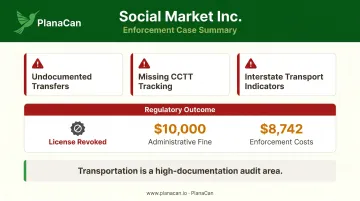
Transportation is a high-documentation audit area because manifests, track-and-trace records, vehicle security, and license authority are all directly inspectable. An auditor doesn't need to observe a violation in real time — they just need to find a gap in your records.
Beyond the Regulatory Checkbox
A transportation SOP also protects the business operationally:
- Reduces theft risk through documented route and personnel controls
- Prevents inventory shrinkage by requiring manifest-to-product verification before departure
- Creates clear accountability when discrepancies arise mid-transit
- Demonstrates due diligence when a regulatory incident occurs
What Your Cannabis Transportation SOP Must Cover
While exact requirements vary by state, every compliant transportation SOP must address five core areas, each documented with enough specificity to survive an audit.
Authorized Personnel and License Requirements
Not everyone in your organization can legally transport cannabis. Authorization is license-specific and role-specific:
| State | Who May Transport | Key Requirement |
|---|---|---|
| California | Licensed distributor or its employees only | Type 11 license required; contractors generally excluded |
| Minnesota | Employees or contractors, 21+ | At least two people in vehicle; one must remain with vehicle at all times |
| Colorado | Employees with valid owner or employee license | Must be an employee of the transporting business |
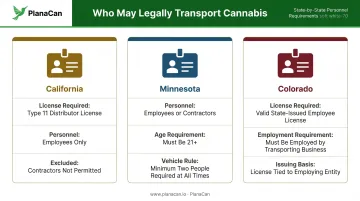
The SOP must identify authorized individuals by job title (not just by name), document age verification (21+ in all verified states), and specify what credentials they must carry during transport.
Vehicle Requirements and Registration
Each state has concrete vehicle-level requirements that must be documented in the SOP before any vehicle is used for transport:
- Ownership/lease documentation — vehicle must be owned or leased by the licensee (California, Minnesota)
- State registration — vehicle must be registered in the operating state (Colorado, Minnesota)
- Active GPS tracking — required in California and Minnesota; a non-functioning GPS is a compliance failure
- Alarm system — required in California; verify your state's specific alarm requirement
- Motor carrier permit — required in California for for-hire transport
- Insurance documentation — required to accompany the vehicle in Colorado
Most states require this information to be submitted to the regulatory body before the vehicle may be used for transport. Filing it once is not enough. Keep all vehicle documentation current.
Shipping Manifests and Track-and-Trace Compliance
California's Section 15314 is the clearest manifest rule across all researched states:
Before transport, the licensed distributor must generate a shipping manifest through the track-and-trace system, transmit it to DCC and the receiving licensee before departure, carry it during transport, and not void or change it after leaving the originating premises.
The manifest must include:
- Name, license number, and address of the originating facility, transporting licensee, and receiving facility
- Product type, quantity, and packaging details
- Driver's license number and vehicle details
- Planned route and estimated departure/arrival times
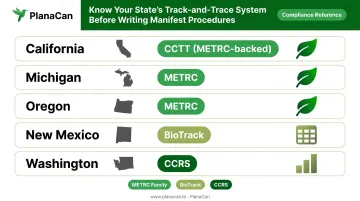
Track-and-trace systems vary by state: California uses CCTT (METRC-backed), Michigan uses METRC, Oregon uses METRC, New Mexico uses BioTrack, and Washington uses its own Cannabis Central Reporting System (CCRS). Know which system governs your state before you write the manifest procedure.
Product Security During Transport
Your SOP must document that cannabis goods meet all of the following security requirements during transport:
- Stored in a locked container or locked compartment secured to the vehicle interior
- Not visible or identifiable from outside the vehicle
- Accompanied by active GPS tracking
- Covered by a functioning alarm system
- Not opened or tampered with during transit
- Attended by at least one authorized person at all times (Minnesota requirement)
Both ends of every transfer carry accountability. Montana's Cannabis Control Division inspection checklist states that a receiving licensed premises cannot accept marijuana without a valid transport manifest.
Route Compliance and Stop Protocols
Minnesota's Rule 9810.2300 requires transporters to make reasonable efforts to randomize driving routes and delivery times, and to avoid having the same driver deliver to the same business at the same time on a recurring schedule. New York's adult-use distributor guidance echoes this.
Route randomization has not been verified as a California or Colorado requirement. Confirm which rules apply in your state before incorporating them into your SOP.
All SOPs should document:
- Approved route types (direct routes between licensed premises only)
- Permissible stops (fuel, rest, vehicle repair) and how to log them
- Prohibited deviations
- How to record any unplanned stops in the track-and-trace system
How to Build Your Cannabis Transportation SOP Step by Step
A transportation SOP isn't a one-time document. It requires review whenever regulations change, a new vehicle is added, or personnel roles shift. Build it to survive an inspection on any given day.
Step 1: Audit Your State's Transportation Regulations
Before writing a single procedure, identify:
- Which agency enforces cannabis transportation in your state (DCC in California, OCM in Minnesota, CRA in Michigan, MED in Colorado, OLCC in Oregon)
- Which license type authorizes transport in your state
- Which track-and-trace system governs manifests
- Whether county or municipal rules add requirements on top of state rules
Regulations change frequently. Consult your compliance counsel or contact the state regulatory body directly before finalizing your SOP.
Step 2: Define Roles, Responsibilities, and Authorization
The SOP must specify:
- Who is authorized — by job title, not by name (names change; titles are more durable)
- What training is required before an individual can conduct transport
- What credentials they carry — driver's license, employee ID, any required endorsements, background check clearance
Step 3: Document Vehicle Protocols and Pre-Departure Checklists
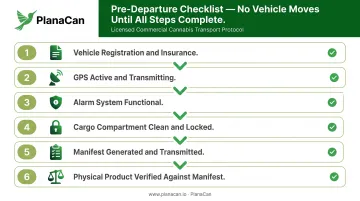
Every transport vehicle needs a documented pre-departure checklist embedded in the SOP. Before the vehicle moves, confirm:
- Vehicle registration and insurance are current
- GPS is active and transmitting
- Alarm system is functional
- Cargo compartment is clean, empty of unauthorized items, and lockable
- Manifest has been generated and transmitted in the track-and-trace system
- Physical product quantities have been verified against the manifest
On the cultivation side, the same checklist discipline applies before a distributor pickup — batch quantities, packaging, and internal documentation should be verified against the outbound manifest before the vehicle departs.
Step 4: Establish Manifest Generation and Chain-of-Custody Procedures
Document the manifest creation process in full:
- Who generates it, in which system, and by what deadline before departure
- How it is transmitted to the receiving licensee and regulatory body
- How product verification at pickup is conducted (compare physical units to manifest line by line)
- What happens if a discrepancy is discovered before departure — do not transport until resolved
- How the receiving facility confirms delivery and closes the transfer in the track-and-trace system
Note: Michigan's CRA compliance guidance makes the last point explicit — the receiving employee must accept the transfer manifest in METRC before leaving the facility. That acceptance step closes the chain of custody.
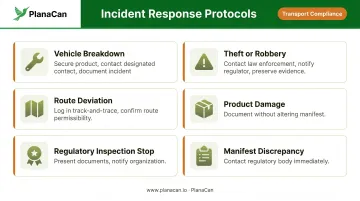
Step 5: Define Incident Response Protocols
A transportation SOP without incident procedures is incomplete. Document response protocols for:
- Vehicle breakdown — who to call, how to secure the product, what to record
- Theft or robbery — law enforcement contact, regulatory notification timeline, evidence preservation
- Route deviations — how to document in the track-and-trace system, when deviation is permissible
- Product damage discovered mid-transit — how to document without altering the manifest
- Regulatory inspection stops — which documents to present, who in the organization to notify
- Manifest discrepancies discovered mid-transport — who to contact at the regulatory body and by what method
Common Cannabis Transportation SOP Mistakes
Treating the Manifest as a Formality
The most common operational failure is weak manifest controls. Three specific breakdowns show up repeatedly in enforcement actions:
- Departing before the manifest is fully generated
- Allowing drivers to adjust quantities at pickup
- Failing to transmit the manifest to the receiving licensee before departure
California's Social Market Inc. decision cited exactly this pattern: inability to provide transfer manifests, unrecorded transfers, and missing CCTT UID information. Oregon's OLCC penalty schedule lists failure to complete a manifest before transport as a named violation.
Build this into your SOP as a hard rule: no vehicle moves without a completed, transmitted manifest that exactly matches the physical product.
Assuming Any Locked Vehicle Qualifies
Operators often assume that adding a padlock to a van satisfies vehicle security requirements. Most states require more:
- A locked compartment or container secured to the vehicle interior (not freestanding)
- Active GPS that is actually transmitting
- A functioning alarm system
- Products not visible from outside the vehicle
The SOP should specify the exact configuration of each approved transport vehicle — make, model, cargo compartment type, locking mechanism, alarm system, and GPS device.
Writing One Generic SOP for All Scenarios
A single generic transportation procedure applied to all routes, product types, and situations creates gaps that surface during inspections. A compliant SOP must address different scenarios:
- Transporting immature plants vs. finished goods (different packaging, different documentation)
- Same-parcel transfers vs. long-distance multi-stop routes
- Emergency procedures vs. standard delivery runs
Update the SOP whenever state regulations change, a new vehicle configuration is added, or personnel roles shift.
Frequently Asked Questions
What is a cannabis transportation SOP?
It's a formal written document required by state cannabis regulatory agencies that outlines every procedure a licensed business must follow when moving cannabis goods between licensed premises. It covers personnel authorization, vehicle requirements, manifest documentation, and chain-of-custody accountability.
Is it illegal to transport cannabis across state lines?
Yes. Cannabis remains a Schedule I controlled substance under federal law, making interstate transport a federal crime regardless of whether both states have legalized cannabis. Every transportation SOP must explicitly prohibit crossing state lines.
What documents are required to accompany a cannabis transport?
A shipping manifest generated through the state's track-and-trace system must accompany every transport and be available for inspection at any time. It must accurately match the physical product being transported — any discrepancy is the transporting licensee's legal responsibility.
Who is authorized to transport cannabis between licensed facilities?
Authorization varies by state. California limits transport to licensed Type 11 distributors and their employees. Minnesota requires at least two employees or contractors aged 21 or older. Colorado requires all transport personnel to hold a valid state-issued employee license. Verify your state's specific license type requirements before operating.
What are the vehicle security requirements for cannabis transportation?
Cannabis goods must be stored in a locked compartment secured to the vehicle interior, not visible from outside the vehicle. The vehicle must have a functioning alarm system at minimum, with active GPS tracking required in Minnesota and California.
What happens if the shipment doesn't match the transportation manifest?
The transporting licensee is legally responsible for any discrepancy between the manifest and the physical product. Discrepancies found at pickup must be resolved before transport begins; those discovered mid-transport must be reported to the state regulatory body immediately and may result in enforcement action.